- Home
- ADC Development
- ADC In Vitro Analysis
- ADC In Vitro Efficacy Evaluation: Comprehensive Binding, Internalization & Cytotoxicity Assays
- ADC In Vitro Cytotoxicity Evaluation: Cell Viability, Apoptosis & Proliferation Assays
ADC In Vitro Cytotoxicity Evaluation: Cell Viability, Apoptosis & Proliferation Assays
Accurate assessment of antibody-drug conjugate (ADC) cytotoxicity is essential for pre-clinical candidate selection and optimization. Creative Biolabs provides comprehensive in vitro cytotoxicity evaluation services, utilizing advanced cell-based assays to quantify ADC efficacy across diverse cancer models. Our integrated platform combines real-time cell analysis, multi-parameter flow cytometry, and high-content imaging to deliver actionable data for informed decision-making in early-stage ADC development.
Inquire About Cytotoxicity EvaluationOverview: The Critical Role of In Vitro Cytotoxicity in ADC Pre-Clinical Research
Antibody-drug conjugates (ADCs) represent a sophisticated class of targeted therapeutics where cytotoxic payloads are covalently attached to monoclonal antibodies via chemical linkers. The in vitro cytotoxicity evaluation is a critical gatekeeping assay that determines whether an ADC candidate possesses the requisite cell-killing potency to justify further development. Unlike traditional chemotherapy, ADCs require antigen-mediated internalization to release their payload, making in vitro cytotoxicity profiling a direct reflection of both target binding and intracellular drug release kinetics.
Why In Vitro Cytotoxicity Matters in Pre-Clinical Studies
In the pre-clinical discovery phase, understanding the relationship between ADC structure, target expression, and cytotoxic potency is essential for optimizing lead candidates. Key considerations include:
- • Potency Correlation: In vitro cytotoxicity IC50 values often correlate with in vivo efficacy, serving as an early predictor of therapeutic potential across diverse target expression levels.
- • Bystander Effect Assessment: Permeable payloads can kill neighboring antigen-negative cells—a desirable property for heterogeneous tumors that can be quantified in vitro.
- • Selectivity Index: Comparing cytotoxicity in target-positive vs. target-negative cell lines establishes the therapeutic window and on-target vs. off-target toxicity profile.
Comprehensive Cytotoxicity Evaluation Coverage
Our in vitro cytotoxicity evaluation services provide multi-dimensional assessment tailored to your ADC's mechanism of action. We evaluate cell viability, apoptotic induction, and cell-cycle disruption across 2D monolayers, 3D spheroids, and patient-derived organoids to support your pre-clinical development objectives.
Overcoming Analytical Challenges in ADC Cytotoxicity Evaluation
Accurate in vitro cytotoxicity assessment is technically demanding due to the multi-step mechanism of ADC action and the complexity of cancer cell models. Common challenges in pre-clinical characterization include:
- ▶ Multi-Step Mechanism Complexity: ADC cytotoxicity requires antibody binding, internalization, lysosomal degradation, and payload release—each step introduces variability that can confound simple cytotoxicity readouts in in vitro models.
- ▶ Cell Model Relevance: Traditional 2D monolayer cultures often fail to recapitulate the extracellular matrix interactions and hypoxic microenvironments that influence ADC penetration and efficacy in solid tumors.
- ▶ Bystander Effect Quantification: Accurately measuring the diffusion radius and potency of released payloads on adjacent non-target cells requires sophisticated co-culture systems and quantitative endpoints.
ADC In Vitro Cytotoxicity Evaluation Services
We provide comprehensive in vitro cytotoxicity evaluation services tailored to your ADC development needs. Our integrated analytical platforms enable accurate assessment of cell viability, apoptotic induction, and cell-cycle disruption. Each service is designed to deliver actionable data for your pre-clinical research and development decisions.
Tailored Cytotoxicity Evaluation for Your Research
Every ADC project has unique cytotoxicity evaluation requirements. Our services can be customized to match your specific target biology, payload mechanism, and research objectives. Whether you need rapid screening of conjugate candidates or comprehensive mechanistic cytotoxicity profiling, we work with you to design the optimal evaluation strategy for your pre-clinical development timeline. Contact us to discuss your specific needs.
| Service Name | Technical Specifications | Analysis Capabilities | Service Deliverables |
|---|---|---|---|
|
Primary Method Cell Viability Assay Service Comprehensive cell viability assessment using real-time and endpoint assays for ADC cytotoxicity profiling. |
• Assay Platforms: MTS/MTT/XTT reduction assays, ATP-based luminescence, real-time impedance (xCELLigence). • Dynamic Range: 6-point dose-response curves with 1:10 serial dilutions. • Culture Formats: 2D monolayers, 3D spheroids, and patient-derived organoids. • Best For: IC50/IC90 determination, selectivity index calculation, drug combination studies. |
• Dose-response curve generation and IC50 calculation • Selectivity index (SI) determination • Bystander killing effect quantification • Time-dependent cytotoxicity profiling |
• Dose-response curves with R2 > 0.95 • Calculated IC50/IC90 values with 95% CI • Viability heatmaps for multi-cell-line screening • Technical support for result interpretation |
|
Mechanistic Apoptosis Analysis Service Multi-parameter apoptosis assessment to elucidate ADC-induced cell death pathways and kinetics. |
• Detection Methods: Annexin V/PI dual staining, caspase activation assays (caspase-3/7), TUNEL assay. • Flow Cytometry: Multi-color panels for apoptotic cell quantification (early/late apoptosis vs. necrosis). • High-Content Imaging: Morphological assessment of apoptotic features (nuclear condensation, membrane blebbing). • Best For: Mechanism of action studies, payload release validation, cell death pathway elucidation. |
• Early and late apoptosis quantification • Caspase activation kinetics profiling • Necrosis vs. apoptosis differentiation • Mitochondrial membrane potential analysis |
• Flow cytometry histograms with gating strategy • Apoptotic index calculations • Caspase activation kinetics plots • High-content images of apoptotic morphology |
|
Cell Cycle Analysis Cell-Cycle Disruption Service DNA content analysis to evaluate cell-cycle arrest and distribution changes induced by ADC payloads. |
• Staining Method: Propidium iodide (PI) or 7-AAD staining with RNase treatment. • Flow Cytometry: High-resolution DNA content histograms for G0/G1, S, G2/M phase quantification. • Payload-Specific: Microtubule disruptor (M-phase arrest) vs. DNA damage (S-phase arrest) profiling. • Best For: Payload mechanism validation, cell-cycle-specific cytotoxicity, combination therapy rationale. |
• Cell-cycle phase distribution analysis • Sub-G1 population quantification (apoptotic cells) • Payload mechanism correlation • Time-course cell-cycle profiling |
• DNA content histograms with phase gating • Cell-cycle distribution tables • Mechanism correlation report • Statistical analysis of phase changes |
|
Advanced 3D Models 3D Spheroid Cytotoxicity Service Physiologically relevant 3D cell culture models to assess ADC penetration and efficacy in tumor-like microenvironments. |
• Model Systems: Patient-derived organoids, multicellular tumor spheroids (MCTS), and scaffold-based 3D cultures. • Readouts: Spheroid volume quantification, viability z-profiling, and payload penetration imaging. • Co-Culture: Tumor-endothelial cell co-cultures to model vascular targeting. • Best For: Solid tumor ADC evaluation, penetration assessment, microenvironment modeling. |
• 3D spheroid viability quantification • Penetration depth analysis • Hypoxia effect on ADC efficacy • ECM interaction assessment |
• 3D spheroid dose-response curves • Viability z-profiles with images • Penetration depth measurements • 3D vs. 2D efficacy comparison report |
Custom Evaluation Services
Co-Culture Bystander Effect Service
Quantitative assessment of payload diffusion and bystander killing using target-positive and target-negative cell co-cultures. Enables DAR and linker-payload optimization for optimal bystander activity.
Resistance Mechanism Profiling
Evaluation of ADC efficacy in resistant cell lines. Assess mechanisms including target downregulation, efflux pump upregulation, and lysosomal dysfunction to guide next-generation conjugate design.
Time-Lapse High-Content Imaging
Real-time visualization of ADC binding, internalization, and cytotoxic kinetics using confocal or plate-based high-content imaging systems. Provides spatiotemporal resolution of cell killing.
Patient-Derived Organoid Evaluation
Assessment of ADC efficacy in patient-derived organoid models that recapitulate the genomic and phenotypic heterogeneity of individual tumors. Ideal for personalized medicine applications.
Standardized Workflow for In Vitro Cytotoxicity Evaluation
Our streamlined pre-clinical cytotoxicity evaluation workflow ensures data integrity, reproducibility, and comprehensive assessment from cell line validation to final reporting:
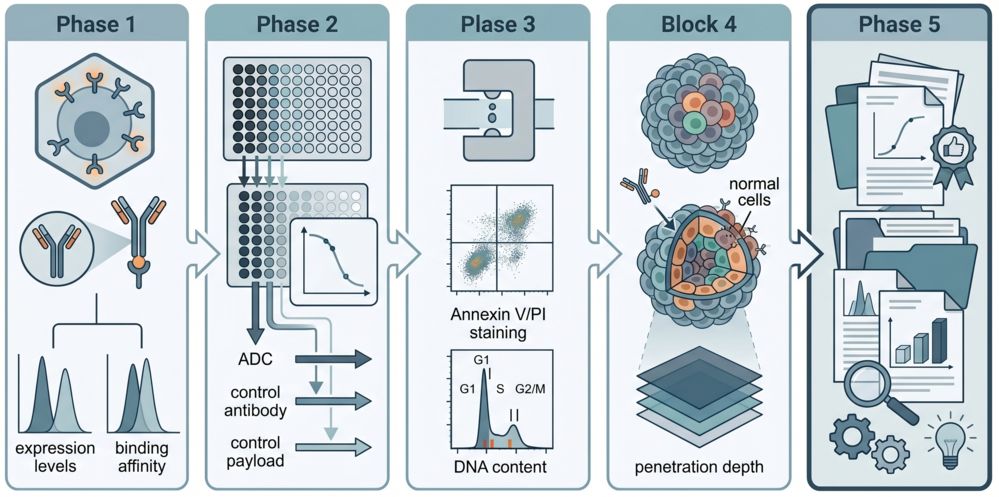
Phase 1: Cell Model Validation & Qualification
We begin by validating target antigen expression levels using flow cytometry and confirming antibody binding affinity. This ensures the selected cell models accurately represent the intended clinical target and provides a baseline for cytotoxicity correlation.
Phase 2: Dose-Response Cytotoxicity Profiling
Parallel assessment of ADC, antibody control, and payload control across a 6-point dose series. Real-time cell analysis (RTCA) and endpoint viability assays provide complementary kinetic and end-point readouts.
Phase 3: Mechanistic Apoptosis & Cell-Cycle Analysis
For advanced characterization, flow cytometric analysis of Annexin V/PI staining and DNA content reveals the mode of cell death (apoptosis vs. necrosis) and cell-cycle specificity of payload action. This is particularly valuable for microtubule and DNA damage payloads.
Phase 4: 3D Model & Bystander Effect Evaluation
Assessment of ADC efficacy in 3D spheroid and co-culture models. Quantification of bystander killing and penetration depth provides critical data for solid tumor indications.
Phase 5: Comprehensive Data Analysis & Reporting
Delivery of a complete cytotoxicity evaluation report including dose-response curves, IC50/IC90 values, selectivity indices, apoptotic kinetics, and 3D efficacy comparisons. Expert interpretation correlates in vitro potency with expected in vivo performance.
Advanced Platforms for In Vitro Cytotoxicity Evaluation
Our multi-platform approach ensures accurate cytotoxicity determination across a wide range of cancer cell models and ADC mechanisms:
1. Real-Time Cell Analysis (RTCA) Platform
A label-free, impedance-based platform that provides continuous monitoring of cell viability, morphology, and attachment. Enables kinetic IC50 determination and reveals the time-dependent cytotoxicity profile of ADCs.
- • Continuous Monitoring: Real-time data acquisition every 15–60 minutes for up to 72 hours post-dose.
- • High Sensitivity: Detects subtle cytotoxicity differences as low as 10% viability change.
- • Multiplexing: Simultaneous assessment of up to 6 cell lines per 96-well plate for comparative selectivity profiling.
2. High-Content Imaging & Analysis Platform
Employs automated confocal microscopy and AI-powered image analysis to quantify morphological changes, apoptotic features, and spatial distribution of cytotoxic effects in 2D and 3D cultures.
- • Morphological Profiling: Nuclear condensation, membrane blebbing, and cell shrinkage quantification.
- • 3D Z-Stack Imaging: Optical sectioning of spheroids to assess penetration depth and viability gradients.
- • Multiplexed Readouts: Simultaneous detection of viability, apoptosis, and cell-cycle markers in single cells.
3. Multi-Parameter Flow Cytometry Platform
A specialized platform for high-resolution quantification of cell death modes (apoptosis vs. necrosis), cell-cycle distribution, and mitochondrial health following ADC treatment.
- • Annexin V/PI Gating: Precise quantification of early apoptosis, late apoptosis, and necrotic cell populations.
- • Caspase Activation: FLICA probes for caspase-3/7 activity measurement.
- • Mitochondrial Depolarization: JC-1 or TMRE staining for mitochondrial integrity assessment.
4. 3D Spheroid & Organoid Culture Platform
A physiologically relevant platform for cytotoxicity evaluation in tumor-like microenvironments. Models the extracellular matrix, hypoxia, and cell-cell interactions that influence ADC penetration and efficacy.
- • Patient-Derived Organoids: Maintains tumor genetic and phenotypic heterogeneity for personalized efficacy assessment.
- • Co-Culture Systems: Tumor cell + stromal cell models to evaluate microenvironment influences on ADC efficacy.
- • Penetration Imaging: Confocal Z-stack profiling of fluorescent payload distribution within spheroids.
Why Choose Our In Vitro Cytotoxicity Evaluation Services?
Multi-Dimensional Cytotoxicity Profiling
We employ orthogonal analytical methods—real-time impedance, endpoint viability, apoptosis flow cytometry, and 3D spheroid assays—to provide a comprehensive picture of ADC cytotoxicity across multiple cell models and timepoints.
Physiologically Relevant 3D Models
Our cytotoxicity evaluation includes 3D spheroid and patient-derived organoid models that better recapitulate the tumor microenvironment, providing more predictive data for solid tumor ADC development.
Mechanistic Depth & Payload Correlation
Beyond simple IC50 determination, we elucidate the mechanism of cell death (apoptosis vs. necrosis) and correlate cytotoxicity profiles with payload mechanism of action for structure-activity relationship studies.
Accelerated Turnaround for Pre-Clinical Research
Our streamlined workflow and dedicated cell biology team deliver comprehensive cytotoxicity evaluation reports within 2-3 weeks, supporting fast-paced pre-clinical ADC development timelines and candidate selection decisions.
Research Insights: Risks of Off-Target Toxicity Mediated by ADC Aggregates
Recent research (Aoyama et al., 2022) has identified a critical safety risk: the hydrophobic nature of ADC payloads often triggers protein aggregation, and these ADC aggregates can significantly increase off-target cytotoxicity through specific mechanisms. The study demonstrates that while aggregation reduces killing efficacy against target-positive cells, it activates non-specific internalization via Fc\gamma receptors expressed on the surface of immune cells.
Key Findings from the PDF Research:
- • Fc\gamma R-Dependent Internalization: ADC aggregates (but not monomers) strongly activate Fc\gamma RIIa and Fc\gamma RIIIa, leading to their unintended uptake by target-negative immune cells, such as monocytic THP-1 and megakaryoblastic MEG01-S cells.
- • Significantly Enhanced Off-Target Toxicity: In Fc\gamma R-expressing cell lines, ADC aggregates induced by stirring stress showed over 100-fold higher off-target cytotoxicity compared to non-stressed ADCs (e.g., T-DXd aggregates showed a dramatic drop in IC50 in THP-1 cells).
- • Risk Mitigation Strategies: The study verified that removing sub-visible particles via 0.45 μm filtration or employing Fc engineering (such as L234A/L235A mutations) to silence Fc-mediated effector functions can effectively reduce the risk of Fc\gamma R-mediated off-target uptake.
- • New Dimensions for Safety Assessment: Conventional in vitro evaluation should incorporate the assessment of ADC physical stability, specifically focusing on aggregation under shear or thermal stress, to better predict potential immunotoxicity and clinical safety risks.
These insights emphasize the necessity of characterizing ADC aggregate properties and Fc\gamma R activation during the pre-clinical development phase.
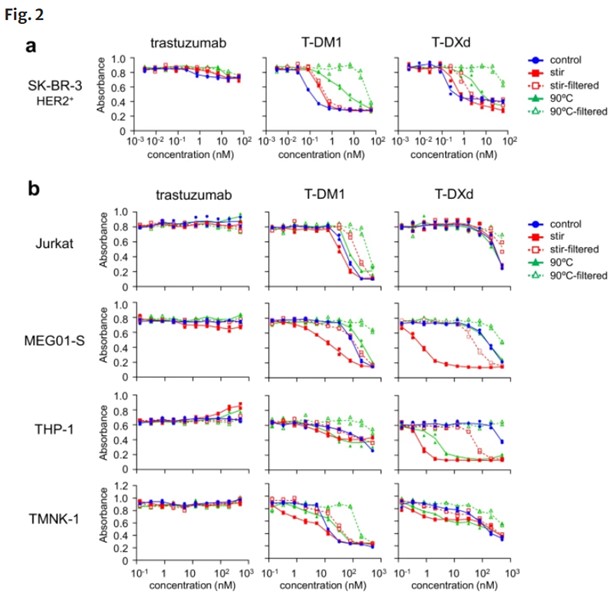
Fig. 1: Cytotoxicity of ADC aggregates.1,2
FAQs about ADC In Vitro Cytotoxicity Evaluation
Q: Which cell models are best for ADC in vitro cytotoxicity evaluation in pre-clinical research?
A: We recommend a panel of cell lines with varying target antigen expression levels (negative, low, medium, high) to establish the dynamic range of ADC activity. For solid tumor ADCs, 3D spheroid or organoid models are strongly recommended to assess penetration and efficacy in physiologically relevant microenvironments.
Q: Can you assess bystander killing effect of our ADC?
A: Absolutely. We use co-culture systems where target-positive and target-negative cells are mixed at defined ratios. By quantifying cell viability in each population separately, we can calculate the bystander killing efficiency of permeable payloads—a key attribute for heterogeneous tumor treatment.
Q: How do you determine the selectivity index (SI) of an ADC?
A: The selectivity index is calculated as the ratio of IC50 in target-negative cells to IC50 in target-positive cells. An SI > 1 indicates on-target cytotoxicity. We recommend using multiple target-negative cell lines to account for cell-line-specific sensitivity to the payload.
Q: Can you evaluate ADC efficacy in patient-derived organoids?
A: Yes. We have established protocols for ADC cytotoxicity evaluation in patient-derived organoids that maintain the genetic and phenotypic heterogeneity of the original tumor. This platform is particularly valuable for personalized medicine applications and rare cancer types where established cell lines are unavailable.
Q: Do you provide kinetic cytotoxicity data or only endpoint measurements?
A: We provide both. Our real-time cell analysis (RTCA) platform delivers continuous kinetic data for up to 72 hours post-dose, revealing the time-dependent cytotoxicity profile. This is complemented by traditional endpoint assays (MTS/ATP) at 24, 48, and 72 hours for method cross-validation.
Other ADC In Vitro Evaluation Services
Related Products
Related Resources

References:
1. Aoyama, M., Tada, M., Yokoo, H., Demizu, Y., & Ishii-Watabe, A. (2022). Fcy Receptor-Dependent Internalization and Off-Target Cytotoxicity of Antibody-Drug Conjugate Aggregates. Pharmaceutical Research, 39(1), 89-103. https://doi.org/10.1007/s11095-021-03158-x
2. Distributed under Open Access License CC BY 4.0, without modification.
For Research Use Only. NOT FOR CLINICAL USE.
Online Inquiry
Welcome! For price inquiries, please feel free to contact us through the form on the left side. We will get back to you as soon as possible.
