


Custom Anti-GM1 Antibody Service for Neuropathy Research
Introduction to Ganglioside GM1 and Anti-GM1 Antibodies
Ganglioside GM1 (often written as ganglioside GM1) is abundant at the nodes of Ranvier and motor axon membranes. Autoantibodies against GM1 are strongly associated with autoimmune neuropathy phenotypes, especially multifocal motor neuropathy (MMN) and subtypes within the Guillain-Barré syndrome (GBS) spectrum. Mechanistically, anti-GM1 antibodies can disrupt ion channel function and neuromuscular transmission, and their presence is frequently used as a research biomarker to stratify neuropathy models and to interrogate disease pathways. Evidence shows:
- anti-GM1 is detected in ~50% of MMN and is a key serological discriminator from CIDP
- molecular mimicry—especially from Campylobacter jejuni lipooligosaccharides bearing GM1-like epitopes—drives antiganglioside responses
- anti-GM1 can block voltage-gated sodium channels and impair peripheral nerve repair in experimental systems
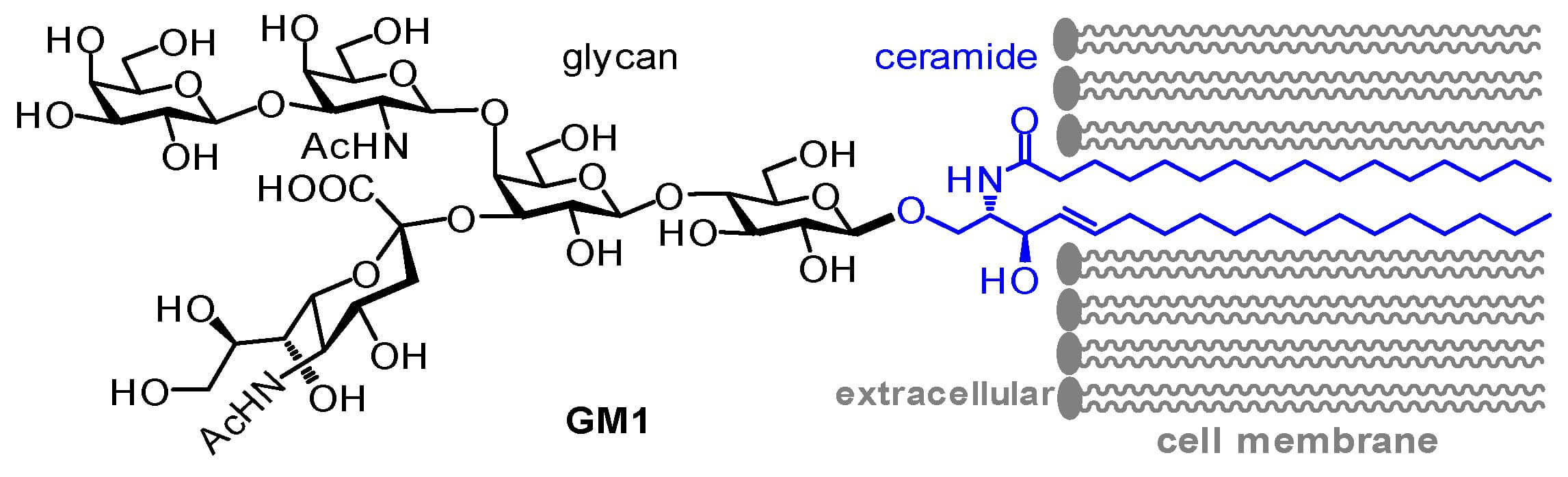 Fig.1 GM1 structure and its membrane association via lipid tail insertion.1
Creative Biolabs offers a suite of custom anti-ganglioside antibody solutions that include end-to-end customization for anti-GM1 antibody—from antigen design that respects glycolipid biophysics to discovery, stringent cross-reactivity de-risking, and application-ready validation for neurology research teams. If you are not interested in designing your antibody, we also provide ready-to-use anti-GM1 antibody products for you.
Why This Matters for Guillain-BarrÉ Syndrome and Related Conditions
GBS comprises demyelinating and axonal forms (AIDP, AMAN, AMSAN) and overlaps with chronic entities like CIDP; anti-GM1 and related antiganglioside repertoires illuminate variant biology across populations. Our project design and readouts align with this diversity so your autoimmune neuropathy studies are both mechanistically relevant and comparable to published evidence.
Our Custom Anti-GM1 Monoclonal Antibody Services
We focus on outcome-first anti-GM1 antibody programs that respect glycolipid biology and your downstream assays. Instead of enumerating methods, we center on what matters: membrane-realistic antigen presentation to bias specificity for ganglioside GM1, adversarial de-risking to eliminate near-neighbor cross-reactivity, and orthogonal analytics that translate into assay-ready monoclonal antibody materials for autoimmune neuropathy and Guillain-Barré syndrome research—delivered with transparent QC and publication-grade documentation. Here's what we offer:
- Tight on-target specificity validated across extensive glycan/glycolipid libraries
- Assay-ready performance (binding curves, kinetics, stability) in RUO-ready packaging
- Clear separation from GD1a/GD1b/GT1a to reduce false positives in complex samples
- Our services include custom-formatting antibodies (IgG or IgM) with labeling options tailored to your needs without sacrificing binding strength.
- Integrate our products into your ELISA/imaging processes through easy-to-use transfer documentation and quality control checks
- Comprehensive traceability: We maintain batch records alongside sensorgrams and array spectra and reproducibility logs.
Custom Anti-GM1 Antibody Development Workflow
- Antigen Design: GM1 presented in membrane-mimetic systems and as defined conjugates to bias true head-group recognition.
- Immunization & Library Build: Host immunization followed by hybridoma, immune phage display, or single-B-cell capture.
- Dual-Gate Screening: Positive selection on GM1; staged negative selection versus GD1a/GD1b/GT1a and mixed panels.
- Orthogonal Validation: ELISA/TLC for binding, broad glycan/glycolipid arrays for specificity, BLI/SPR for kinetics.
- Formatting & Scale-up: IgG or IgM, recombinant or hybridoma production; high-purity prep with in-process controls.
- QC & Delivery: Stability checks, acceptance criteria review, and a complete data dossier ready for RUO deployment.
Ready-to-Use Anti-GM1 Antibodies Products
Need a fast, validated reagent to kickstart your autoimmune neuropathy and Guillain-Barré syndrome studies? In addition to custom programs, Creative Biolabs supplies catalog anti-GM1 antibody products targeting ganglioside GM1. If you prefer a tailored clone or specific isotype/label, please pair the catalog antibody with our custom discovery to lock in the exact specificity, affinity, and format your workflow demands.
-
Mouse Anti-GM1 Monoclonal Antibody (AGM-047YJ)(CAT#: AGM-047YJ)Online InquiryHost: MouseAntibody Isotype: IgMSpecies Reactivity: HumanApplication: TLC, FC, ELISA, ICC, IHC
Why Choose Creative Biolabs for Anti-GM1 Antibodies
- Glycolipid-savvy antigen engineering that respects membrane context and GM1 head-group presentation—critical for eliciting the right paratope.
- Stringent cross-reactivity control with staged negative selection across GM1-adjacent gangliosides and whole-spectrum glycan arrays.
- Transparent QC & documentation for every lot—suited to regulated labs' record-keeping standards.
- Flexible formats (IgG/IgM, species, labels) and downstream application support from ELISA development to imaging protocols.
- Experience across anti-glycolipid landscapes for broader comparative studies.
How Researchers Use Anti-GM1 Antibodies
Pathomechanism Dissection in Autoimmune Neuropathy
Anti-GM1 may be used to block neuronal voltage-gated sodium channels, providing a direct mechanistic handle to recapitulate features of conduction block in vitro and ex vivo.
Model Building and Functional Validation
Experimental models of neuritis/neuropathy have been generated by injection of antiganglioside antibodies or through molecular mimicry using bacterial lipooligosaccharides, allowing for intervention and biomarker discovery studies.
Biomarker Development & Seroprofiling
Anti-GM1 signals serve as biomarkers to differentiate MMN from CIDP and may link fine specificity to disease severity and variant classification.
Node-of-Ranvier Visualization and Complement Studies
Anti-GM1 antibodies localize to GM1-rich nodes of Ranvier; passive transfer of IgG anti-GM1 antibodies impairs nerve repair, providing complementary rationale to support complement deposition or ion-channel readouts in your research pipeline.
Assay kit/ELISA Development
Your custom anti-GM1 antibody can be used to seed RUO immunoassay development, with our team supporting standard curves, cross-reactivity guards and documentation.
Services You May Be Interested in
- Custom Anti-GM2 Antibody development
- Custom Anti-GM3 Antibody development
- Custom Anti-GD1a Antibody development
- Glycan Microarray & Glycolipid Microarray Profiling for antibody specificity mapping and serology deconvolution.
- Phage display / Hyperdoma™ platforms for rapid anti-glycolipid binder discovery and sequence capture.
Ready to design your anti-GM1 monoclonal antibody? Tell us your intended assays (ELISA, imaging, functional), preferred format (IgG vs IgM), and specificity constraints. We'll propose antigen design, screening gates, and deliverables as soon as possible. Start a quick consultation with Creative Biolabs now.
FAQs
IgG or IgM anti-GM1, which should I order?
IgM can use avidity against multivalent GM1 on a membrane, while IgG can be used for ELISA, Western, and imaging. We favor IgG for general RUO applications, but IgM is held for functional assays where high clustering to GM1-rich surfaces is essential.
How do you know my antibody will be specific to GM1, without cross-reacting to GD1a/GD1b/GT1a?
We use a dual-gate screening process: positive selection on GM1, then stepwise negative selection against the most similar gangliosides, then glycan-array confirmation to ensure an on-target-only binding profile.
Can you help me link the properties of my antibody to disease pathophysiology?
Yes—several reports document the ability of anti-GM1 antibodies to block neuronal sodium channels, and to inhibit nerve regeneration in a mouse model. Channel-linked or complement assays can be included in your development plan if desired.
Can you accommodate an unusual context for the antigen (e.g., GM1-GD1a complexes)?
Defined GM1-containing complexes can be included in the screening process, and arrays can be used to dissect subtle specificity, as has been reported that the presence of complex epitopes can influence the neuropathy phenotype.
What exactly will I get?
Clone ID and sequences (if recombinant), purified antibody, ELISA/array/SPR datasets, stability data, and a signed report with methods used and acceptance criteria. Batch records are filed in accordance with SOP.
Can you help me develop my antibody to an RUO ELISA?
Absolutely. We can help determine capture/presentation conditions for GM1 and create calibrators, then push-test cross-reactivity to ensure clean analytical performance.
Reference:
- Guo, Zhongwu. "Ganglioside GM1 and the central nervous system." International Journal of Molecular Sciences 24.11 (2023): 9558. Distributed under Open Access license CC BY 4.0, without modification. https://doi.org/10.3390/ijms24119558