


Anti-Sialyltransferase (ST) Antibody Development Service
Sialyltransferases (STs) are a critical family of glycosyltransferases responsible for the transfer of sialic acid residues from cytidine monophosphate N-acetylneuraminic acid (CMP-Neu5Ac) to the terminal position of glycan chains on glycoproteins and glycolipids. Located primarily in the Golgi apparatus, these enzymes regulate the physicochemical properties of molecules, influencing cell adhesion, signaling, and immune recognition. The dysregulation of ST expression is a hallmark of many pathological conditions, particularly cancer, where hypersialylation often drives metastasis and immune evasion. At Creative Biolabs, we offer a specialized platform for the generation of high-affinity anti-sialyltransferase antibody tools. As a key component of our comprehensive Anti-Glycan Related Enzyme Antibody Development Service, this offering provides researchers with precise reagents to investigate the subcellular localization, expression levels, and functional roles of specific ST isoforms in complex biological systems.
The Complexity of Sialyltransferase Research
Studying sialyltransferases presents unique challenges compared to other protein targets. The human genome encodes 20 different STs, classified into four families (ST3GAL, ST6GAL, ST6GALNAC, and ST8SIA) based on the linkage formed (alpha-2,3, alpha-2,6, or alpha-2,8) and the acceptor substrate. Developing a specific ST antibody that does not cross-react with other highly homologous family members is a significant hurdle. Furthermore, these enzymes are often expressed at low levels and are typically anchored in the Golgi membrane, making them difficult to access for standard immunogens.
Common pain points in glycosyltransferase antibody development include:
- Isoform Redundancy: Distinguishing between closely related enzymes, such as ST6GAL1 and ST6GAL2, requires targeting unique peptide sequences outside the conserved catalytic domains.
- Low Immunogenicity: Many catalytic domains are highly conserved across species, often resulting in poor immune responses in traditional host animals.
- Application Specificity: An antibody that works for Western Blot (WB) may not function in Immunofluorescence (IF) to show Golgi localization due to epitope masking in fixed cells.
Targeted Solutions for ST Biology
To address these challenges, Creative Biolabs utilizes a suite of proprietary antigen design strategies and high-throughput screening methods. We generate antibodies that can reliably detect the expression and localization of specific sialyltransferases. Whether you are studying the upregulation of alpha-2,6-sialylation in tumors or the role of polysialic acid in neuronal development, our services are tailored to your specific research needs. We also provide support for related targets, including neuraminidase antibody and sialidase antibody development, to facilitate comprehensive studies of sialic acid dynamics.
Key Enzyme Families We Target
ST3GAL Family (alpha-2,3-Sialyltransferases)
Enzymes in this family transfer sialic acid in an alpha-2,3 linkage to galactose. They are crucial for the synthesis of sialyl-Lewis antigens and other terminal glycan structures involved in inflammation and viral entry. We develop specific antibodies to isoforms such as ST3GAL1, ST3GAL3, and ST3GAL4, enabling researchers to differentiate their distinct biological functions.
ST6GAL Family (alpha-2,6-Sialyltransferases)
This family creates alpha-2,6 linkages on N-glycans. The ST6GAL1 antibody is particularly sought after due to the enzyme's prominent role in cancer progression and stem cell biology. Our development process ensures that the resulting antibodies can distinguish ST6GAL1 from other GalNAc-specific transferases, providing a reliable tool for assessing invasive potential in tumor research samples.
ST8SIA Family (Polysialyltransferases)
These enzymes attach sialic acid to another sialic acid via an alpha-2,8 linkage, often forming polysialic acid (polySia) chains on proteins like NCAM. We offer polysialyltransferase antibody development (e.g., targeting ST8SIA2 or ST8SIA4) to assist in neurobiology research where these enzymes regulate synaptic plasticity and cell migration.
Related Glycan-Processing Enzymes
Beyond sialyltransferases, our platform covers a broad spectrum of carbohydrate active enzyme antibody targets. We can simultaneously develop antibodies against upstream or downstream enzymes, such as FUT8 antibody (core fucosyltransferase), NEU1 antibody (sialidase), or OGT antibody (O-GlcNAc transferase), allowing for a holistic view of the glycosylation machinery.
Service Workflow & Customization
Why Choose Our ST Antibody Development?
Isoform Specificity
Custom strategies to distinguish between closely related ST family members (e.g., ST3GAL3 vs ST3GAL4).
Application Versatility
Validated for IHC, IF, WB, and IP to support both structural and functional glycan research.
Broad Enzyme Coverage
Expertise extending to FUT antibody, NEU1 antibody, and other glycosyltransferase targets.
Expert Technical Support
Ph.D. level consultation to guide your experimental design and data interpretation.
Inquire About ST Antibody Services
Published Data
Peritoneal dissemination is a primary mechanism of metastasis in ovarian carcinoma, often leading to a poor prognosis. Recent investigations into the molecular drivers of this process have highlighted the role of the Golgi glycosyltransferase, ST6Gal-I. This enzyme mediates the addition of α2,6-linked sialic acids to N-acetyllactosamine structures on glycoproteins, including β1 integrins. In a study examining the functional consequences of this modification, researchers screened multiple ovarian carcinoma cell lines and identified distinct variations in endogenous ST6Gal-I protein levels. By stably transducing ST6Gal-I-deficient cells to express the enzyme, the study demonstrated that ST6Gal-I-mediated hypersialylation of β1 integrins fundamentally alters cell behavior. Specifically, cells expressing ST6Gal-I exhibited significantly enhanced adhesion to collagen I and increased haptotactic migration compared to controls. Furthermore, invasion assays utilizing Matrigel matrices revealed that ST6Gal-I upregulation confers a markedly more invasive phenotype. These findings suggest that the sialylation state of integrins plays a critical role in peritoneal metastasis by modulating tumor cell interaction with the extracellular matrix. Consequently, high-quality antibodies capable of detecting ST6Gal-I and its glycosylated targets are essential tools for elucidating the complex mechanisms of tumor progression.
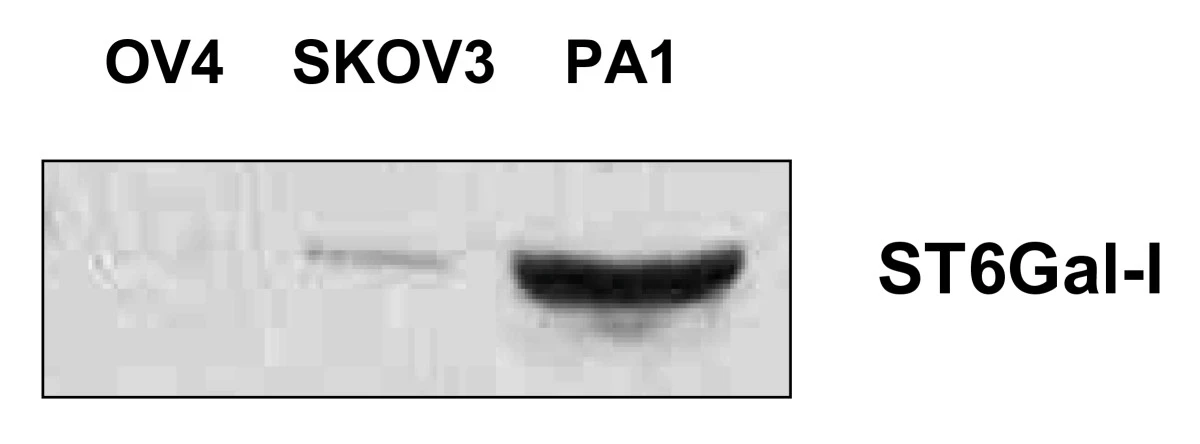 Fig.1 Western blot analysis of ST6Gal-I expression in ovarian carcinoma cell lines PA1, OV4, and SKOV3 using anti-ST6Gal-I antibody.1
FAQs
How do you ensure your anti-sialyltransferase antibodies distinguish between ST6GAL1 and ST6GAL2?
We achieve specificity by carefully selecting immunogens from hypervariable regions of the enzymes, avoiding the highly conserved sialylmotif regions (L, S, and VS motifs) responsible for donor substrate binding. This allows us to generate an ST6GAL1 antibody that does not cross-react with ST6GAL2.
Can these antibodies be used for flow cytometry to detect surface expression?
Generally, sialyltransferases are intracellular Golgi-resident enzymes. While some studies suggest a minor pool may exist on the cell surface or be secreted (soluble form), standard flow cytometry typically requires permeabilization to detect the intracellular pool. We can validate antibodies for intracellular flow cytometry protocols upon request.
Do you offer antibodies for other glycosyltransferases like FUT8 or OGT?
Yes, our Anti-Glycan Related Enzyme Antibody Development service covers a wide range of targets, including FUT8 antibody (alpha-1,6-fucosyltransferase), OGT antibody (nuclear/cytoplasmic O-GlcNAc transferase), and various anti-neuraminidase antibody targets.
What host species are available for antibody production?
We offer antibody development in mice and rats for monoclonal antibodies, and in rabbits, goats, and llamas (VHH) for polyclonal or recombinant antibody production. Rabbit hosts are often preferred for anti-glycan enzyme antibody projects due to their high affinity and ability to recognize diverse epitopes.
Are your antibodies suitable for immunoprecipitation (IP) of enzyme complexes?
Yes, we can screen for clones that bind the native protein conformation, making them suitable for IP assays to study sialyltransferase interaction partners within the Golgi membrane complex.
What Our Customers Say
"We needed a specific ST6GAL1 antibody that wouldn't cross-react with other sialyltransferases for our IF studies. Creative Biolabs delivered a rabbit monoclonal that gave beautiful Golgi staining with zero background. Highly recommended."
"Finding reliable antibodies for glycosyltransferases is always a headache. Their custom service for ST3GAL enzymes provided us with reagents that worked perfectly in both Western Blot and immunoprecipitation."
"The team at Creative Biolabs was very knowledgeable about CAZymes. They helped us design an antigen strategy for a rare polysialyltransferase, and the resulting antibody has been instrumental in our neural development research."
"Fast turnaround and excellent communication. The validation report was thorough, showing exactly how the anti-ST antibody performed in different assays. It saved us months of troubleshooting."
Reference:
- Christie, Daniel R., et al. "ST6Gal-I expression in ovarian cancer cells promotes an invasive phenotype by altering integrin glycosylation and function." Journal of Ovarian Research 1.1 (2008): 3. Distributed under Open Access license CC BY 4.0. doi:10.1186/1757-2215-1-3
Supports
- Glycosyltransferase & Glycosidase Substrate Microarray
- Glycosylation Analysis
- Custom Glycosylation of Biomolecules