Creative Biolabs is offering the most comprehensive services for antibody development projects. With strict regulation and effective execution, we are dedicated to providing the most valuable solutions to complete your projects.
HighlightsCreative Biolabs is offering the most comprehensive services for antibody development projects. With strict regulation and effective execution, we are dedicated to providing the most valuable solutions to complete your projects.
HighlightsCreative Biolabs has established a broad range of platforms for developing novel antibodies or equivalents. These cutting-edge technologies enable our scientists to meet your demands from different aspects and tailor the most appropriate solution that contributes to the success of your projects.
HighlightsWith deep understanding in antibody-related realms and extensive project experience, Creative Biolabs offers a variety of references to help you learn more about our capacities and achievements, including infographic, flyer, case study, peer-reviewed publications, and all kinds of knowledge that can assist your projects. You are also welcome to contact us directly for more specific solutions.
HighlightsGet a real taste of Creative Biolabs, one of the most professional custom service providers in the world. We are committed to providing highly customized comprehensive solutions with the best quality to advance your projects.
HighlightsCreative Biolabs offers Butyrylation-Specific Antibody Discovery Services to deliver precise and sensitive antibodies for research advancement using our specialized antibody production and characterization skills. Our solutions enable you to manage the challenges that come with studying this crucial post-translational modification.
Butyrylation serves as a novel post-translational modification where a butyryl group attaches to lysine residues in proteins. The structural resemblance between butyrylation and other chemical modifications, such as acetylation and propionylation, together with its existence in both prokaryotic and eukaryotic life forms and its influence on multiple protein functions, has become the primary target of recent scientific investigations.
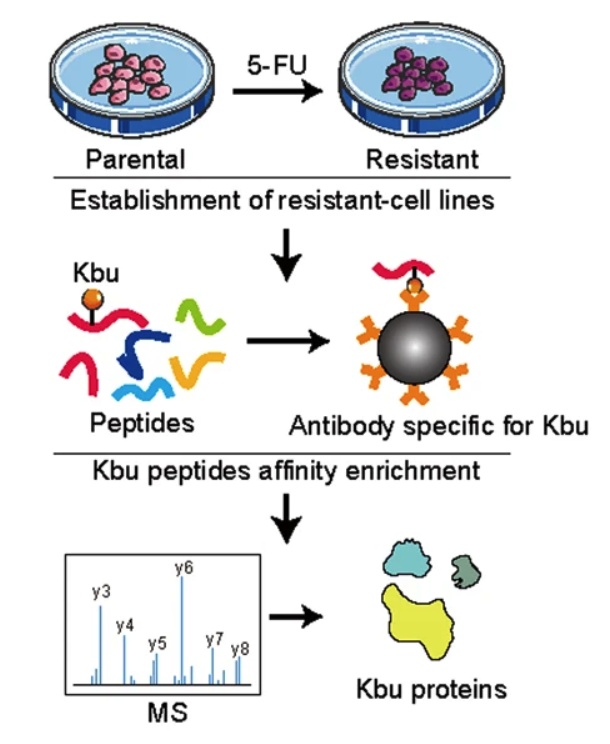 Fig.1 Scheme of the lysine butyrylome in 5-FU-resistant cell line KYSE150-FR and the parental cells KYSE150.1
Butyrylation, alongside comparable PTMs, broadens protein functionality while affecting various cellular processes. Histone lysine butyrylation acts as an epigenetic regulator that modifies chromatin structure to control DNA transcription and cellular metabolism. Inappropriate butyrylation of proteins is linked to the onset of metabolic diseases and cancer formation. Research into butyrylation processes is necessary to grasp how cellular functions operate and how diseases develop. The analysis of PTM requires specific antibodies to allow researchers to detect modified proteins and locate modification sites, as well as understand the butyrylation effects. The services offered by Creative Biolabs provide indispensable tools that researchers need to move forward with their research.
Creative Biolabs delivers both monoclonal and polyclonal antibodies derived from rabbit, mouse, or sheep host animals. Our antibody types include:
Creative Biolabs uses three main strategies to develop our antibody services:
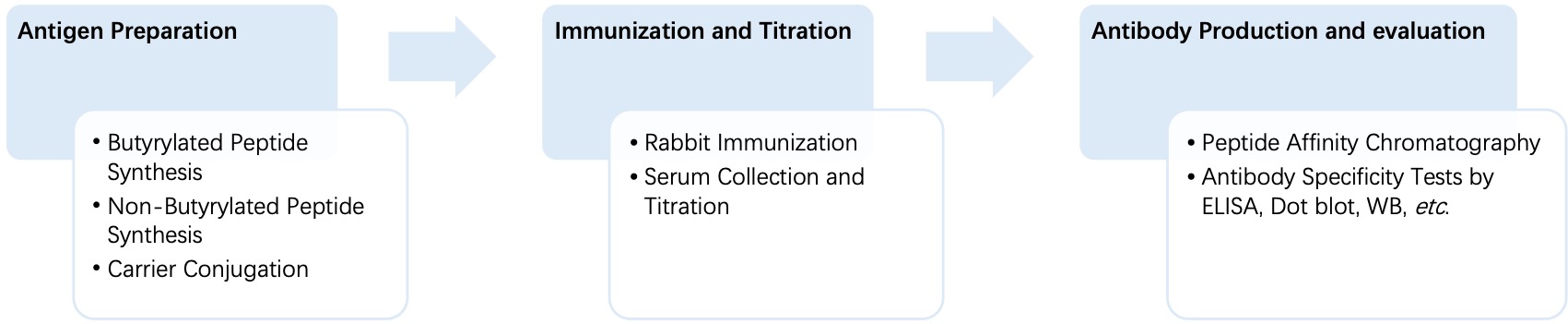
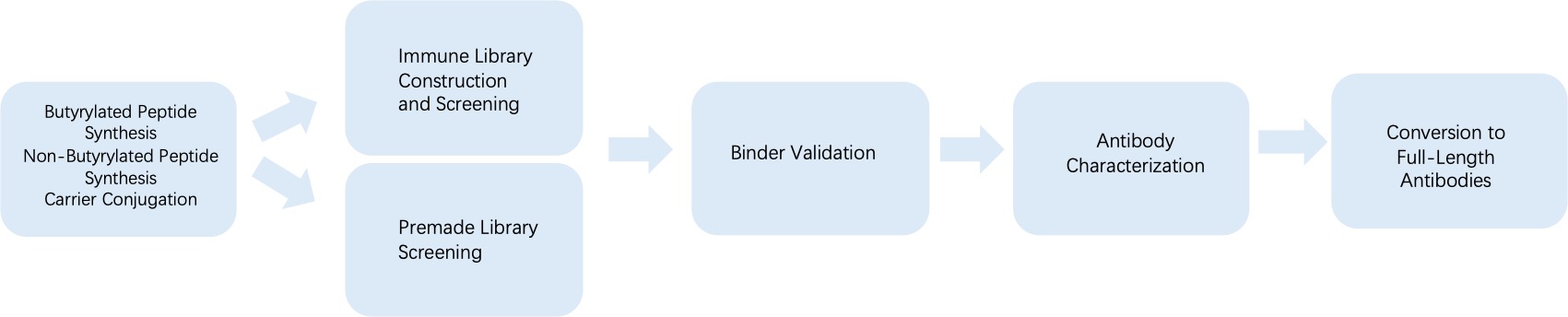
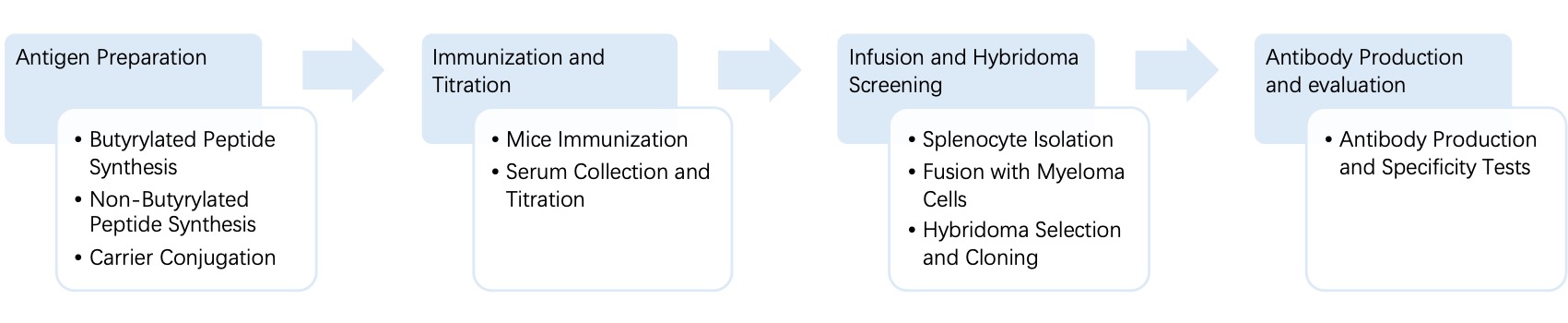
We provide butyrylation specific antibodies and antibodies targeting a variety of PTMs, as shown in the table below.
Choose Creative Biolabs as your trusted provider for Butyrylation-Specific Antibody Discovery Services. We offer:
Q: What criteria should I use to determine whether my research needs a butyrylation-specific antibody?
A: When your study requires the analysis of butyrylation's impact within biological processes or involves identifying proteins with butyrylation modifications and mapping their sites, then specialized butyrylation antibodies are necessary. Our team specializes in guiding researchers to select the most appropriate antibody for their particular application needs. Please reach out to us to schedule a consultation.
Q: What is the main difference between your monoclonal antibodies and polyclonal antibodies?
A: Monoclonal antibodies exhibit high specificity toward a single epitope, which provides reliability and replicability in research experiments. Polyclonal antibodies maintain specificity yet recognize multiple epitopes which may result in experimental variability. Our comprehensive range includes both monoclonal and polyclonal antibodies to accommodate diverse research requirements. Contact us to discuss your specific requirements.
Q: What antibodies do you produce against various post-translational modifications (PTMs)?
A: Creative Biolabs features a complete range of PTM-specific antibody production services that cover acetylation, phosphorylation, and methylation, along with butyrylation-specific antibodies. We welcome any questions regarding our complete service offerings.
Q: How should I choose a butyrylation-specific antibody?
A: When selecting an antibody, you should evaluate its specificity alongside its sensitivity and intended use cases, such as Western blotting, immunoprecipitation, and immunofluorescence. Our detailed product information and expert support will guide you toward the best decision. Contact our team for personalized guidance.
Q: How can I contact you for antibody production services?
A: Getting started is easy! Connect with us by visiting our website or using the contact details listed below this text. Our team stands ready to discuss your project needs and provide a comprehensive quote while guiding you throughout each step. Our primary objective is to assist you in achieving research success.
Creative Biolabs' services for discovering butyrylation-specific antibodies equip researchers with essential tools to investigate the significant field of protein butyrylation. Our expertise in antibody production and characterization enables us to support your research objectives. Please for more details.
All listed services and products are For Research Use Only. Do Not use in any diagnostic or therapeutic applications.