







We engineer CAR-T cells with optimized metabolic profiles to enforce stem-like memory phenotypes and enhance long-term persistence against solid tumors.
Creative Biolabs has a tradition of commitment. To achieve efficient execution and regulatory approval, we offer careful considerations of your program for the development of a cellular or gene therapy product – now and in the future.
EXPLORE MORE HighlightsWe focus on unmet needs and develop novel cellular and gene drugs and solutions that offer significant benefits over existing options.
EXPLORE MORE HighlightsThe advent of Chimeric Antigen Receptor T-cell (CAR-T) therapies has revolutionized the field of oncology, providing new avenues for treating various forms of cancer. Our 20 years of experience in the biotechnology sector have equipped us with the expertise and technological capabilities to support the entire lifecycle of CAR-T products, from early development to commercialization.
EXPLORE MORETo accelerate advanced breakthroughs of your projects, we offer broad range of platforms which enable our clients be free to tackle problems with cutting-edge technologies from different angles and in different methods.
EXPLORE MORE HighlightsUse the resources in our library to help you understand your options and make critical decisions for your study. We offer oncolytic virus, CAR-T, and dendritic cell related documents, as well as newsletter. If you don't find the answers you're looking for, contact us for additional assistance.
EXPLORE MORE HighlightsGet a real taste and understanding of the business and culture of one of the world's great research-based cellular and gene therapy discovery and development companies.
EXPLORE MORE
The reprogramming of cellular metabolism serves as a pivotal regulator determining the in vivo efficacy and persistence of CAR-T cells, directly influencing their effector differentiation and memory subset formation. Creative Biolabs' CAR-T Therapy Development Services: Overcoming Hypoxia & Metabolic Stress are designed to systematically counter metabolic suppression imposed by the tumor microenvironment on CAR-T cell function. Our core expertise lies in integrating cutting-edge metabolic insights with precision genetic engineering, enabling targeted optimization of key metabolic pathways to equip CAR-T cells with superior antitumor activity and long-term durability.
CAR-T cell therapy in solid tumor treatment is primarily attributed to the hostile nature of the tumor microenvironment (TME), specifically the intrinsic presence of hypoxia and metabolic stress. These factors collectively constitute critical barriers that severely restrict CAR-T cell persistence, functional capacity, and anti-tumor activity. Consequently, a foundational strategy to overcome TME-mediated metabolic challenges and significantly enhance the in vivo cytotoxicity and long-term survival of CAR-T cells is the deliberate optimization of their metabolic fitness. This optimization can be achieved through targeted interventions, such as genetic engineering or pharmacological manipulation, designed to augment nutrient uptake, confer resistance to inhibitory metabolic byproducts, or fundamentally reprogram mitochondrial function.
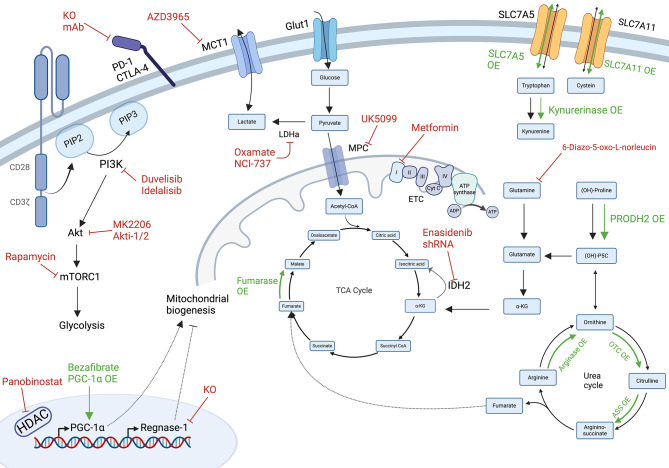 Fig.1 Targeting metabolic pathways to optimize CAR-T cell persistence and functional recall.1
Creative Biolabs' CAR-T Therapy Development Services deliver next-generation CAR-T solutions specifically engineered to overcome the two primary roadblocks in solid tumors: safety and persistence. We assist your project by integrating CAR-T development with advanced cellular metabolism optimization. Our core capability is delivering a validated, TME-resistant CAR-T cell line ready for downstream development and manufacturing scale-up. We provide the scientific foundation to transition your oncology program from hematological successes to solid tumor efficacy.
Our comprehensive suite of services focuses on addressing the core metabolic and safety challenges in CAR-T development for solid tumors.
We engineer CAR-T cells with optimized metabolic profiles to enforce stem-like memory phenotypes and enhance long-term persistence against solid tumors.
We precisely target key metabolic circuits to armor CAR-T cells against the suppressive tumor microenvironment, boosting their efficacy and durability.
We enhance CAR-T cell nutrient utilization and suppress exhaustion pathways to generate products with sustained anti-tumor activity and metabolic flexibility.
Required Starting Materials:
Key steps:
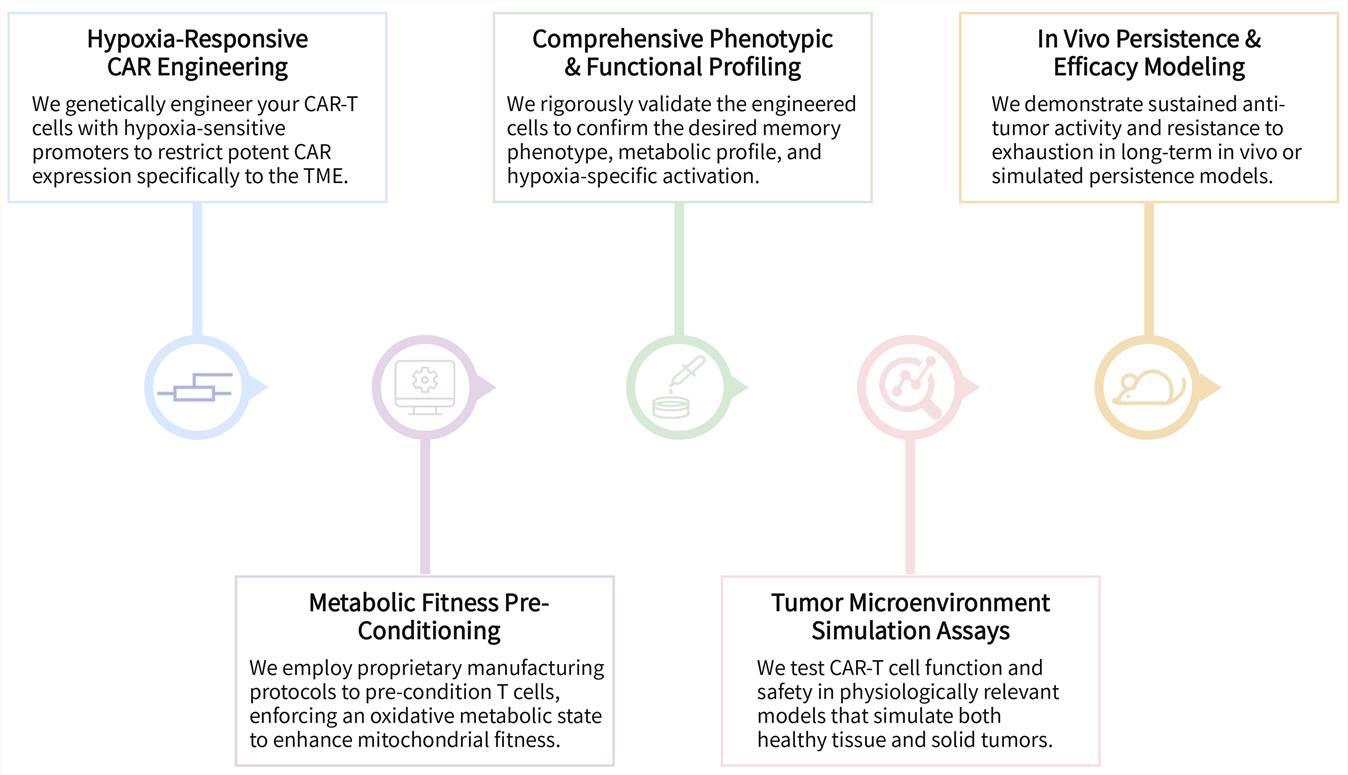
Final Deliverables:
What is the key advantage of your approach compared to relying solely on co-stimulatory domain engineering?
While co-stimulatory domains optimize how a T cell responds to activation, our strategy fundamentally determines whether and for how long it can function. We equip T cells with the essential metabolic fitness and endurance to survive and persist within the immunosuppressive TME.
How does your hypoxia-sensing switch improve safety over conventional CAR-T designs?
Conventional CAR-T cells constitutively express their receptor, posing risks of on-target, off-tumor toxicity against healthy tissues expressing low antigen levels. In contrast, our system uses HREs to restrict CAR expression specifically to severely hypoxic regions within solid tumors, effectively creating a dynamic, environmentally triggered safety switch.
We provide a scientifically-validated, dual-pillar strategy to engineer CAR-T cells that conquer the solid tumor microenvironment. Our unique integration of a hypoxia-responsive safety switch and mitochondrial fitness programming ensures tumor-restricted activity, enhanced metabolic resilience, and durable central memory persistence. Our multi-modal approach delivers de-risked candidates with superior therapeutic potential.
"Using Creative Biolabs' CAR-T Therapy Development Services: Overcoming Hypoxia & Metabolic Stress in our research has significantly improved the durability of our CD8+ T cells, which is crucial for solid tumor applications. The shift towards an OXPHOS-dominant metabolism was evident in our follow-up Seahorse assays." Mk Ce, Research Director.
"The final manufacturing protocol dossier by Creative Biolabs was incredibly detailed. Specifically, the steps for pharmacological preconditioning with metabolic modulators were clearly defined and resulted in a population with consistently higher Spare Respiratory Capacity (SRC) compared to our internal standard protocols." Dn Pl, Process Development Scientist.
Pioneer a new class of cell therapies designed to conquer the suppressive solid tumor microenvironment. Are you ready to explore how HRE-enabled targeting and intrinsic metabolic fitness can transform your therapeutic outcomes?
Partner with our scientists to advance your solid tumor CAR-T program.
Reference
For any technical issues or product/service related questions, please leave your information below. Our team will contact you soon.
All products and services are For Research Use Only and CANNOT be used in the treatment or diagnosis of disease.
 NEWSLETTER
The latest newsletter to introduce the latest breaking information, our site updates, field and other scientific news, important events, and insights from industry leaders
LEARN MORE NEWSLETTER NEW SOLUTION
CellRapeutics™ In Vivo Cell Engineering: One-stop in vivo T/B/NK cell and macrophage engineering services covering vectors construction to function verification.
LEARN MORE SOLUTION NOVEL TECHNOLOGY
Silence™ CAR-T Cell: A novel platform to enhance CAR-T cell immunotherapy by combining RNAi technology to suppress genes that may impede CAR functionality.
LEARN MORE NOVEL TECHNOLOGY NEW SOLUTION
Canine CAR-T Therapy Development: From early target discovery, CAR design and construction, cell culture, and transfection, to in vitro and in vivo function validation.
LEARN MORE SOLUTION