







We employ both high-efficiency Lentiviral Transduction for stable integration and non-viral mRNA Electroporation for transient, safety-controlled expression of the CXCR3 receptor and CAR construct.
Creative Biolabs has a tradition of commitment. To achieve efficient execution and regulatory approval, we offer careful considerations of your program for the development of a cellular or gene therapy product – now and in the future.
EXPLORE MORE HighlightsWe focus on unmet needs and develop novel cellular and gene drugs and solutions that offer significant benefits over existing options.
EXPLORE MORE HighlightsThe advent of Chimeric Antigen Receptor T-cell (CAR-T) therapies has revolutionized the field of oncology, providing new avenues for treating various forms of cancer. Our 20 years of experience in the biotechnology sector have equipped us with the expertise and technological capabilities to support the entire lifecycle of CAR-T products, from early development to commercialization.
EXPLORE MORETo accelerate advanced breakthroughs of your projects, we offer broad range of platforms which enable our clients be free to tackle problems with cutting-edge technologies from different angles and in different methods.
EXPLORE MORE HighlightsUse the resources in our library to help you understand your options and make critical decisions for your study. We offer oncolytic virus, CAR-T, and dendritic cell related documents, as well as newsletter. If you don't find the answers you're looking for, contact us for additional assistance.
EXPLORE MORE HighlightsGet a real taste and understanding of the business and culture of one of the world's great research-based cellular and gene therapy discovery and development companies.
EXPLORE MORE
Enhance CAR-T infiltration and persistence in solid tumors with Creative Biolabs' CXCL9/10/11–CXCR3 Chemokine-Axis Matching CAR-T Development Service. By precisely engineering CAR-T cells to express optimized CXCR3 isoforms, we enable efficient trafficking into "cold" tumor sites driven by the natural CXCL9/10/11 gradient. This targeted chemokine-axis alignment promotes robust immune activation within the tumor microenvironment, transforming non-responsive lesions into immunologically "hot" tumors and supporting more durable and clinically meaningful anti-tumor responses.
The CXCR3 chemokine axis is critical for immune cell trafficking, yet its dual role presents a therapeutic challenge. The receptor exists as opposing isoforms: CXCR3-A promotes tumor cell proliferation and metastasis, while CXCR3-B drives apoptosis and recruits anti-tumor lymphocytes to the TME. The key to effective immunotherapy lies in harnessing the CXCL9/10/11 gradient, a marker of IFN-γ-driven immunity, to selectively guide effector cells. This targeted recruitment is the next frontier in improving CAR-T efficacy against solid tumors that lack sufficient T-cell infiltration.
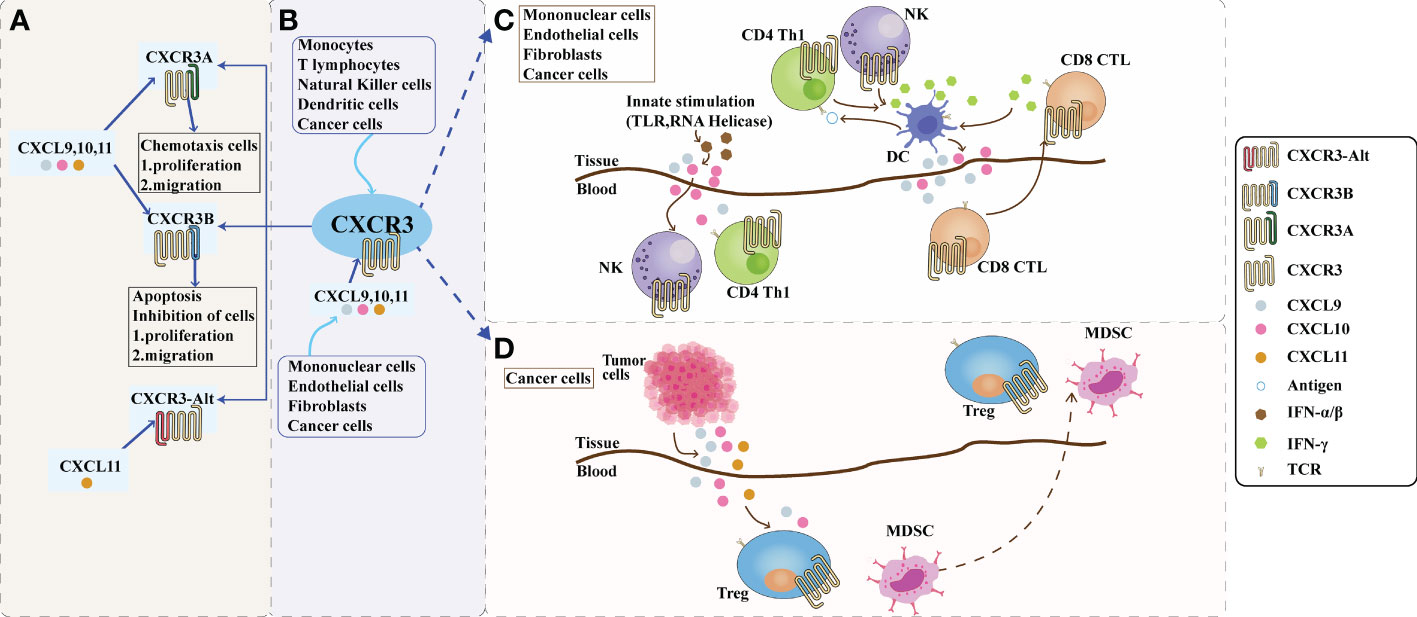 Fig.1 Function of the CXCR3 signaling pathway in the tumor microenvironment.1
The major hurdle in solid tumor CAR-T therapy is the immune-excluded tumor microenvironment where T-cells fail to infiltrate and reach the target antigen. Creative Biolabs solves this fundamental problem by transforming conventional CAR-T cells into "programmable hunters" equipped with the correct homing device: the CXCR3 receptor.
We provide a scientifically grounded, functional solution by engineering your CAR-T cells to effectively read the TME's chemokine signals.
Discover How We Can Help - Request a Consultation.
Creative Biolabs utilizes proprietary, adaptable platforms to execute the precise genetic modification required for chemokine-axis matching. Our services integrate advanced molecular engineering with rigorous functional validation.
We employ both high-efficiency Lentiviral Transduction for stable integration and non-viral mRNA Electroporation for transient, safety-controlled expression of the CXCR3 receptor and CAR construct.
Utilizing site-directed mutagenesis and vector optimization, we ensure the CAR-T cells predominantly express the anti-tumorigenic CXCR3-B splice variant, maximizing homing potential while mitigating pro-tumor effects.
High-throughput screening is used to confirm stable co-expression of the CAR, the CXCR3 receptor, and T-cell activation markers, enabling selection of the most potent cell subset for expansion.
We perform customized real-time 3D migration and haptotaxis assays using client-specific chemokine gradients (CXCL9, CXCL10, CXCL11) to quantitatively assess the functional homing efficiency of the engineered CAR-T cells before any in vivo commitments.
The required starting materials include tumor biopsy data detailing CXCL9/10/10/11 expression profiles, the target antigen scFv sequence, and patient leukapheresis material for genetic engineering.
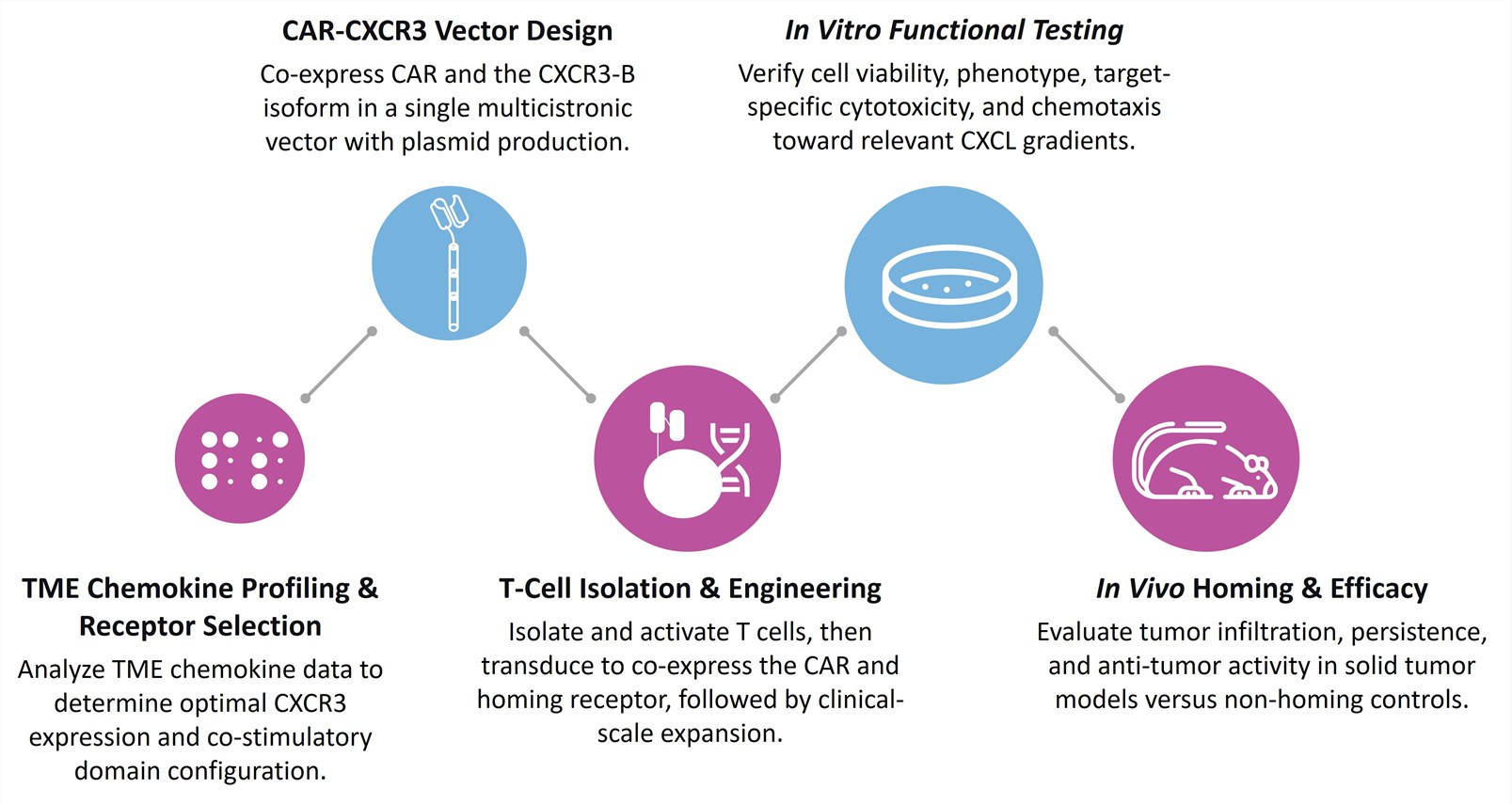
The final deliverables comprise a vector plasmid, a comprehensive in vitro data package with chemotaxis and cytotoxicity results, and a preclinical in vivo efficacy report on T-cell persistence and tumor reduction.
How does chemokine-axis matching improve CAR-T performance?
It equips CAR-T cells with CXCR3 receptors to actively follow tumor-released CXCL9/10 signals, directly overcoming T-cell exclusion and enhancing local efficacy.
Are there safety risks with additional receptor expression?
Risks are minimized by using the anti-proliferative CXCR3-B isoform and controlled expression systems. We also offer transient mRNA platforms for enhanced safety in early studies.
Which tumor types suit CXCR3-matching best?
Ideal for "immunologically hot" tumors with high CXCL9/10/11 expression. We recommend initial TME profiling to confirm suitability.
How is homing capability confirmed preclinically?
We use microfluidic migration assays that simulate chemokine gradients, providing a quantitative Chemokine Migration Index to predict in vivo homing efficacy.
Creative Biolabs is your strategic partner in advancing the next generation of adoptive cell therapies. Our CXCL9/10/11-CXCR3 Chemokine-Axis Matching CAR-T Development Service provides the essential technology to overcome solid tumor barriers, delivering a T-cell product programmed for superior homing and enhanced efficacy. Ready to revolutionize your solid tumor CAR-T pipeline? Our expert team is available to discuss your specific project requirements and design a customized, data-driven strategy. Contact Our Team for More Information and to Discuss Your Project.
Reference
For any technical issues or product/service related questions, please leave your information below. Our team will contact you soon.
All products and services are For Research Use Only and CANNOT be used in the treatment or diagnosis of disease.
 NEWSLETTER
The latest newsletter to introduce the latest breaking information, our site updates, field and other scientific news, important events, and insights from industry leaders
LEARN MORE NEWSLETTER NEW SOLUTION
CellRapeutics™ In Vivo Cell Engineering: One-stop in vivo T/B/NK cell and macrophage engineering services covering vectors construction to function verification.
LEARN MORE SOLUTION NOVEL TECHNOLOGY
Silence™ CAR-T Cell: A novel platform to enhance CAR-T cell immunotherapy by combining RNAi technology to suppress genes that may impede CAR functionality.
LEARN MORE NOVEL TECHNOLOGY NEW SOLUTION
Canine CAR-T Therapy Development: From early target discovery, CAR design and construction, cell culture, and transfection, to in vitro and in vivo function validation.
LEARN MORE SOLUTION