







Creative Biolabs uses lipid nanoparticles (LNPs) to deliver mRNA encoding CAR in vivo. This method supports transient CAR expression, enabling in-body CAR-T generation without relying on viral systems or lengthy ex vivo manufacturing.
Creative Biolabs has a tradition of commitment. To achieve efficient execution and regulatory approval, we offer careful considerations of your program for the development of a cellular or gene therapy product – now and in the future.
EXPLORE MORE HighlightsWe focus on unmet needs and develop novel cellular and gene drugs and solutions that offer significant benefits over existing options.
EXPLORE MORE HighlightsThe advent of Chimeric Antigen Receptor T-cell (CAR-T) therapies has revolutionized the field of oncology, providing new avenues for treating various forms of cancer. Our 20 years of experience in the biotechnology sector have equipped us with the expertise and technological capabilities to support the entire lifecycle of CAR-T products, from early development to commercialization.
EXPLORE MORETo accelerate advanced breakthroughs of your projects, we offer broad range of platforms which enable our clients be free to tackle problems with cutting-edge technologies from different angles and in different methods.
EXPLORE MORE HighlightsUse the resources in our library to help you understand your options and make critical decisions for your study. We offer oncolytic virus, CAR-T, and dendritic cell related documents, as well as newsletter. If you don't find the answers you're looking for, contact us for additional assistance.
EXPLORE MORE HighlightsGet a real taste and understanding of the business and culture of one of the world's great research-based cellular and gene therapy discovery and development companies.
EXPLORE MORE
Currently, CAR-T therapy using ex vivo-generated cells poses multiple barriers associated, being complicated and expensive to manufacture, and with a high risk of toxicity. Therefore, in vivo CAR-T Cell Engineering is a potential solution with the ease of production and the possibility of standardization. Furthermore, studies have shown that in vivo CAR-T Engineering is associated with a reduced risk of the most common toxicities, such as CRS, and "on-target, off-tumor" toxicity.
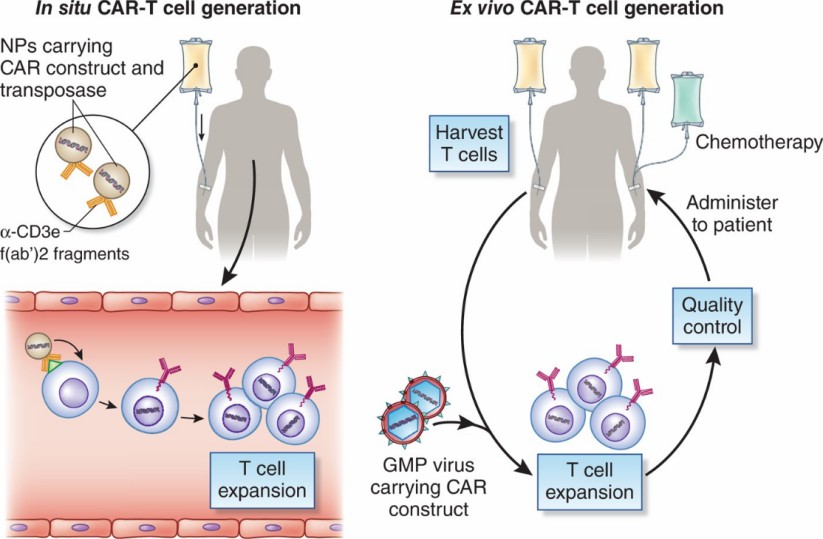 Fig.1 Comparison of generating CAR-T in-vitro and generating CAR-T-in-vivo by nano-delivery systems.1
The rapid development of non-viral delivery systems has brought new perspectives to the design of in vivo CAR-T cell engineering. The non-viral delivery system has many advantages, its processing can take a variety of optimized formulations, and its synthesis is more streamlined, enabling precise drug delivery, reducing toxicity, and increasing the targeting of in vivo CAR-T therapeutics. Powered by years of experience in the CAR-T field, Creative Biolabs possesses strong capabilities in providing in vivo non-viral CAR-T Cell engineering services to facilitate customers' projects. There are some of our featured services as follows for reference, meanwhile, we also provide highly-customized in vivo non-viral CAR-T Cell engineering services to help global customers.
Creative Biolabs uses lipid nanoparticles (LNPs) to deliver mRNA encoding CAR in vivo. This method supports transient CAR expression, enabling in-body CAR-T generation without relying on viral systems or lengthy ex vivo manufacturing.
Creative Biolabs employs in vitro–transcribed circular RNA (circRNA) to deliver CAR constructs. circRNA lends prolonged stability and expression in vivo, enabling sustained CAR production in T cells without integrating into the genome.
Using self-amplifying RNA (saRNA) synthesized via in vitro transcription, Creative Biolabs programs CARs in T cells in vivo. SaRNA supports strong replication of the CAR-encoding transcript, reducing the required dosing while maintaining transient expression.
Creative Biolabs encapsulates plasmid DNA encoding CAR constructs into lipid nanoparticles and delivers them in vivo. This strategy provides transient CAR expression and avoids the use of viral vectors, reducing integration risk.
Creative Biolabs designs poly (βamino ester) (PBAE) nanocomplexes that compact CAR-encoding nucleic acids. These biodegradable polymer-based carriers promote efficient delivery to T cells in vivo and allow for targeted internalization and release.
Creative Biolabs leverages optimized lipid nanoparticle formulations to deliver different CAR-encoding payloads (mRNA, saRNA, DNA). These LNPs are tailored for in vivo T cell uptake, enabling CAR expression with a controlled, non-viral approach.
Creative Biolabs develops custom-designed synthetic carriers (lipid or polymer-based) to deliver CAR constructs. These carriers are optimized for targeting, release kinetics, and payload compatibility to support safe, effective in vivo programming.
Creative Biolabs is leading the next generation of in vivo CAR-T programming technology, launching customized development services based on Genome Editing Delivery Vesicles (GEDV). Unlike traditional synthetic carriers, GEDV technology utilizes engineering methods to fuse the natural tropism of biological vesicles with cutting-edge gene-editing tools, achieving more precise cellular reprogramming.
Creative Biolabs uses fusogenic nanovesicles (FuNVs) engineered to fuse with T cell membranes in vivo, delivering pre-expressed CAR proteins directly. This fusion-based method enables CAR-T cell generation without nucleic acid transfer.
Our platform integrates cutting-edge mRNA and nanoparticle-based delivery methods to achieve highly efficient and controlled CAR expression in target T cells. Advanced formulations are carefully optimized to enhance cellular uptake, functional persistence, and bioavailability while reducing off-target effects and immune-related risks. The service covers the full spectrum of design, production, characterization, quality control, and in vivo validation, enabling researchers to seamlessly transition from early-stage discovery to robust preclinical studies with reproducible, high-quality results.
Discover How We Can Help - Request a Consultation
We provide one-stop in vivo non-viral CAR-T cell engineering services to assist clients' projects, here are several prominent services you can refer to:
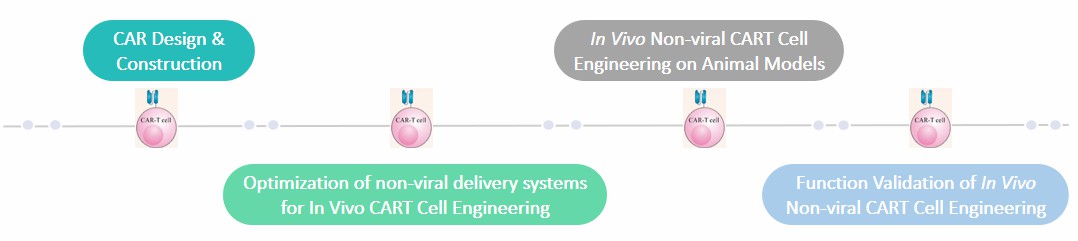
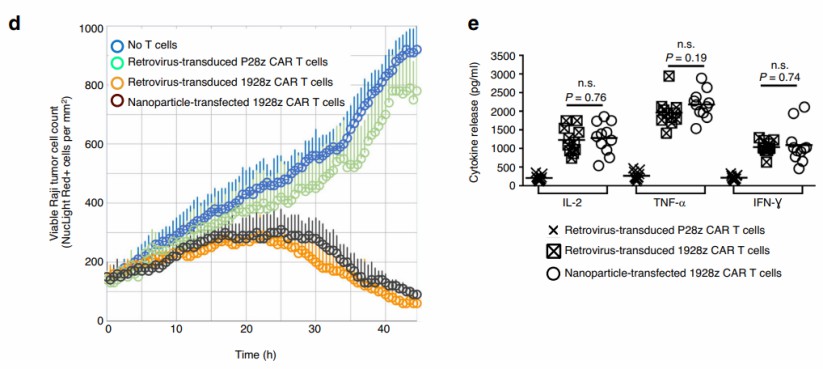
Here are some results displaying the in vivo non-viral CAR-T cell engineering as a potentially ideal solution for tumor immunotherapy.
| 1. In situ CAR-T programming using synthetic DNA nanocarriers. | |
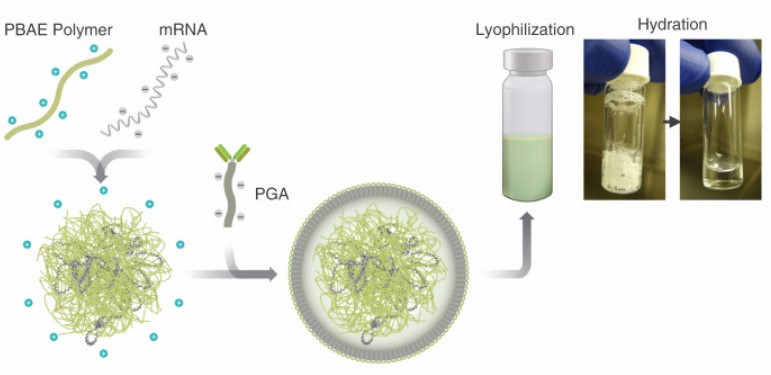
| 2. In situ CAR-T programming using IVT mRNA nanocarriers. | |
|
|
| Fig.2 Design and manufacture of IVT mRNA nanocarriers for in vivo CAR-T programming.2 | Fig.3 In vitro cytotoxicity assay of nanoparticle-transfected T cells against Raji lymphoma cells.2 |
Q1. Whether in vivo non-viral CAR engineering solution can be applied to other cells?
A: In vivo non-viral CAR-T cell engineering has many potential directions of application, such as in situ CAR-NK cells programming using the non-viral delivery system, in suit CAR-M cells programming.
Q2. What are the advantages of the non-viral approach comparing the viral-based approach for in vivo CAR-T engineering?
| Types of Vector | Pros | Cons | |
| Non-viral vector | Lipid-based nanoparticles | Simple manufacturing process | Low transfection efficiency |
| Polymer-based nanoparticles | High genetic cargo capacity | Toxicity related to materials | |
| Inorganic nanoparticles | Low immunogenicity | ||
| Viral vector | Adenovirus | High transfection | Limited genetic cargo capability |
| Retrovirus | efficiency | Immunogenicity | |
| Lentivirus | High stability of expression | Host genome integration | |
Professional consultation provides you with guidance throughout the entire project process, please contact us for a tailored solution.
Non-viral CAR-T engineering offers enhanced safety and flexibility compared with viral approaches. Synthetic RNA or DNA-based carriers allow transient CAR expression without genome integration, reducing insertional risks. Nanoparticle-based delivery enables targeted T cell programming, lower immunogenicity, and potential for repeated dosing. Our platform simplifies manufacturing, supports rapid iteration, and is suitable for both preclinical research and translational development. Contact our team today to discuss your customized in vivo CAR-T project.
References
For any technical issues or product/service related questions, please leave your information below. Our team will contact you soon.
All products and services are For Research Use Only and CANNOT be used in the treatment or diagnosis of disease.
 NEWSLETTER
The latest newsletter to introduce the latest breaking information, our site updates, field and other scientific news, important events, and insights from industry leaders
LEARN MORE NEWSLETTER NEW SOLUTION
CellRapeutics™ In Vivo Cell Engineering: One-stop in vivo T/B/NK cell and macrophage engineering services covering vectors construction to function verification.
LEARN MORE SOLUTION NOVEL TECHNOLOGY
Silence™ CAR-T Cell: A novel platform to enhance CAR-T cell immunotherapy by combining RNAi technology to suppress genes that may impede CAR functionality.
LEARN MORE NOVEL TECHNOLOGY NEW SOLUTION
Canine CAR-T Therapy Development: From early target discovery, CAR design and construction, cell culture, and transfection, to in vitro and in vivo function validation.
LEARN MORE SOLUTION