






Creative Biolabs develops enzyme-armored CAR-T cells expressing matrix-degrading or TME-modifying enzymes to overcome physical barriers, enhance tumor penetration, and improve antitumor efficacy in dense solid tumor microenvironments.
Creative Biolabs has a tradition of commitment. To achieve efficient execution and regulatory approval, we offer careful considerations of your program for the development of a cellular or gene therapy product – now and in the future.
EXPLORE MORE HighlightsWe focus on unmet needs and develop novel cellular and gene drugs and solutions that offer significant benefits over existing options.
EXPLORE MORE HighlightsThe advent of Chimeric Antigen Receptor T-cell (CAR-T) therapies has revolutionized the field of oncology, providing new avenues for treating various forms of cancer. Our 20 years of experience in the biotechnology sector have equipped us with the expertise and technological capabilities to support the entire lifecycle of CAR-T products, from early development to commercialization.
EXPLORE MORETo accelerate advanced breakthroughs of your projects, we offer broad range of platforms which enable our clients be free to tackle problems with cutting-edge technologies from different angles and in different methods.
EXPLORE MORE HighlightsUse the resources in our library to help you understand your options and make critical decisions for your study. We offer oncolytic virus, CAR-T, and dendritic cell related documents, as well as newsletter. If you don't find the answers you're looking for, contact us for additional assistance.
EXPLORE MORE HighlightsGet a real taste and understanding of the business and culture of one of the world's great research-based cellular and gene therapy discovery and development companies.
EXPLORE MORE
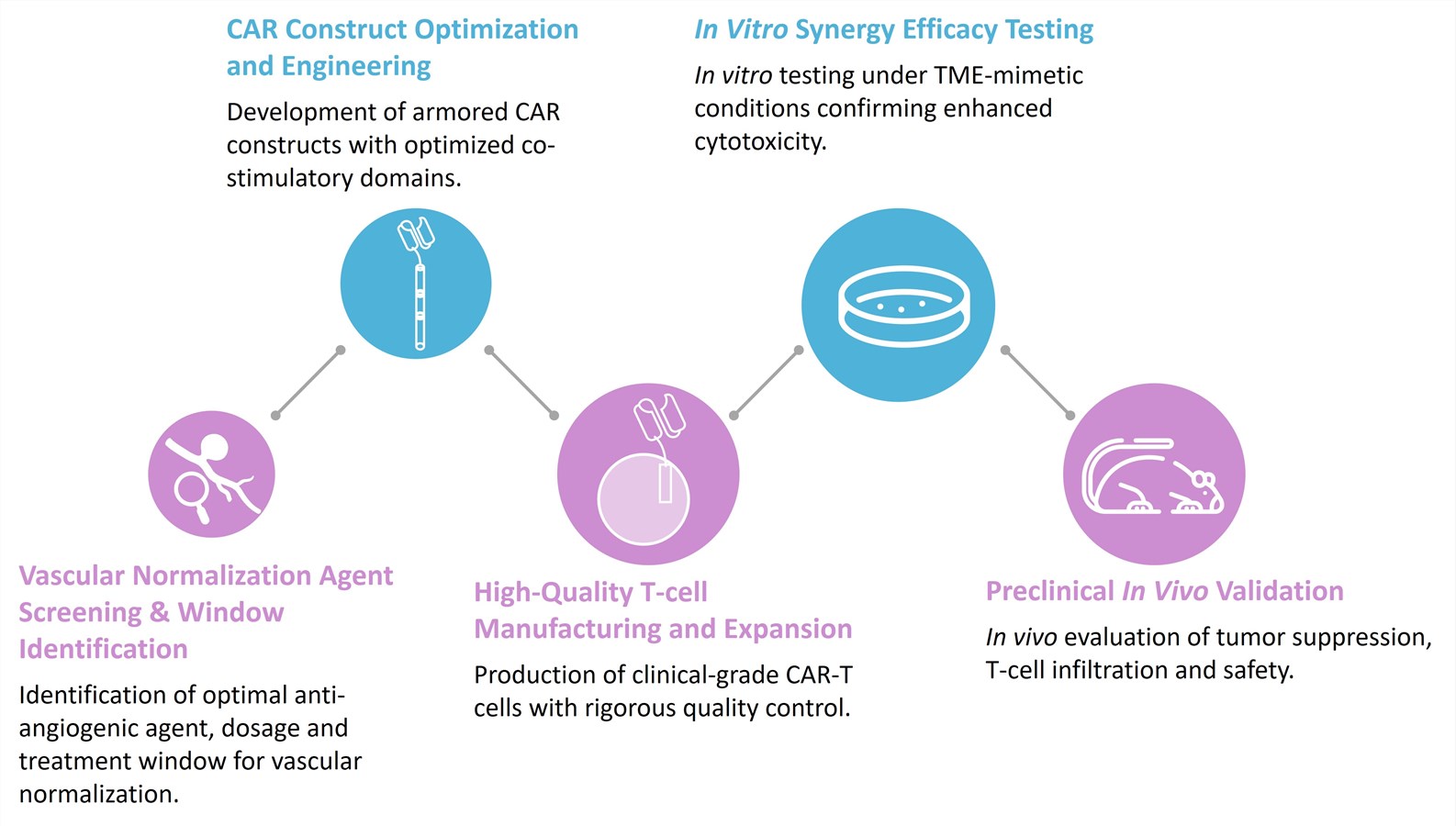
Creative Biolabs' Solid Tumor Targeting CAR-T Development Service with Anti-Angiogenic Normalization is designed to overcome limited CAR-T efficacy and restricted infiltration in immunosuppressive tumor microenvironments. By combining precise anti-angiogenic agent selection with rational combinatorial strategies, this platform enhances T-cell trafficking, remodels tumor vasculature, and boosts local anti-tumor activity. Through these integrated approaches, researchers can achieve improved intra-tumoral access, sustained CAR-T function, and accelerated development of next-generation therapies for challenging solid tumor indications.
Abnormal, leaky vasculature in solid tumors creates hypoxia, acidosis, and high fluid pressure, forming a barrier to CAR-T infiltration and function. Anti-Angiogenic Normalization temporarily restores tumor vessel function by targeting pro-angiogenic factors, reducing physical barriers and hypoxia, and reprogramming the TME from immunosuppressive to immune-receptive, enabling CAR-T cells to reach and kill tumor cells. Recent studies support its role in enhancing CAR-T efficacy.
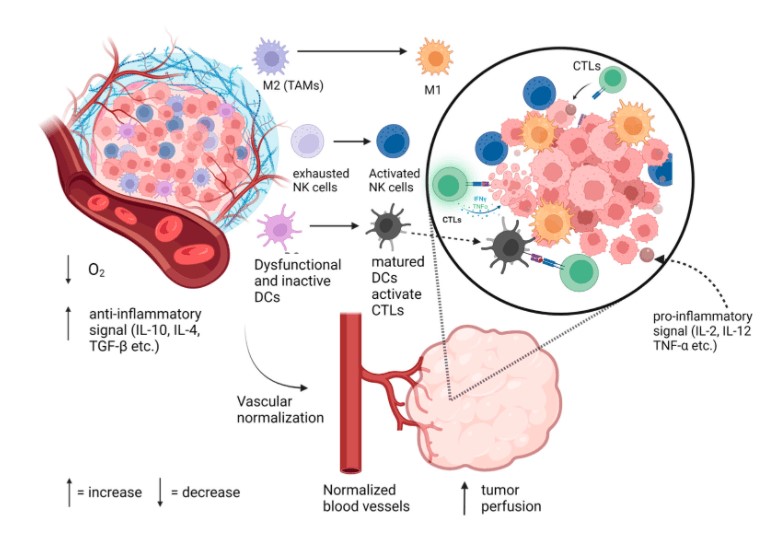 Fig.1 Alterations in the immune cell population following tumor vessel normalization.1
Creative Biolabs' service leverages anti-angiogenic normalization to temporarily restore tumor vessel function, reduce hypoxia, and remodel the tumor microenvironment from immunosuppressive to immune-receptive. This enhances CAR-T infiltration, activity, and tumor-killing efficacy. Our team can design, optimize, and validate CAR-T constructs tailored to your solid tumor model, accelerating preclinical development and improving therapeutic outcomes.
Our comprehensive service includes CAR-T design and optimization with custom constructs, in vitro potency testing using tumor cell killing assays and 3D models, mechanistic assays for migration and TME modulation, in vivo validation in Xenograft/PDX models, PK/PD and safety assessment for biodistribution and toxicity, and regulatory and production support for preparation and documentation.
Discover How We Can Help - Request a Consultation.
| Objective | Assay | Readout / Metric |
|---|---|---|
| Evaluate CAR-T infiltration | 3D tumor spheroid models, vascular normalization treatment | CAR-T penetration depth |
| Assess tumor-killing efficacy | Co-culture CAR-T with tumor, endothelial cells, and anti-angiogenic normalization modulators | Tumor cell lysis rate, cytokine secretion |
| Measure TME remodeling | Hypoxia and interstitial pressure assays | Oxygenation levels, pressure metrics |
| In vivo validation | Solid tumor xenograft or PDX models with/without anti-VEGF | Tumor growth inhibition, CAR-T tumor homing |
| Functional synergy | Cytokine, anti-angiogenic normalization therapy | Tumor clearance, CAR-T persistence, TME cytokine profiling |
How long does the vessel normalization window typically last, and how do you ensure our CAR-T cells are delivered during this period?
The vascular normalization window is transient. Our service precisely maps this period in your model and delivers a timed combination strategy, synchronizing CAR-T infusion with peak vessel function for maximum efficacy.
What types of anti-angiogenic agents can be integrated into the normalization strategy?
We evaluate a range of agents, including established tyrosine kinase inhibitors that target VEGF/VEGFR signaling, as well as novel small molecules or biologics that modulate the TME. The final choice is data-driven and tailored to the specific mechanism of your tumor type.
Does your normalization approach increase the risk of systemic side effects compared to traditional anti-angiogenic therapy?
We employ precisely titrated, low-dose regimens to transiently restore vascular function. This minimizes systemic risks from sustained anti-angiogenic therapy while creating a critical window for CAR-T delivery.
Creative Biolabs develops enzyme-armored CAR-T cells expressing matrix-degrading or TME-modifying enzymes to overcome physical barriers, enhance tumor penetration, and improve antitumor efficacy in dense solid tumor microenvironments.
Creative Biolabs develops dual CAR-T cells targeting both tumor antigens and cancer-associated fibroblasts, enabling simultaneous tumor killing and stromal remodeling to improve infiltration, reduce immunosuppression, and enhance therapeutic responses in solid tumors.
Creative Biolabs provides a specialized and integrated approach to CAR-T development, specifically tackling the hostile solid tumor microenvironment through precise anti-angiogenic normalization strategies. By validating the perfect combination of your CAR-T product and a vascular normalizing agent, we deliver the necessary data to significantly increase the probability of therapeutic success. To discuss your project, learn more about our proprietary screening platforms, or request detailed quotes, please contact us today. Our scientific team is ready to assist you in designing the optimal strategy for overcoming solid tumor resistance.
Reference
For any technical issues or product/service related questions, please leave your information below. Our team will contact you soon.
All products and services are For Research Use Only and CANNOT be used in the treatment or diagnosis of disease.
 NEWSLETTER
The latest newsletter to introduce the latest breaking information, our site updates, field and other scientific news, important events, and insights from industry leaders
LEARN MORE NEWSLETTER NEW SOLUTION
CellRapeutics™ In Vivo Cell Engineering: One-stop in vivo T/B/NK cell and macrophage engineering services covering vectors construction to function verification.
LEARN MORE SOLUTION NOVEL TECHNOLOGY
Silence™ CAR-T Cell: A novel platform to enhance CAR-T cell immunotherapy by combining RNAi technology to suppress genes that may impede CAR functionality.
LEARN MORE NOVEL TECHNOLOGY NEW SOLUTION
Canine CAR-T Therapy Development: From early target discovery, CAR design and construction, cell culture, and transfection, to in vitro and in vivo function validation.
LEARN MORE SOLUTION