Creative Biolabs has a tradition of commitment. To achieve efficient execution and regulatory approval, we offer careful considerations of your program for the development of a cellular or gene therapy product – now and in the future.
EXPLORE MORE HighlightsWe focus on unmet needs and develop novel cellular and gene drugs and solutions that offer significant benefits over existing options.
EXPLORE MORE HighlightsThe advent of Chimeric Antigen Receptor T-cell (CAR-T) therapies has revolutionized the field of oncology, providing new avenues for treating various forms of cancer. Our 20 years of experience in the biotechnology sector have equipped us with the expertise and technological capabilities to support the entire lifecycle of CAR-T products, from early development to commercialization.
EXPLORE MORETo accelerate advanced breakthroughs of your projects, we offer broad range of platforms which enable our clients be free to tackle problems with cutting-edge technologies from different angles and in different methods.
EXPLORE MORE HighlightsUse the resources in our library to help you understand your options and make critical decisions for your study. We offer oncolytic virus, CAR-T, and dendritic cell related documents, as well as newsletter. If you don't find the answers you're looking for, contact us for additional assistance.
EXPLORE MORE HighlightsGet a real taste and understanding of the business and culture of one of the world's great research-based cellular and gene therapy discovery and development companies.
EXPLORE MORE
Creative Biolabs offers a comprehensive Solid Tumor Targeting CAR-T Development Service with Integrated Checkpoint Blockade to address exhaustion, limited persistence, and toxicity challenges in solid tumors. Our platform enables the engineering of cell-intrinsic checkpoint resistance through advanced strategies such as PD-1 dominant-negative receptors and CRISPR-mediated gene silencing, eliminating reliance on systemic checkpoint inhibitor infusions. By restoring durable effector function within the immunosuppressive tumor microenvironment, this service enhances therapeutic efficacy and safety. We provide end-to-end support, from construct design and cell engineering to functional validation and preclinical evaluation, helping advance robust CAR-T candidates capable of overcoming the barriers of solid malignancies.
The clinical success of CAR-T therapy in liquid tumors has been hindered in solid tumors by the PD-1/PD-L1 axis, which induces T-cell anergy upon infiltration. Blocking these inhibitory pathways is essential for restoring effector functions such as IFN-gamma and Granzyme B secretion. The cell-intrinsic strategies, such as Dominant-Negative Receptors (DNR), outperform systemic antibody combinations in sustainability and tumor-limited specificity.
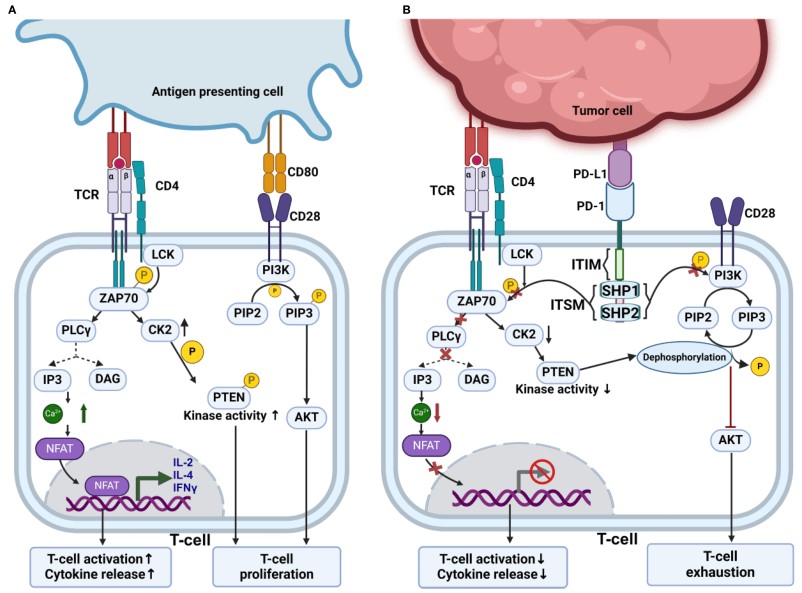
Fig.1 Inhibitory pathway blockade and T cell reactivation.1
Our service provides a comprehensive suite of solutions designed to transform conventional CAR-T candidates into "armored" therapies capable of surviving the hostile tumor microenvironment.
Discover How We Can Help - Request a Consultation.
We provide a multi-faceted technology platform for developing next-generation CAR-T therapies with integrated checkpoint inhibition:
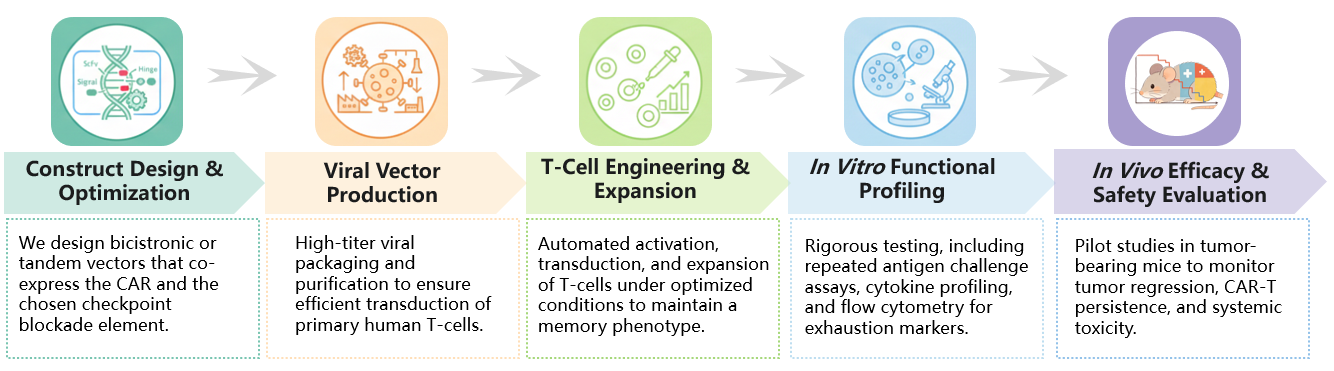
Final Deliverables: Clients receive a Comprehensive Bioanalytical Report detailing all experimental parameters and results, the Engineered CAR-T Cell Product, and Preclinical Data Packages suitable.
What types of immune checkpoints can be integrated into CAR-T development?
Commonly supported targets include PD-1/PD-L1 and other inhibitory pathways relevant to solid tumor immunosuppression.
Is this service suitable for early-stage research projects?
Yes. The platform supports feasibility studies, proof-of-concept evaluation, and optimization at the discovery and preclinical stages.
Can checkpoint modulation be combined with different CAR targets?
Yes. Checkpoint strategies can be paired with a wide range of solid tumor antigens based on project needs.
How is efficacy evaluated in solid tumor contexts?
Evaluation includes cytotoxicity assays, checkpoint resistance testing, tumor infiltration analysis, and in vivo antitumor activity.
We work closely with partners to design flexible, mechanism-focused development strategies that accelerate translational progress while maintaining scientific rigor. Whether you are exploring new targets, optimizing checkpoint-resistant CAR designs, or advancing a candidate toward preclinical readiness, we provide customized, transparent, and collaborative support at every stage. Please contact us to discuss the optimal strategy for your trial design.
Reference
For any technical issues or product/service related questions, please leave your information below. Our team will contact you soon.
All products and services are For Research Use Only and CANNOT be used in the treatment or diagnosis of disease.
 NEWSLETTER
The latest newsletter to introduce the latest breaking information, our site updates, field and other scientific news, important events, and insights from industry leaders
LEARN MORE NEWSLETTER NEW SOLUTION
CellRapeutics™ In Vivo Cell Engineering: One-stop in vivo T/B/NK cell and macrophage engineering services covering vectors construction to function verification.
LEARN MORE SOLUTION NOVEL TECHNOLOGY
Silence™ CAR-T Cell: A novel platform to enhance CAR-T cell immunotherapy by combining RNAi technology to suppress genes that may impede CAR functionality.
LEARN MORE NOVEL TECHNOLOGY NEW SOLUTION
Canine CAR-T Therapy Development: From early target discovery, CAR design and construction, cell culture, and transfection, to in vitro and in vivo function validation.
LEARN MORE SOLUTION