Creative Biolabs has a tradition of commitment. To achieve efficient execution and regulatory approval, we offer careful considerations of your program for the development of a cellular or gene therapy product – now and in the future.
EXPLORE MORE HighlightsWe focus on unmet needs and develop novel cellular and gene drugs and solutions that offer significant benefits over existing options.
EXPLORE MORE HighlightsThe advent of Chimeric Antigen Receptor T-cell (CAR-T) therapies has revolutionized the field of oncology, providing new avenues for treating various forms of cancer. Our 20 years of experience in the biotechnology sector have equipped us with the expertise and technological capabilities to support the entire lifecycle of CAR-T products, from early development to commercialization.
EXPLORE MORETo accelerate advanced breakthroughs of your projects, we offer broad range of platforms which enable our clients be free to tackle problems with cutting-edge technologies from different angles and in different methods.
EXPLORE MORE HighlightsUse the resources in our library to help you understand your options and make critical decisions for your study. We offer oncolytic virus, CAR-T, and dendritic cell related documents, as well as newsletter. If you don't find the answers you're looking for, contact us for additional assistance.
EXPLORE MORE HighlightsGet a real taste and understanding of the business and culture of one of the world's great research-based cellular and gene therapy discovery and development companies.
EXPLORE MORE
Overcome the barriers of poor CAR-T trafficking and an immunosuppressive tumor microenvironment with Creative Biolabs' Solid Tumor Targeting CAR-T Development Services. Through proprietary Chemokine-Axis Matching and TME remodeling strategies, we enhance CAR-T cell homing, infiltration, and sustained functional activity within solid tumors. Our integrated approach enables more durable anti-tumor responses and supports efficient translation from research to clinical development - unlocking the therapeutic potential of CAR-T cells in previously treatment-resistant solid tumors.
CAR-T cell success in liquid cancers has not translated to solid tumors due to the highly complex, barricaded, and hostile TME. Ineffective T cell trafficking is the primary hurdle. Research shows that genetically engineering CAR-T cells to express specific chemokine receptors (e.g., CXCR2, CCR8) can precisely co-opt the natural chemokine system to direct them into the tumor site, a strategy supported by numerous preclinical findings demonstrating superior anti-tumor immune responses and enhanced overall survival in solid tumor models.
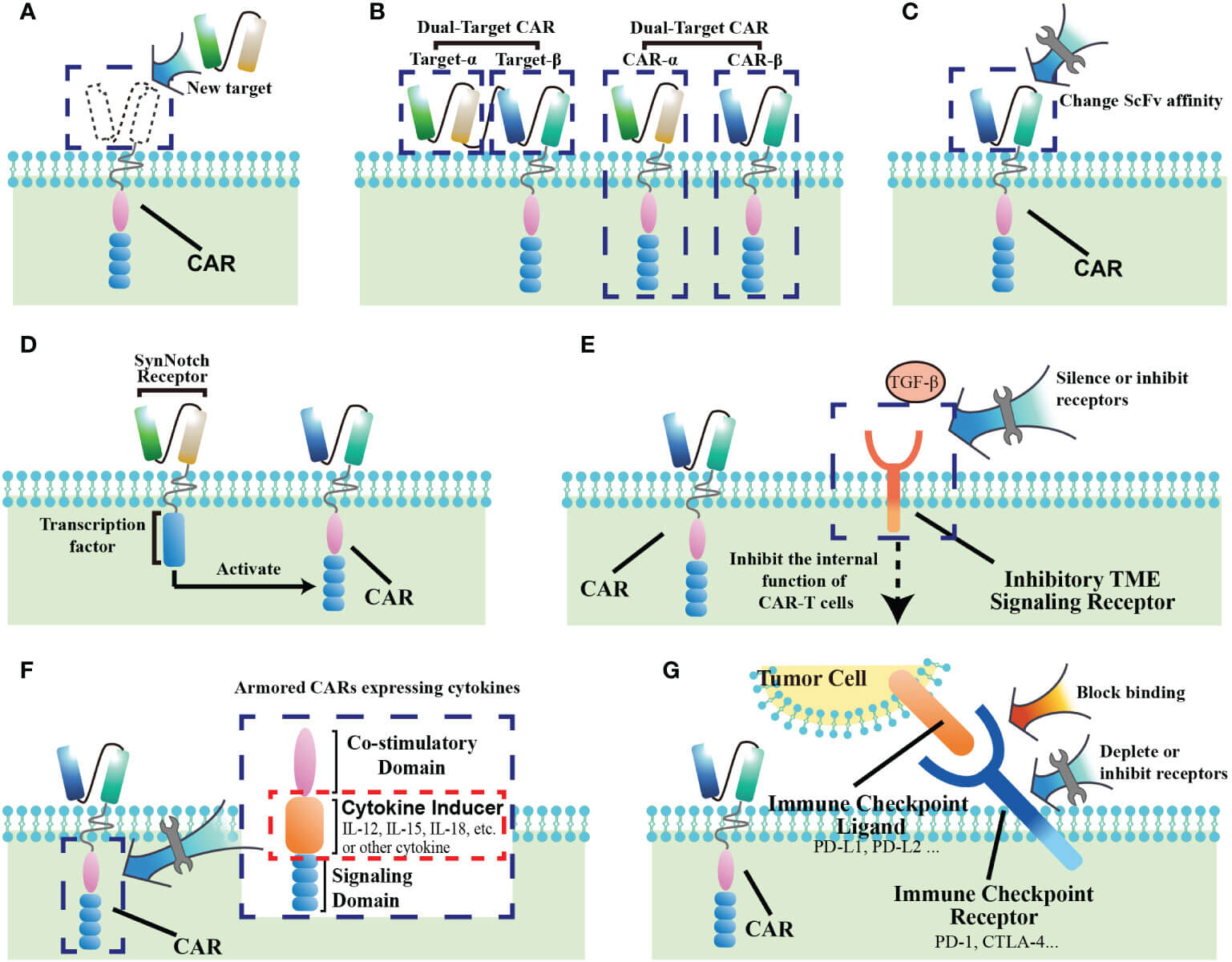 Fig.1 Strategies for improving CAR-T cell therapy in solid tumors.1
Our services are specifically designed to address the foundational failure point of most solid tumor CAR-T trials: inefficient T cell homing. By integrating detailed TME analysis with advanced genetic engineering, we provide you with high-quality, pre-validated CAR-T cell leads engineered for superior infiltration and function. Key capabilities:
Discover How We Can Help - Request a Consultation.
Understanding the dominant chemokines in a patient's tumor is critical for selecting the most effective CAR-T chemokine receptor match. We integrate the following mainstream technology platforms and experiments to ensure optimal Chemokine-Axis Matching and TME modification:
| High-Throughput Ligand Screening | Utilizing bead-based multiplex assays and quantitative ELISA to generate a detailed, quantitative profile of chemokine and cytokine expression in patient-derived tumor tissue or cell line supernatant. This identifies the best homing axes. |
| Receptor Expression Optimization | Flow cytometry and molecular cloning platforms to monitor, validate, and optimize the stable surface expression of engineered chemokine receptors on primary T cells. |
| Multi-omics Analysis |
Transcriptome sequencing: Quantifies chemokine mRNA in tumor and immune cells. Proteomic detection: Measures levels of secreted chemokines Spatial analysis: Maps chemokine distribution and tumor microenvironment infiltration |
| Data Processing and Visualization |
Chemokine signature construction and classification. Receptor-ligand matching heatmaps and scoring models. |
The required starting materials include the scFv sequence and car backbone design for the primary antigen, tumor tissue, or cell lines with chemokine expression data, and client-provided PBMCs or T cells for initial testing.
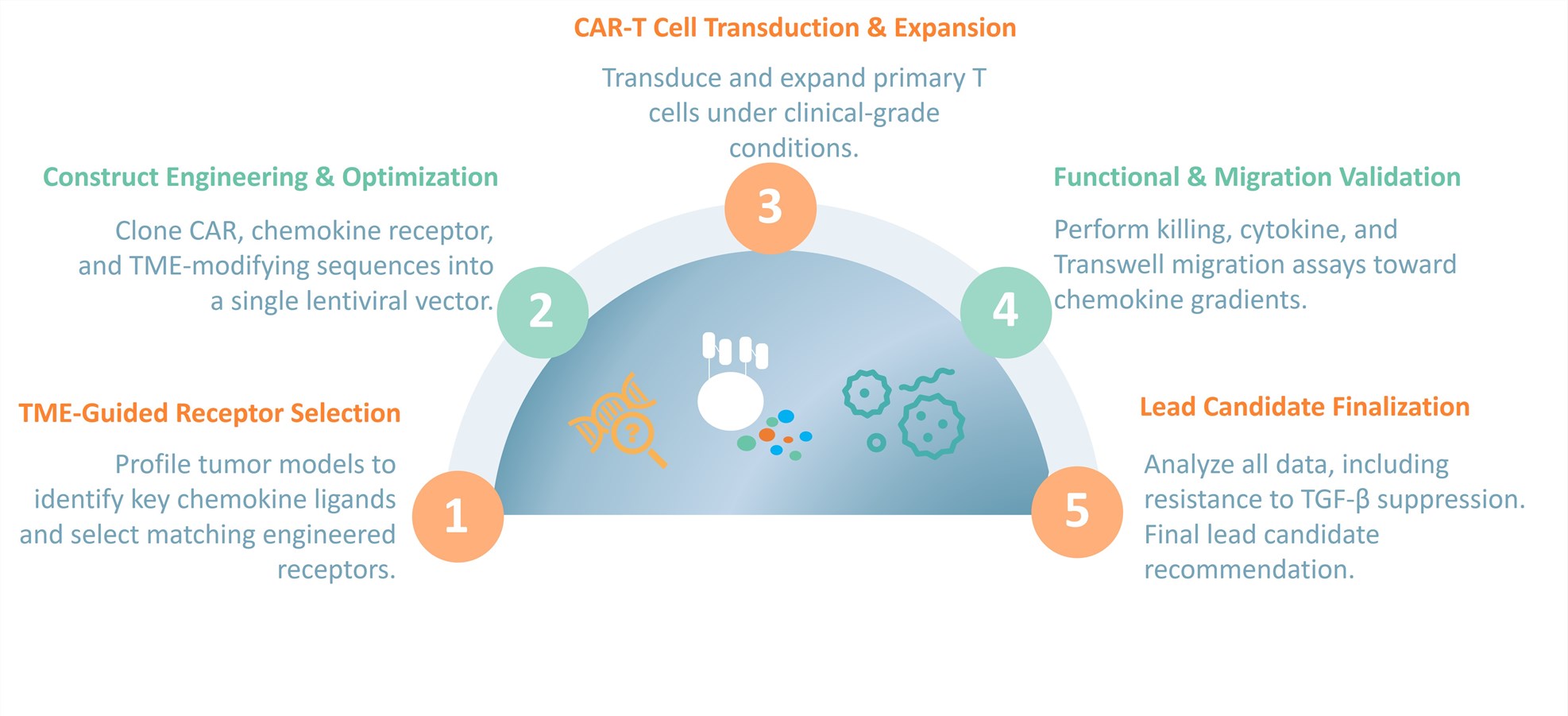
The final deliverables consist of the engineered plasmid or lentivirus supply, a detailed functional characterization report and assay data, and a validated CAR-T cell line ready for further development.
| Chemokine Axis | Key TME Ligands Targeted | Therapeutic Application Focus |
| CXCL9/10/11-CXCR3 Chemokine-Axis Matching |
CXCL9 (MIG), CXCL10 (IP-10), CXCL11 (I-TAC) |
Cancers where T cell infiltration is associated with high endogenous CXCR3 ligand expression, often responsive to interferon-gamma modulation. |
| CXCL16-CXCR6 Chemokine-Axis Matching | CXCL16 | Targeting cancers, particularly those of epithelial origin, that constitutively express CXCL16, offering a distinct homing pathway. |
| CXCL1/8-CXCR1/2 Chemokine-Axis Matching |
CXCL1, CXCL8(IL-8) |
Targeting common tumor environments that release pro-inflammatory chemokines, which often recruit suppressive cells but can be re-purposed to recruit anti-tumor CAR-T cells. |
| CCL19/21-CCR7 Chemokine-Axis Matching |
CCL19, CCL21 |
Primarily used to enhance the persistence and positioning of T cells within tumor-draining lymph nodes and specialized TME structures before final infiltration. |
We analyze your tumor's unique chemokine profile to design a matching homing receptor, moving beyond generic CAR-T development.
We co-engineer T-cells for enhanced trafficking (via chemokine receptors) and TME resilience, addressing multiple barriers simultaneously.
Our proprietary Transwell assays quantitatively measure migration efficiency early, enabling data-driven decisions before in vivo studies.
How to select the right chemokine receptor?
Selection depends on your tumor's unique chemokine profile. Use our TME Chemokine Profiling Service for data-driven selection (e.g., CXCR2 or CCR8), avoiding trial-and-error.
Can CAR-T overcome physical TME barriers?
Yes. We offer TME Modification Co-Engineering, enabling CAR-T cells to express enzymes that degrade the extracellular matrix for enhanced tumor penetration.
Are chemokine receptor modifications safe?
Yes. Targeted homing concentrates CAR-T cells at the tumor site, potentially lowering systemic exposure. We perform thorough specificity testing to ensure a favorable safety profile.
How does this compare to systemic T-cell injection?
Systemic injection relies on passive distribution. Our Chemokine-Axis Matching provides active, directional homing, significantly increasing tumor T-cell concentration as shown in published studies.
Creative Biolabs is dedicated to transforming the solid tumor landscape by pioneering CAR-T cell precision engineering. Our Solid Tumor Targeting CAR-T Development Services through Chemokine-Axis Matching ensure your therapy reaches its intended target effectively, safely, and functionally. We invite you to connect with our specialists to discuss your solid tumor target, utilize our TME profiling capabilities, or begin a personalized collaboration.
Reference
For any technical issues or product/service related questions, please leave your information below. Our team will contact you soon.
All products and services are For Research Use Only and CANNOT be used in the treatment or diagnosis of disease.
 NEWSLETTER
The latest newsletter to introduce the latest breaking information, our site updates, field and other scientific news, important events, and insights from industry leaders
LEARN MORE NEWSLETTER NEW SOLUTION
CellRapeutics™ In Vivo Cell Engineering: One-stop in vivo T/B/NK cell and macrophage engineering services covering vectors construction to function verification.
LEARN MORE SOLUTION NOVEL TECHNOLOGY
Silence™ CAR-T Cell: A novel platform to enhance CAR-T cell immunotherapy by combining RNAi technology to suppress genes that may impede CAR functionality.
LEARN MORE NOVEL TECHNOLOGY NEW SOLUTION
Canine CAR-T Therapy Development: From early target discovery, CAR design and construction, cell culture, and transfection, to in vitro and in vivo function validation.
LEARN MORE SOLUTION