Solid Tumor Targeting CAR-T Development Services with ECM & Stroma Disruption
Online Inquiry
Background Service What We Can Offer Workflow Highlights Data Support FAQs Contact
Creative Biolabs provides Solid Tumor Targeting CAR-T Development Services with ECM & Stroma Disruption, designed to overcome physical infiltration barriers, immunosuppressive signaling networks, and off-target toxicities that limit CAR-T efficacy in solid tumors. Through multi-modal CAR engineering, enzymatic matrix remodeling, and stroma-targeted logic-gated constructs, our platform enhances T-cell penetration, functional persistence, and tumor-selective activation within the complex TME.
Introduction
Solid tumors present the most critical obstacle to the broad success of CAR-T cell therapy, primarily due to the dense, immunosuppressive Tumor Microenvironment (TME) that blocks T cell infiltration and survival. Creative Biolabs' Solid Tumor Targeting CAR-T Development Services with ECM & Stroma Disruption directly addresses these barriers. Enhanced infiltration through enzymatic TME degradation dramatically potentiates CAR-T efficacy against solid tumors, and advanced engineering, including logic-gated designs, is essential to mitigate toxicity and enhance specificity.
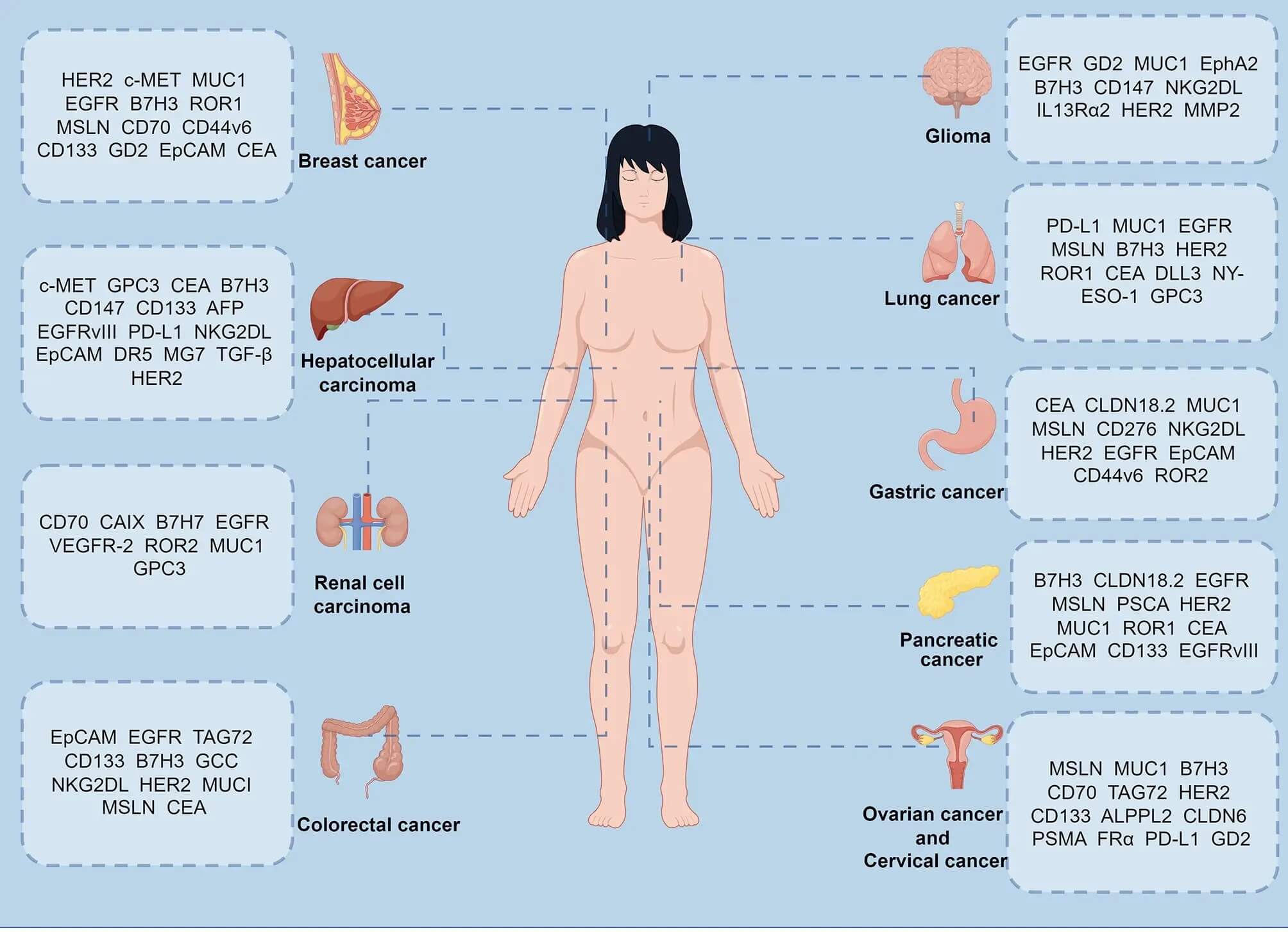 Fig.1 Therapeutic targeting of solid tumors by CAR cells.1,3
Creative Biolabs' CAR-T Development with ECM & Stroma Disruption
The primary failure point for Chimeric Antigen Receptor (CAR)-T cells in solid tumors is not the T cell itself, but the complex and hostile TME. This environment—dense with extracellular matrix (ECM) components and immunosuppressive cells—acts as a physical and chemical fortress, preventing T cell access and function.
Creative Biolabs offers bespoke engineering solutions designed to dismantle this fortress, enabling effective and precise therapeutic delivery. We provide specific deliverables that result in a clinically viable, optimized CAR-T construct ready for IND-enabling studies. We focus on integrating enzymatic disruption mechanisms and advanced targeting strategies. Our solutions directly address the four major bottlenecks in solid tumor CAR-T therapy: restricted infiltration, insufficient targeting specificity, immunosuppression, and systemic toxicity risk.
Discover How We Can Help - Request a Consultation.
Key Technology Platforms for CAR-T Development
Our TME-disruption services are powered by advanced analytical and engineering platforms that ensure data integrity and product quality. We provide customized service packages that leverage these key technologies:
|
High-Resolution Flow Cytometry
|
Quantify CAR/enzyme co-expression, phenotype, and activation status.
|
|
Cell Multiomics
|
Profile CAR-T persistence and functional states.
|
|
Advanced Live-Cell Imaging
|
Visualize tumor penetration and killing kinetics in 3D models.
|
|
Multiplex Immunoassays
|
Measure cytokine secretion and TME factor degradation.
|
|
Spheroid/Organoid Penetration Assays
|
Advanced live-cell imaging quantifies CAR-T cell infiltration in dense tumor spheroids/organoids, directly validating TME disruption efficacy.
|
Project Workflow
Our end-to-end service follows a rigorous, transparent process suitable for seamless integration into your development pipeline. The required starting materials include the target antigen sequence for scFv development, patient or donor T cell samples for engineering, and any available prior pre-clinical data to inform construct design.
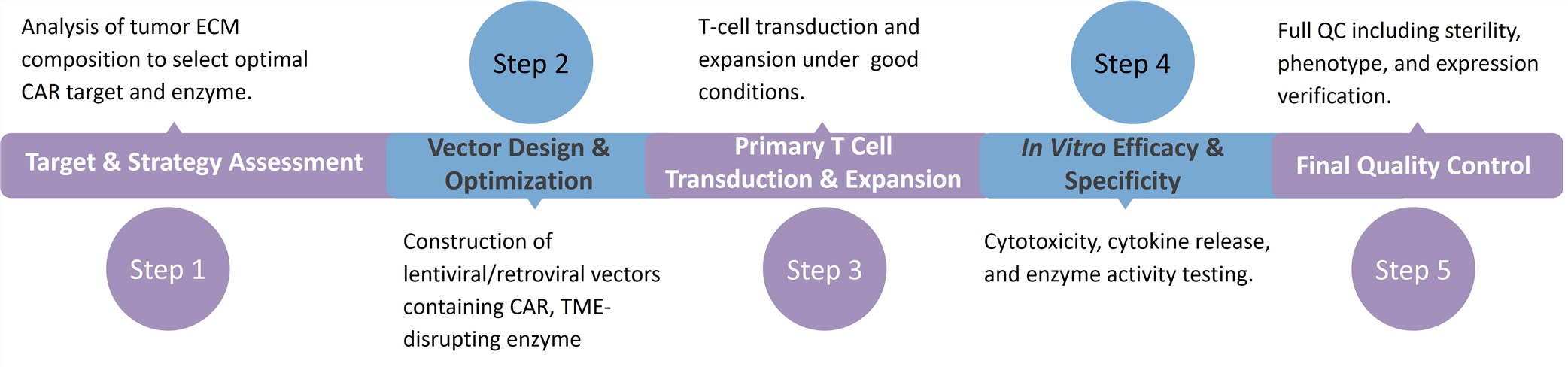
Types of Our CAR-T Development with ECM & Stroma Disruption
This service focuses on engineering T cells to co-express a lytic enzyme, alongside the CAR construct. The enzyme is secreted or expressed on the cell surface, actively degrading key components of the ECM. The enzymatic armor creates channels for T cell migration and promotes deeper penetration into the tumor core, overcoming physical impedance and improving overall treatment response.
Cancer-Associated Fibroblasts (CAFs) are abundant stromal components that secrete pro-fibrotic and immunosuppressive factors contributing to the TME barrier. This service develops dual-targeting CARs aimed at depleting or reprogramming CAFs, alongside targeting tumor cells. By mitigating stromal-driven immunosuppression, we significantly improve the overall environment for CAR-T activity.
Aberrant tumor vasculature creates hypoxic zones that suppress T cell activity and hinder delivery. This service engineers CAR-T cells to release factors that promote the normalization of tumor vasculature. By remodeling leaky, chaotic vessels into a functional network, we improve oxygenation and facilitate sustained T cell delivery and persistence within the tumor.
Unique Features
-
Stromal & Immunosuppression Targeting: Develop dual-targeting CARs or secretory constructs to neutralize immunosuppressive signals and deplete stromal cells.
-
Advanced Vector Production: Optimize high-titer lentiviral/retroviral production for stable multi-gene CAR expression.
-
Comprehensive Functional Validation: Verify engineered T-cell function through HA degradation assays, multi-day cytotoxicity tests, and specificity profiling.
Data Support
This study tackles a key limitation of CAR-T therapy in solid tumors: inadequate T-cell infiltration. Researchers identified hyaluronic acid (HA) in the tumor matrix as a primary barrier and engineered CAR-T cells to secrete a modified human enzyme that degrades HA. In pre-clinical gastric cancer models, this strategy significantly improved CAR-T cell migration, tumor penetration, and overall anti-tumor efficacy, while preserving their original cytotoxic function.
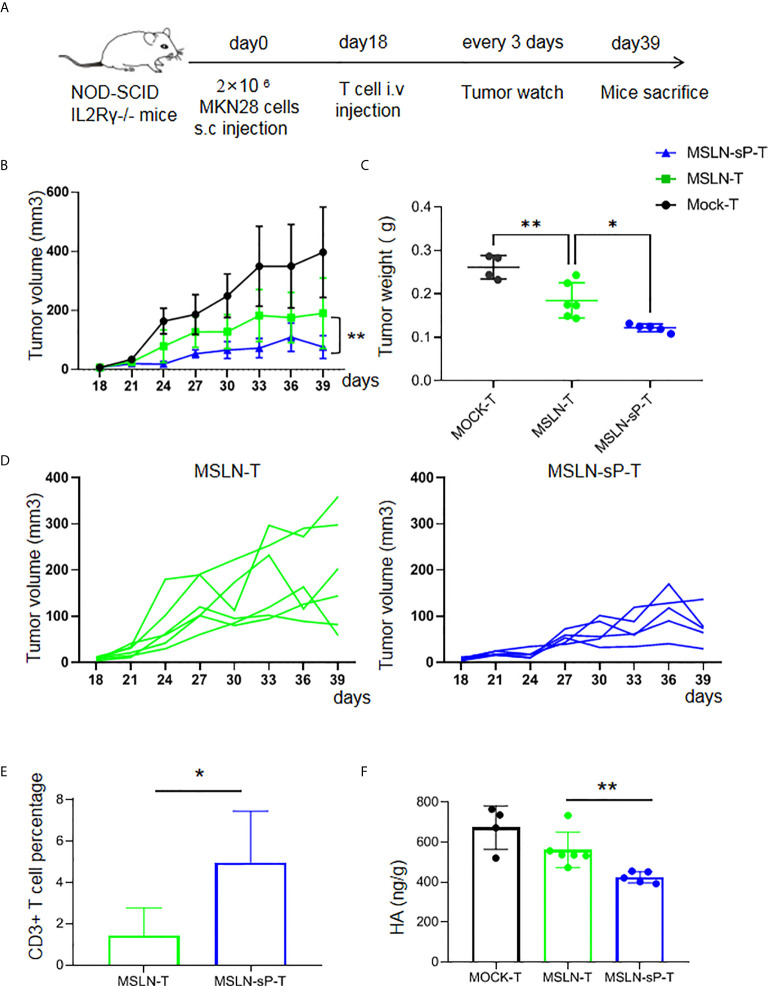 Fig.2 Enhanced infiltration and antitumor activity of CAR-T cells in a gastric cancer mouse model.2,3
FAQs
How does adding ECM disruption impact the safety profile of the CAR-T therapy?
We prioritize safety. The TME-disrupting enzyme is generally co-expressed only upon CAR activation or targeted to the tumor site. Logic-gated designs combined with TME disruption (requiring two signals) ensure localized activity, advantageous over systemic administration.
Can you integrate your TME disruption technology into an existing CAR construct that we have already developed?
Absolutely. We can clone the TME-disrupting payload into your existing CAR-encoding vector backbone, provided compatibility. This modular approach significantly de-risks and accelerates the transition of your current pipeline candidate.
What is the primary advantage of your enzyme-armored CAR-T over simply administering the enzyme systemically?
The Enzyme-armored approach ensures the lytic agent is delivered directly and highly concentrated at the tumor site by the CAR-T cell itself. This precision delivery system is superior to systemic dosing, which leads to rapid clearance and potentially greater systemic side effects.
Partner with Us
Creative Biolabs is your strategic partner in overcoming the most formidable challenge in cancer immunotherapy: the solid tumor microenvironment. Our Solid Tumor Targeting CAR-T Development Services with ECM & Stroma Disruption offer validated, proprietary solutions, from enzyme-armored barrier degradation to logic-gated precision, to accelerate your candidate toward clinical efficacy.
Ready to dismantle the TME and unlock the full therapeutic potential of your CAR-T program? Our team of immunology and cell engineering specialists is available to discuss your specific targets and timeline requirements. Contact us to discuss specific safety protocols.
References
-
Chen, Tong et al. "Current challenges and therapeutic advances of CAR-T cell therapy for solid tumors." Cancer Cell International vol. 24,1 133. 15 Apr. 2024. https://doi.org/10.1186/s12935-024-03315-3
-
Zhao, Ruocong et al. "Human Hyaluronidase PH20 Potentiates the Antitumor Activities of Mesothelin-Specific CAR-T Cells Against Gastric Cancer." Frontiers in immunology vol. 12 660488. 13 Jul. 2021. https://doi.org/10.3389/fimmu.2021.660488
-
Distributed under Open Access License CC BY 4.0, without modification.