





Creative Biolabs provides a PLGA microneedle patch–based CAR-T delivery platform that enables localized, minimally invasive administration, improving intra-tumoral retention, activation, and therapeutic potency for solid tumor treatment.
Creative Biolabs has a tradition of commitment. To achieve efficient execution and regulatory approval, we offer careful considerations of your program for the development of a cellular or gene therapy product – now and in the future.
EXPLORE MORE HighlightsWe focus on unmet needs and develop novel cellular and gene drugs and solutions that offer significant benefits over existing options.
EXPLORE MORE HighlightsThe advent of Chimeric Antigen Receptor T-cell (CAR-T) therapies has revolutionized the field of oncology, providing new avenues for treating various forms of cancer. Our 20 years of experience in the biotechnology sector have equipped us with the expertise and technological capabilities to support the entire lifecycle of CAR-T products, from early development to commercialization.
EXPLORE MORETo accelerate advanced breakthroughs of your projects, we offer broad range of platforms which enable our clients be free to tackle problems with cutting-edge technologies from different angles and in different methods.
EXPLORE MORE HighlightsUse the resources in our library to help you understand your options and make critical decisions for your study. We offer oncolytic virus, CAR-T, and dendritic cell related documents, as well as newsletter. If you don't find the answers you're looking for, contact us for additional assistance.
EXPLORE MORE HighlightsGet a real taste and understanding of the business and culture of one of the world's great research-based cellular and gene therapy discovery and development companies.
EXPLORE MORE
Inadequate CAR-T cell infiltration, T-cell exhaustion, and the challenge posed by the blood–brain barrier (BBB) continue to limit therapeutic efficacy in solid tumor settings. Our Solid Tumor Targeting CAR-T Development Service through Fibrin Gel enables localized and sustained immunotherapy by delivering highly potent CAR-T cells within a custom-engineered, biocompatible fibrin matrix, supporting enhanced regional retention, improved cell viability, and more effective tumor engagement.
CAR-T cell therapy has revolutionized hematologic cancer treatment, yet its application in solid tumors is hindered by the hostile TME, which limits T-cell infiltration, survival, and function. Regional administration of CAR-T cells bypasses the systemic challenges of IV infusion and promotes local drug concentrations. Our service is based on the superior performance of biomaterial platforms like fibrin gel, which functions as an in situ forming scaffold to accommodate and gradually release functional CAR-T cells into the tumor site.
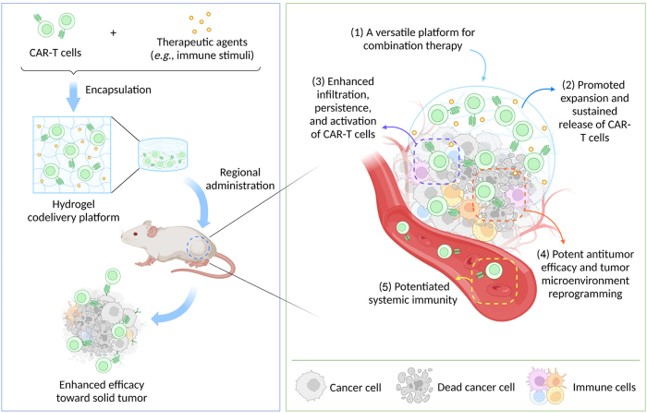 Fig.1 Schematic illustration of CAR-T cells treating solid tumors via a hydrogel.1
Traditional intravenous (IV) delivery of CAR-T cells often results in low tumor infiltration and rapid T-cell exhaustion due to systemic distribution and the hostile tumor microenvironment. Our specialized service provides a crucial bypass by enabling local, in situ formation of a CAR-T cell depot, resulting in significantly enhanced therapeutic persistence and tumor control, especially in post-surgical settings where residual disease is a major concern. We offer a precise methodology for developing, validating, and formulating your specific CAR-T construct within this advanced biomaterial platform.
The fibrin matrix can be applied to post-surgical tumor beds to help limit local recurrence, to dense or inoperable solid tumors to support deeper CAR-T infiltration, or to body cavities to achieve high local exposure with reduced systemic effects. The gel structure is tunable: a low-density formulation allows rapid CAR-T release for fast infiltration, while a denser, retention-focused matrix supports prolonged cell presence for sustained immune surveillance.
Discover How We Can Help - Request a Consultation.
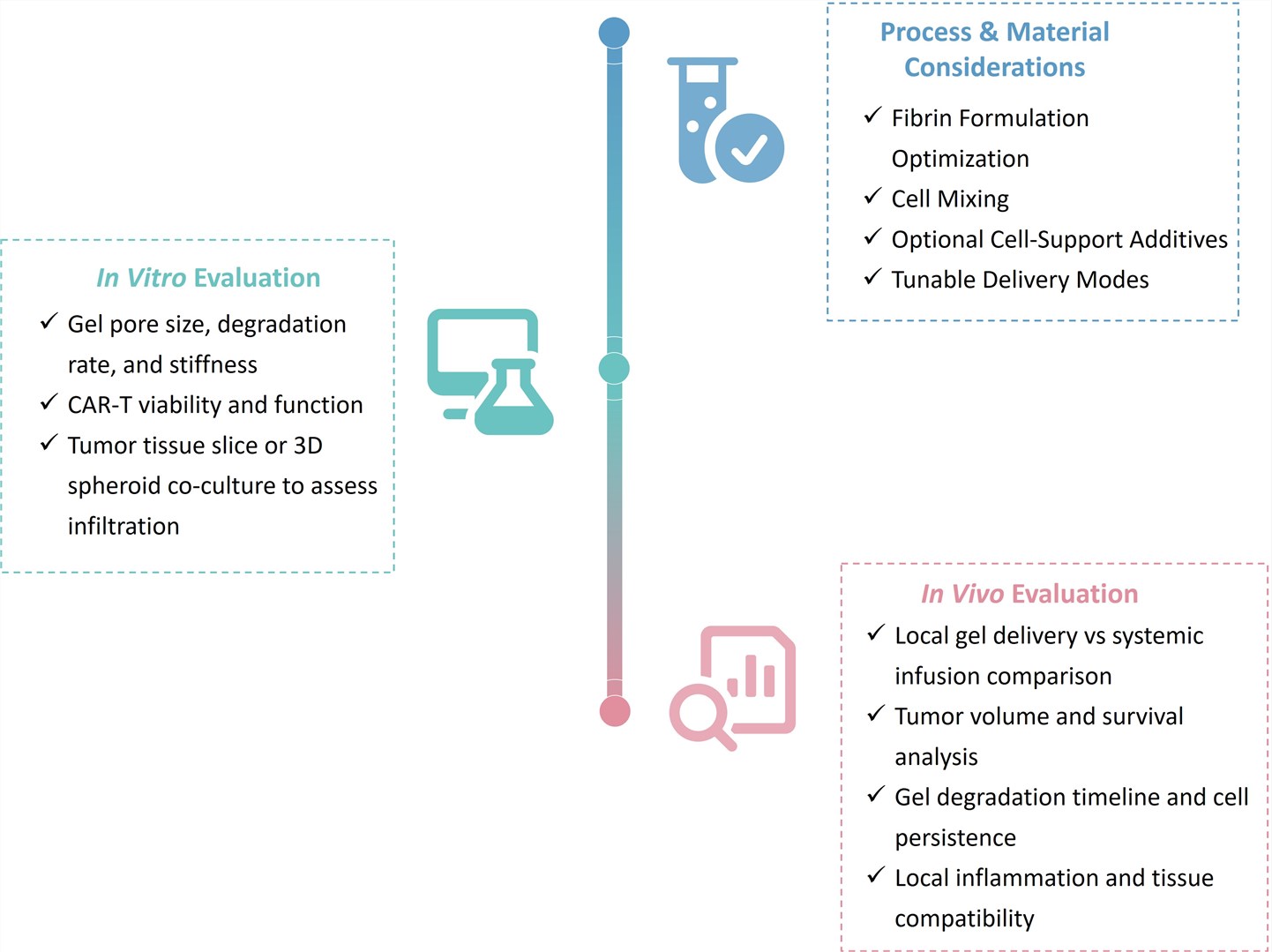
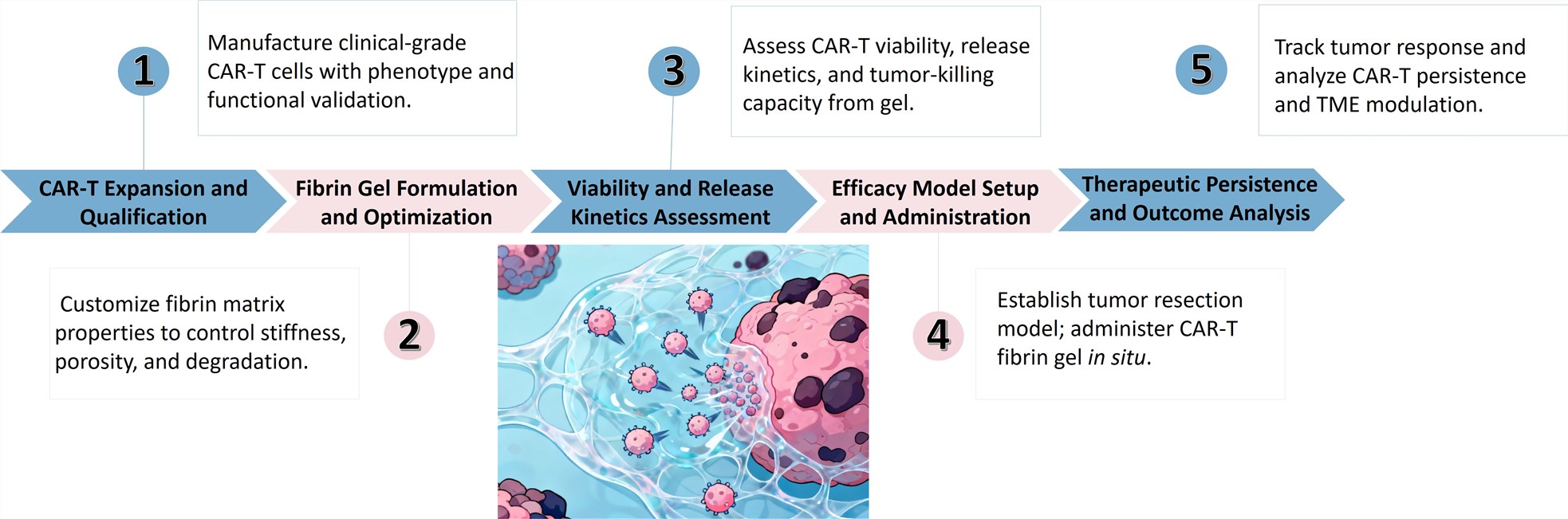
The final deliverables include an optimized fibrin gel protocol, an in vivo efficacy and persistence report with survival and tumor-infiltrating lymphocytes data, and functional release data demonstrating T-cell viability and cytokine secretion post-encapsulation.
Creative Biolabs provides a PLGA microneedle patch–based CAR-T delivery platform that enables localized, minimally invasive administration, improving intra-tumoral retention, activation, and therapeutic potency for solid tumor treatment.
Creative Biolabs develops TFN micromesh–assisted CAR-T delivery systems that support controlled cell release, enhanced tumor conformity, and sustained immune engagement in challenging solid tumor environments.
Creative Biolabs utilizes PNP hydrogel platforms for localized CAR-T encapsulation and release, boosting cell viability, persistence, and concentrated antitumor activity within solid tumor sites.
What types of solid tumors is this regional delivery platform best suited for?
It shows exceptional promise for tumors where surgical resection is performed, such as glioblastoma, melanoma, and pleural malignancies, where the hydrogel placed in the resection cavity prevents recurrence. It is ideal for local, non-resectable, or recurrent solid tumors where local injection is feasible.
Can I co-encapsulate other therapeutic agents with my CAR-T cells in the fibrin matrix?
Absolutely. The platform's versatility allows for combination therapy. We routinely optimize the fibrin formulation to co-deliver small-molecule drugs, cytokines, or antibodies to actively modulate the TME and enhance CAR-T cell activity.
How do you confirm that the CAR-T cells remain functional after being encapsulated and released from the gel?
We use rigorous in vitro and ex vivo assays, including live/dead imaging and metabolic testing while encapsulated. This is followed by coculture cytotoxicity assays and cytokine profiling after release. This data confirms that the encapsulated CAR-T cells retain their full proliferative capacity and potent antitumor function.
Creative Biolabs' Solid Tumor Targeting CAR-T Development Service through Fibrin Gel offers a validated, next-generation solution for overcoming the systemic delivery and persistence challenges in solid oncology. By combining cutting-edge CAR-T manufacturing with a customized, biocompatible fibrin biomaterial, we provide a localized, sustained, and highly efficacious delivery platform for your immunotherapy assets. Our expert team is ready to discuss your specific CAR construct and assist in developing a robust regional delivery system through our proprietary fibrin gel technology. Contact Our Team for More Information.
Reference
For any technical issues or product/service related questions, please leave your information below. Our team will contact you soon.
All products and services are For Research Use Only and CANNOT be used in the treatment or diagnosis of disease.
 NEWSLETTER
The latest newsletter to introduce the latest breaking information, our site updates, field and other scientific news, important events, and insights from industry leaders
LEARN MORE NEWSLETTER NEW SOLUTION
CellRapeutics™ In Vivo Cell Engineering: One-stop in vivo T/B/NK cell and macrophage engineering services covering vectors construction to function verification.
LEARN MORE SOLUTION NOVEL TECHNOLOGY
Silence™ CAR-T Cell: A novel platform to enhance CAR-T cell immunotherapy by combining RNAi technology to suppress genes that may impede CAR functionality.
LEARN MORE NOVEL TECHNOLOGY NEW SOLUTION
Canine CAR-T Therapy Development: From early target discovery, CAR design and construction, cell culture, and transfection, to in vitro and in vivo function validation.
LEARN MORE SOLUTION