Creative Biolabs has a tradition of commitment. To achieve efficient execution and regulatory approval, we offer careful considerations of your program for the development of a cellular or gene therapy product – now and in the future.
EXPLORE MORE HighlightsWe focus on unmet needs and develop novel cellular and gene drugs and solutions that offer significant benefits over existing options.
EXPLORE MORE HighlightsThe advent of Chimeric Antigen Receptor T-cell (CAR-T) therapies has revolutionized the field of oncology, providing new avenues for treating various forms of cancer. Our 20 years of experience in the biotechnology sector have equipped us with the expertise and technological capabilities to support the entire lifecycle of CAR-T products, from early development to commercialization.
EXPLORE MORETo accelerate advanced breakthroughs of your projects, we offer broad range of platforms which enable our clients be free to tackle problems with cutting-edge technologies from different angles and in different methods.
EXPLORE MORE HighlightsUse the resources in our library to help you understand your options and make critical decisions for your study. We offer oncolytic virus, CAR-T, and dendritic cell related documents, as well as newsletter. If you don't find the answers you're looking for, contact us for additional assistance.
EXPLORE MORE HighlightsGet a real taste and understanding of the business and culture of one of the world's great research-based cellular and gene therapy discovery and development companies.
EXPLORE MORE
Are you currently facing low response rates in solid tumors, severe T cell exhaustion, or a highly immunosuppressive Tumor Microenvironment (TME)? Creative Biolabs' Solid Tumor Targeting CAR-T Development Service by Inhibiting IDO & ARG1 helps you deliver highly persistent and effective CAR-T cell therapies for solid tumors through dual metabolic checkpoint blockade and TME reprogramming. We provide solutions that overcome the primary metabolic barriers to T cell function and survival.
IDO and ARG1 function as critical metabolic immune checkpoints that deplete essential amino acids, tryptophan and arginine, within the tumor microenvironment. This depletion significantly impairs effector T cell function and proliferation, while promoting the expansion of immunosuppressive populations such as regulatory T cells, thereby undermining antitumor immune responses. Inhibition of IDO and ARG1 can effectively reverse this local immunosuppression, restore the metabolic fitness and cytotoxic capacity of CAR-T cells, and enhance their tumor infiltration and sustained antitumor activity. Consequently, combining IDO/ARG1 inhibitors with CAR-T therapy not only improves T cell survival and functional persistence in immunosuppressive milieus but also holds promise for overcoming current therapeutic limitations, potentially elevating clinical response rates and long-term efficacy in solid tumor treatments.
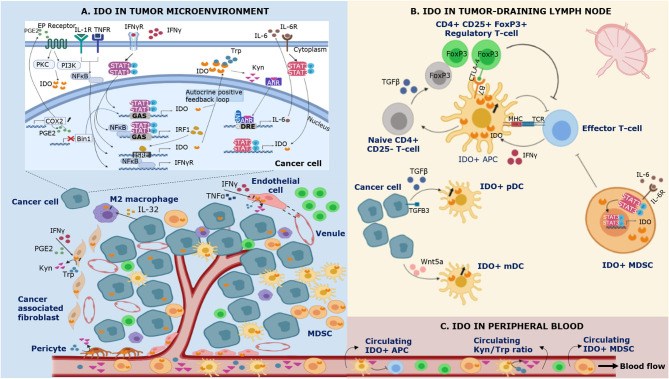 Fig.1 IDO expression across immune compartments in cancer.1
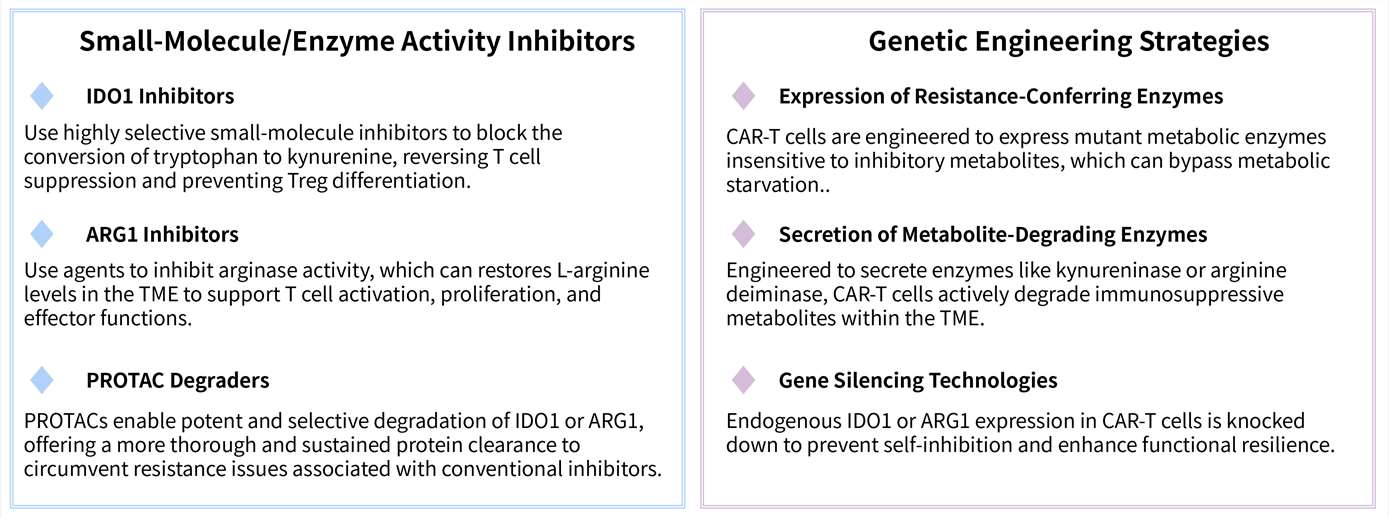
Creative Biolabs' Solid Tumor Targeting CAR-T Development Service by Inhibiting IDO & ARG1 provides a comprehensive development platform for creating solid tumor-resistant CAR-T cells through dual metabolic checkpoint blockade. We employ genetic engineering and pharmacological strategies to simultaneously target the IDO1/kynurenine and ARG1/L-arginine pathways, enhancing the persistence and effector function of CAR-T products.
We offer a comprehensive portfolio of IDO/ARG1-targeting solutions, from small-molecule inhibitors and novel degraders to advanced genetic engineering strategies, all designed to dismantle key metabolic barriers in the TME and generate resilient, persistent CAR-T cells for solid tumors.
Required Starting Materials:
Key Steps:

Final Deliverables:
Why is targeting both IDO1 and ARG1 necessary for solid tumors, and how is this better than traditional CAR-T?
Targeting both pathways provides a comprehensive defense against metabolic suppression. IDO1 causes direct T cell exhaustion and apoptosis, while ARG1 starves T cells of critical nutrients (L-Arginine) by promoting immunosuppressive MDSCs. A traditional CAR T focuses only on antigen recognition, making it vulnerable to both of these parallel metabolic attacks. Our dual strategy ensures robustness and superior persistence.
Can this metabolic reprogramming approach be applied to any solid tumor target?
Yes, the principles of IDO1 and ARG1 suppression are conserved across many cancer types, including pancreatic, gastric, and colorectal tumors. We always begin with TME profiling to confirm the expression of these enzymes in your specific target tumor. This data-driven approach ensures the inhibitory strategy we implement is maximally effective for your project.
We provide a unique dual metabolic checkpoint blockade strategy, simultaneously targeting the IDO1/kynurenine and ARG1/L-arginine pathways to fundamentally overcome key immunosuppressive mechanisms in the tumor microenvironment. Our approach enables the development of CAR-T cells with superior infiltration, persistence, and antitumor efficacy against solid tumors.
"Using Creative Biolabs' Solid Tumor Targeting CAR-T service in our research has significantly improved the sustained cytotoxic function of our lead CAR-T candidate. We observed a clear mitigation of Kynurenine-induced apoptosis, a major benefit not seen with our previous 4-1BB co-stim design alone." M. K***in.
"The dual IDO1/ARG1 blockade strategy facilitated by Creative Biolabs was essential. Our challenge was MDSC accumulation in the solid tumor core, which depleted L-Arginine. Their Arg1-targeting approach effectively cleared this suppressive population, which we confirmed using Published Data benchmarks." P. J***son.
"Creative Biolabs' comprehensive workflow, from TME profiling to in vivo validation under lymphodepleting conditions, streamlined our preclinical phase by nearly two months. The clear data on T-cell persistence in the xenografts gave us the confidence needed to move directly into clinical trials." S. L***er.
Ready to realize the full potential of your CAR-T pipeline for solid tumors? Our expert team is ready to conduct an in-depth analysis of your existing data and leverage these insights to develop a bespoke metabolic reprogramming strategy, designed to overcome current therapeutic challenges.
Contact our team to learn more and explore a potential collaboration.
Reference
For any technical issues or product/service related questions, please leave your information below. Our team will contact you soon.
All products and services are For Research Use Only and CANNOT be used in the treatment or diagnosis of disease.
 NEWSLETTER
The latest newsletter to introduce the latest breaking information, our site updates, field and other scientific news, important events, and insights from industry leaders
LEARN MORE NEWSLETTER NEW SOLUTION
CellRapeutics™ In Vivo Cell Engineering: One-stop in vivo T/B/NK cell and macrophage engineering services covering vectors construction to function verification.
LEARN MORE SOLUTION NOVEL TECHNOLOGY
Silence™ CAR-T Cell: A novel platform to enhance CAR-T cell immunotherapy by combining RNAi technology to suppress genes that may impede CAR functionality.
LEARN MORE NOVEL TECHNOLOGY NEW SOLUTION
Canine CAR-T Therapy Development: From early target discovery, CAR design and construction, cell culture, and transfection, to in vitro and in vivo function validation.
LEARN MORE SOLUTION