Creative Biolabs has a tradition of commitment. To achieve efficient execution and regulatory approval, we offer careful considerations of your program for the development of a cellular or gene therapy product – now and in the future.
EXPLORE MORE HighlightsWe focus on unmet needs and develop novel cellular and gene drugs and solutions that offer significant benefits over existing options.
EXPLORE MORE HighlightsThe advent of Chimeric Antigen Receptor T-cell (CAR-T) therapies has revolutionized the field of oncology, providing new avenues for treating various forms of cancer. Our 20 years of experience in the biotechnology sector have equipped us with the expertise and technological capabilities to support the entire lifecycle of CAR-T products, from early development to commercialization.
EXPLORE MORETo accelerate advanced breakthroughs of your projects, we offer broad range of platforms which enable our clients be free to tackle problems with cutting-edge technologies from different angles and in different methods.
EXPLORE MORE HighlightsUse the resources in our library to help you understand your options and make critical decisions for your study. We offer oncolytic virus, CAR-T, and dendritic cell related documents, as well as newsletter. If you don't find the answers you're looking for, contact us for additional assistance.
EXPLORE MORE HighlightsGet a real taste and understanding of the business and culture of one of the world's great research-based cellular and gene therapy discovery and development companies.
EXPLORE MORE
Creative Biolabs provides a specialized Solid Tumor Targeting CAR-T Development Service: Switch Receptor, designed to help researchers overcome the immunosuppressive tumor microenvironment (TME) that limits conventional CAR-T efficacy. By converting inhibitory signals such as TGF-β, IL-4, IL-10, or PD-L1 into activating cues, switch receptor–engineered CAR-T cells gain enhanced persistence, cytotoxicity, and adaptability in hostile solid tumor niches. This platform supports projects seeking stronger in vivo functionality, improved T-cell fitness, and durable tumor clearance.
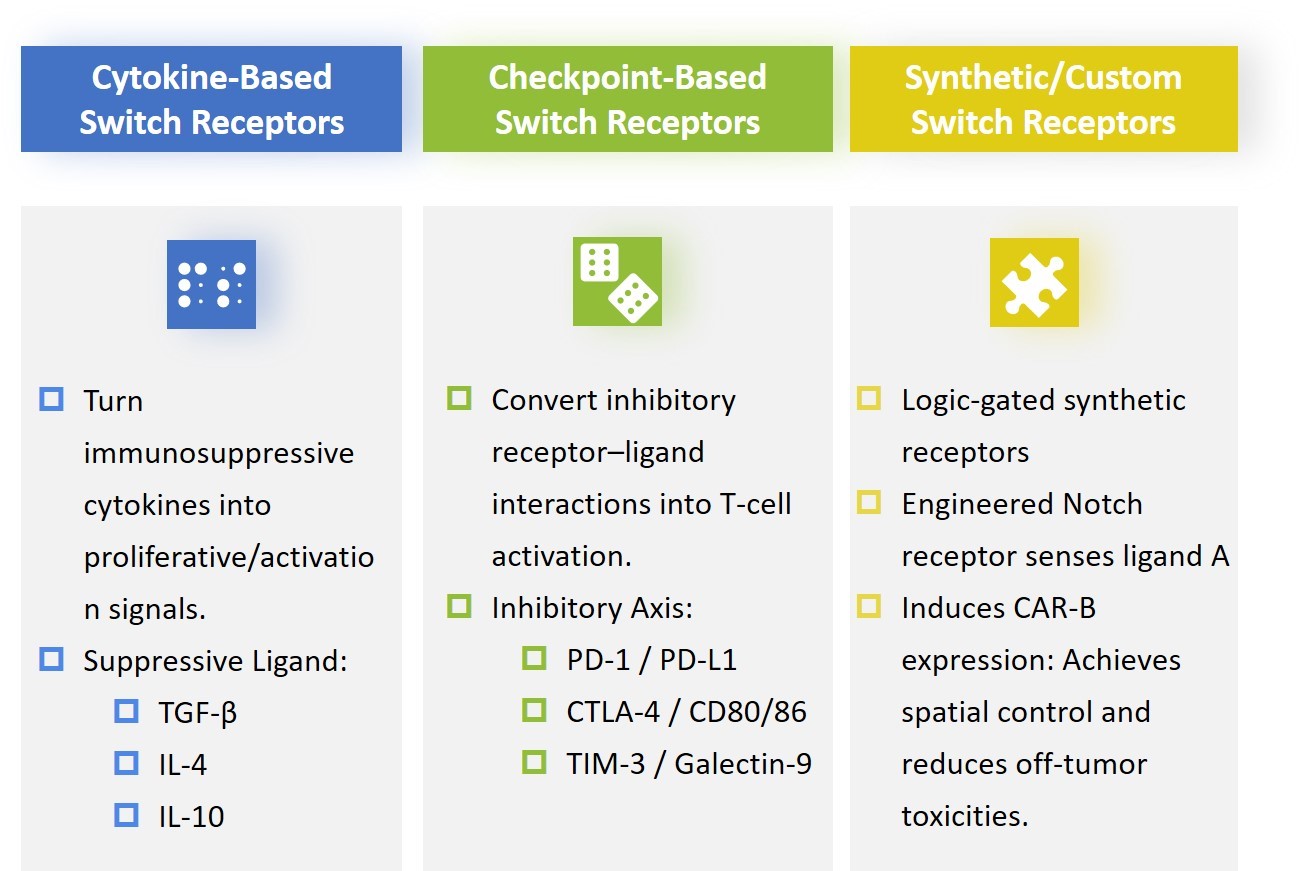
Solid tumors secrete high levels of inhibitory cytokines (e.g., TGF-β, IL-4, IL-10) and express checkpoint ligands (e.g., PD-L1) that suppress T-cell proliferation and cytotoxicity. The Switch Receptor strategy reprograms these suppressive cues into activation signals, enabling CAR-T cells to thrive even in a hostile TME.
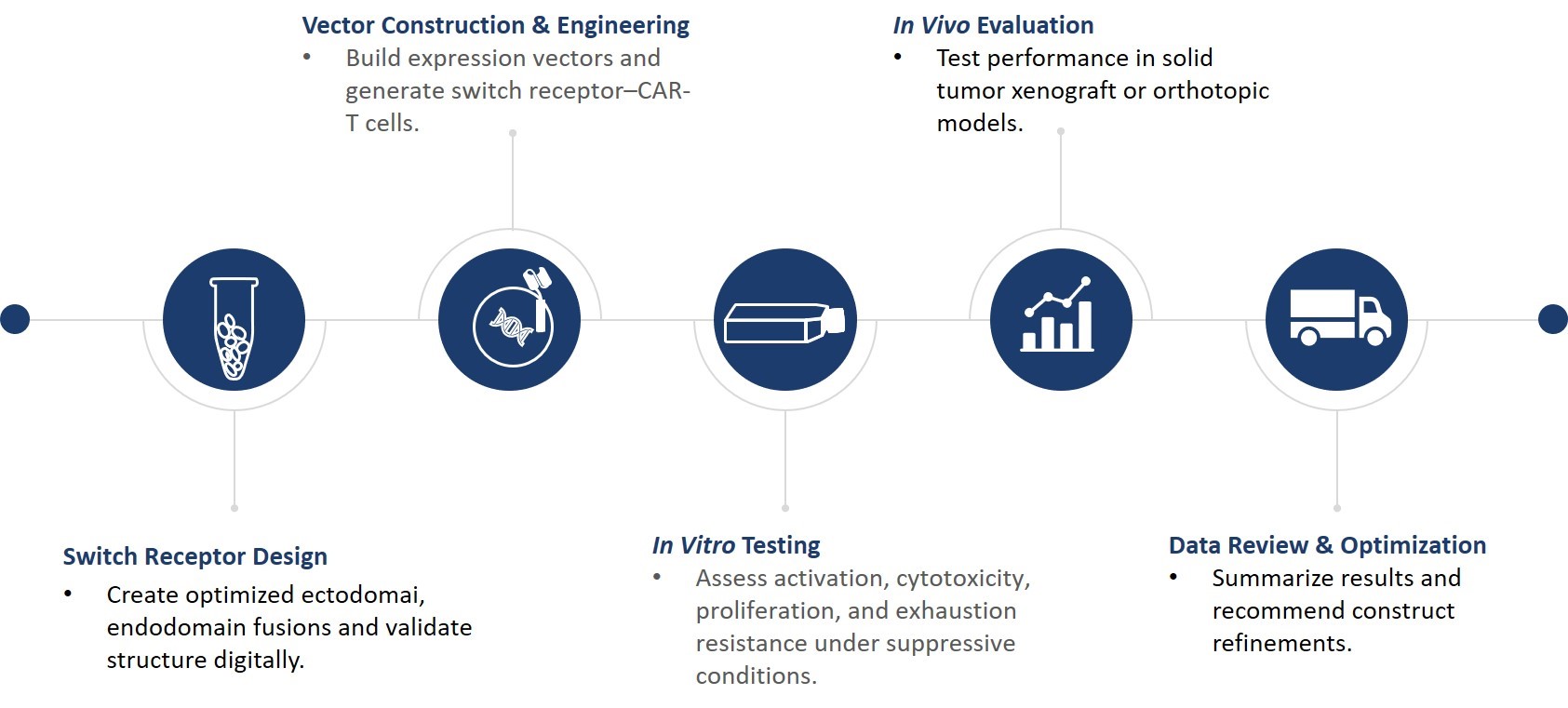
Switch receptors enable a proactive reprogramming of the TME by inverting suppressive signals into stimulatory cascades. Creative Biolabs integrates this approach into a comprehensive development pipeline:
Our teams design modular switch receptors that fuse ligand-binding domains with potent costimulatory endodomains. These constructs help ensure CAR-T activation even in cytokine-rich, immunosuppressive tumor beds. Projects requiring high-fidelity customization, dual-switch combinations, or tumor-specific activation logic benefit from our rational architecture design and codon-optimized constructs.
Each engineered CAR-T candidate undergoes rigorous functional evaluation, including resistance to TGF-β/IL-4 suppression, PD-L1–induced activation profiling, and assays measuring cytokine secretion, proliferation, and exhaustion marker reduction. These data-supported workflows provide evidence-driven decisions for pipeline advancement.
Creative Biolabs assists with translational-scale production, safety modules, and documentation tailored for regulatory submission. Teams planning to progress toward animal studies often rely on our experience across solid tumor models, including orthotopic and TME-integrated xenografts.
Discover How We Can Help - Request a Consultation.
The required starting materials include target tumor information detailing suppressive ligand expression, detailed project goals specifying car constructs and efficacy requirements, and source material specifications for T-cells or cell lines.
This study addresses two major limitations of CAR-T cell therapy: its toxicity to healthy tissues and the poor persistence of the therapeutic cells. The researchers developed an innovative switch receptor called T3/28. CAR-T cells equipped with this receptor showed reduced exhaustion, enhanced proliferation, and significantly longer-lasting anti-tumor activity in a mouse model of lymphoma, offering a promising strategy to improve the durability and safety of this cancer treatment.
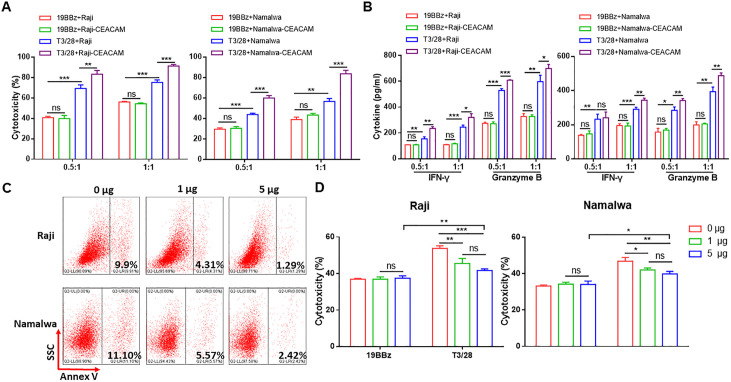
Fig.1 Switch receptors to enhance the cytotoxicity of CAR-T cells.1
How do switch receptors improve CAR-T performance in solid tumors?
Switch receptors convert suppressive ligands into activating signals, enabling CAR-T cells to proliferate and function within cytokine-rich TME conditions. This strategy benefits projects struggling with T-cell exhaustion or weak persistence.
Can switch receptors be combined with standard CAR architectures or other enhancements?
Yes. They are compatible with second and third-generation CARs and can operate alongside cytokine armoring, checkpoint-resistant designs, or logic-gated systems. Teams exploring multi-modality engineering can request integrated design recommendations.
What tumor types are most suitable for switch receptor–based CAR-T therapy?
Tumors with high levels of TGF-β, IL-4, IL-10, or PD-L1 expression, such as pancreatic, lung, colorectal, and ovarian cancers, show strong potential. Creative Biolabs can help evaluate ligand expression profiles to guide construct selection.
Creative Biolabs provides a full suite of capabilities for Solid Tumor Targeting CAR-T Development using Switch Receptors, including custom receptor construction, comprehensive functional testing, and translational support. This service empowers research teams to overcome TME challenges and advance more potent CAR-T candidates. For personalized guidance, contact our scientific team at any stage to discuss your study's needs.
Reference
For any technical issues or product/service related questions, please leave your information below. Our team will contact you soon.
All products and services are For Research Use Only and CANNOT be used in the treatment or diagnosis of disease.
 NEWSLETTER
The latest newsletter to introduce the latest breaking information, our site updates, field and other scientific news, important events, and insights from industry leaders
LEARN MORE NEWSLETTER NEW SOLUTION
CellRapeutics™ In Vivo Cell Engineering: One-stop in vivo T/B/NK cell and macrophage engineering services covering vectors construction to function verification.
LEARN MORE SOLUTION NOVEL TECHNOLOGY
Silence™ CAR-T Cell: A novel platform to enhance CAR-T cell immunotherapy by combining RNAi technology to suppress genes that may impede CAR functionality.
LEARN MORE NOVEL TECHNOLOGY NEW SOLUTION
Canine CAR-T Therapy Development: From early target discovery, CAR design and construction, cell culture, and transfection, to in vitro and in vivo function validation.
LEARN MORE SOLUTION