Introduction to Opsonization
Opsonization is a means of facilitating the cell phagocytosis and cell-receptor binding by coating specific particles with different proteins. Opsonization of microorganisms usually occurs at the binding of immunoglobulin G (IgG) and target epitopes of surface antigens. Afterward, the complement system will be activated by different complement pathways, including interacting with microbial polysaccharides by using the alternative pathway, interacting with IgG or IgM molecules to bind bacteria by using the classic pathway. Moreover, Pilot studies have shown that antibodies and complement components play an important role in mediating the opsonization of particles. Opsonization in complement system is capable of recruiting and activating a number of cells, such as complement complement therapeutic target-C3a, complement therapeutic target-C5a, and therapeutic target C5b-9. In addition, iC3b and bind C3b can be recognized by specific receptors, such as CR3 identified on many phagocytic cells, CR4 and gp150 found in both lymphocytes and phagocytes, as well as CR1 selectively bind C3b with high affinity.
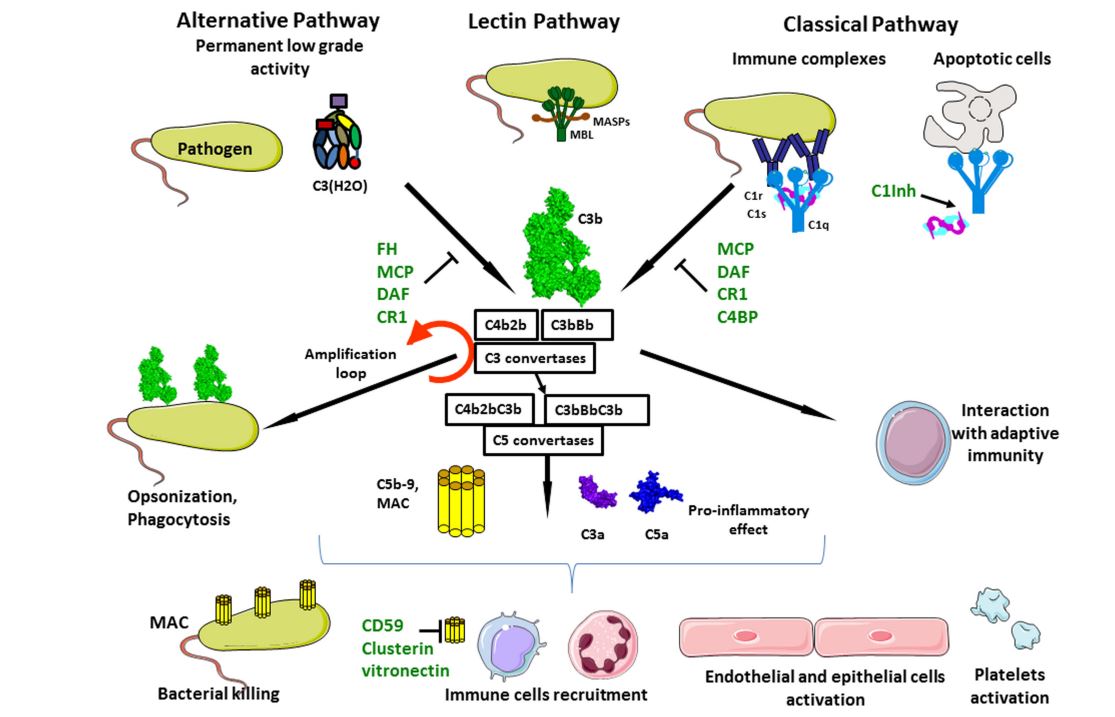
Fig. 1 Complement activation.1, 2
The opsonization Relationship to Diseases
Opsonization is a critical process for cell processing that has been widely studied in the past few years. Due to the key role in cell phagocytosis and the immune system, the opsonization in a number of diseases models has been widely studied. For instance, more recent studies have indicated that serum opsonization of E. coli and yeasts have been observed in many patients with chronic liver diseases. In particular, the opsonization can be reduced in patients suffering from chronic active hepatitis. In addition, recent reports have shown that the defect of opsonization can be related to the low expression levels of specific complement factors in complement pathways. As a result, the deficiency of opsonization may improve the chance of bacterial infection in patients with chronic active hepatitis.
Role of Complement System in Mediated Opsonization
Opsonization is a key process for enhancing the capacity of particle destruction by cell phagocytosis. Previous studies have revealed that opsonization enables eliminate dead cells or various types of pathogens in mammals. As a result, Opsonization has been regarded as the main step for phagocytosis, which making the pathogens more easily identified by the phagocyte. Meanwhile, recent researchers have demonstrated that complement is also involved in pathogen opsonization. Different microorganisms require particular complement pathways for activating complement cascade to regulate the activity of T cells and B cells, as well as trigger immune responses against inflammatory diseases or infections. For example, the complement molecules bind C3b, C4b therapeutic and C1q have been widely used as opsonins for the opsonization process. Furthermore, opsonization with antibodies of different types refers to IgG, IgE, and IgA will improve the efficacy of macrophages to destroy viruses.
Creative Biolabs offers a full range of complement component-related services and products. If you’d like to know more information, please directly contact us.
References
-
Merle, Nicolas S., et al. "Complement system part II: role in immunity." Frontiers in immunology 6 (2015): 257.
-
under Open Access license CC BY 4.0, without modification
Related Product
For Research Use Only.
Related Sections: