ADGRD1 analysis is essential for confirming its expression and function as a potential therapeutic target. By precisely quantifying ADGRD1 levels and assessing its activation status, researchers can validate its role in disease pathology.
At Creative Biolabs, we offer a variety of strategic options to help clients navigate the complexities of biomarker research and accelerate drug discovery. Our comprehensive ADGRD1 analysis solutions are designed to provide the precise, actionable data you need to drive your project forward.
Introduction of ADGRD1
Adhesion G protein-coupled receptor D1 (ADGRD1), also known as GPR133, is a member of the adhesion GPCR family and an oncogene in various cancers, particularly glioblastoma (GBM). Its activation mechanism involves autoproteolytic cleavage, which forms N-terminal (NTF) and C-terminal (CTF) fragments that remain associated. Activation is initiated by the interaction between an endogenous agonist sequence and the receptor's transmembrane domains, a process that can be modulated by lipid binding.
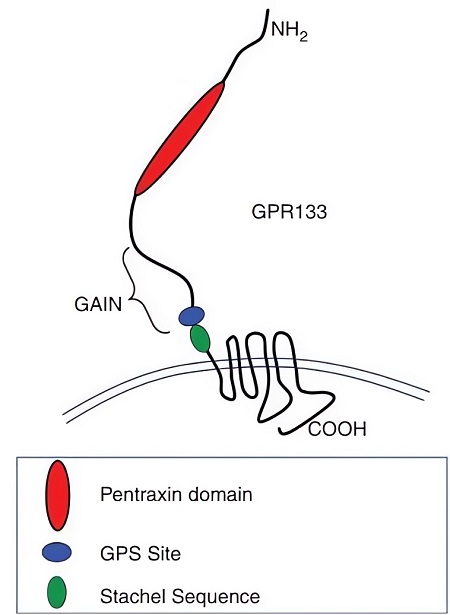 Fig.1 Schematic of ADGRD1 structure.1
Research highlights ADGRD1's critical role in GBM. Studies show its expression is necessary for tumor growth, and its knockdown impairs tumor initiation in vitro and in vivo. ADGRD1 is expressed de novo in GBM but not in healthy brain tissue, and its expression correlates with glioma grade. This selective expression makes it an ideal candidate for targeted therapies, such as anti-ADGRD1 antibodies to deliver antibody-drug conjugates (ADCs). Beyond oncology, ADGRD1 is also being explored for its roles in osteoporosis, making it a key biomarker.
ADGRD1 Analysis Services at Creative Biolabs
Creative Biolabs provides a comprehensive suite of ADGRD1 analysis services to meet your project's specific needs. We have developed high-quality ADGRD1 antibodies, including proprietary polyclonal antibodies, for use in various scientific applications such as IHC, WB, and ICC. We also offer personalized recombinant antibody expression services, allowing us to create tailored reagents for your unique research goals. Our deep expertise enables us to fully explore the biological significance of ADGRD1.
Our key analytical services include but are not limited to the following:
- Cell-Based Functional Assays
These assays analyze ADGRD1's signaling pathways and cellular responses to better understand its function within a biological context.
- Ligand-Receptor Binding Assays
We precisely measure the binding affinity and kinetics between ADGRD1 and potential ligands to identify and validate new therapeutic candidates.
- ADGRD1 Profiling Service
Our detailed profiling provides a comprehensive overview of ADGRD1 expression and post-translational modifications, offering valuable insights for biomarker development.
- Expression Analysis
We quantify ADGRD1 expression levels in different samples, which is crucial for determining its role in disease pathology and its potential as a diagnostic marker.
Service Workflow
Our streamlined ADGRD1 analysis workflow ensures a seamless process from start to finish, providing a clear and efficient path for your research project.
01Initial Consultation
Our scientific team begins with a comprehensive consultation to understand your specific project goals and technical requirements. This allows us to design a tailored experimental strategy.
02Material Submission
You provide the necessary starting materials, which can include cell lines, fresh or frozen tissue samples, or purified proteins. We ensure proper handling and quality control of all submitted materials.
03Analysis Execution
Our team then conducts the specified ADGRD1 analysis using state-of-the-art platforms for advanced techniques like WB, flow cytometry, or ELISA.
04Progress Tracking
We provide regular, transparent updates on the project's progress, ensuring you are always informed and can address any questions.
05Final Report Delivery
The project concludes with a detailed, professional report. This includes all raw data, comprehensive analysis results, and our expert interpretation of the findings to help you accelerate your research.
Applications
Target Identification & Validation
Biomarker Discovery & Diagnostics
Given its selective expression in GBM, ADGRD1 analysis can serve as a diagnostic biomarker. Profiling ADGRD1 expression in patient samples can aid in disease staging, prognosis prediction, and patient stratification for clinical trials.
Therapeutic Development
For drug development programs, ADGRD1 analysis is critical for developing and testing targeted therapies. This includes evaluating the binding affinity of anti-ADGRD1 antibodies or assessing the efficacy of small-molecule inhibitors in modulating ADGRD1 signaling.
Understanding Disease Mechanisms
By using functional assays and expression analysis, researchers can gain insight into the role of ADGRD1 in a wide range of biological processes. This helps in understanding the fundamental mechanisms driving cancer progression and other related pathologies.
Service Highlights
- Expert Consultation: Our team provides professional guidance for your ADGRD1 analysis projects. We help you design the most effective experimental strategies to achieve your research objectives.
- Validated Reagents: We use and provide our proprietary, high-quality ADGRD1 antibodies. These reagents have been rigorously validated across multiple applications to ensure accurate and reliable results every time.
- Customized Solutions: We tailor our ADGRD1 analysis services to your specific research needs. From specialized functional assays to custom expression profiling, we offer flexible solutions.
- High-Impact Data: Our services deliver reproducible and reliable data that meets the highest scientific standards. This provides the confidence you need for publication and regulatory submissions.
FAQs
-
How do you validate your ADGRD1 antibodies?
Our ADGRD1 antibodies undergo a rigorous, multi-step validation process. We perform comprehensive and extensive testing using multiple complementary techniques, such as Western Blotting and Immunohistochemistry, to meticulously confirm their specificity and optimal performance, ensuring consistent results across different lots.
-
Can you perform ADGRD1 analysis on patient-derived xenografts?
We can perform ADGRD1 analysis on patient-derived xenografts. Our assays are specifically optimized for these complex samples, leveraging our extensive experience to ensure highly accurate and meaningful results for your research.
-
Is your ADGRD1 analysis quantitative or qualitative?
We can provide both quantitative and qualitative analysis. Techniques such as ELISA and WB offer precise quantification, while IHC provides qualitative localization data to visualize protein distribution.
-
Do you offer services to identify ADGRD1 ligands?
We can offer services to help identify ADGRD1 ligands. Our personalized functional assays and binding assays are designed to explore receptor-ligand interactions, including both endogenous and novel compounds.
-
What controls are used in your ADGRD1 analysis assays?
Our analysis assays include all necessary controls. We use appropriate negative and positive controls to ensure the validity and reliability of every experiment, confirming the integrity of the data generated.
-
What is the minimum amount of sample required for your services?
The minimum amount of sample required for our services varies. We will discuss the specific sample requirements for your chosen analysis method during our initial project consultation, working with you to accommodate your available materials.
-
Can you develop a custom ADGRD1 assay for our specific application?
We can develop custom ADGRD1 assays. Our team specializes in creating bespoke solutions tailored to the unique requirements of your research or drug development program.
If you cannot find the service you're looking for, contact us today to develop custom solution for specific needs at Creative Biolabs.
Reference
- Frenster, Joshua D., et al. "Expression profiling of the adhesion G protein-coupled receptor GPR133 (ADGRD1) in glioma subtypes." Neuro-oncology advances 2.1 (2020): vdaa053. Distributed under Open Access license CC BY 4.0. The image was modified by extracting and using only part of the original image. https://doi.org/10.1093/noajnl/vdaa053
For Research Use Only.