We offer an end-to-end solution from initial project design and sequence analysis to complex receptor-ligand binding assays and data interpretation.
Are you currently facing challenges in detecting low-abundance membrane receptors or maintaining the structural integrity of complex GPCRs during analysis? Our AGTR2 Analysis Services help you streamline the characterization of the Angiotensin II Type 2 Receptor to unlock its therapeutic potential in cardiovascular and regenerative medicine. Through Creative Biolabs’ high-sensitivity immunoassay platforms and advanced protein stabilization techniques, we provide precise quantitative and qualitative data to move your project from the lab to the clinic faster.
Contact our team to get an inquiry now!
Introduction of AGTR2: Structural Insights and Biological Significance
The Angiotensin II Type 2 Receptor (AGTR2) is a critical member of the G protein-coupled receptor (GPCR) family, primarily known for its role in counteracting the effects of the AGTR1 receptor within the renin-angiotensin system (RAS). Structurally, AGTR2 consists of seven transmembrane alpha-helices. Unlike AGTR1, which mediates vasoconstriction and inflammation, AGTR2 is highly expressed during fetal development and plays a pivotal role in vasodilation, anti-proliferation, and neuroprotection in adults.
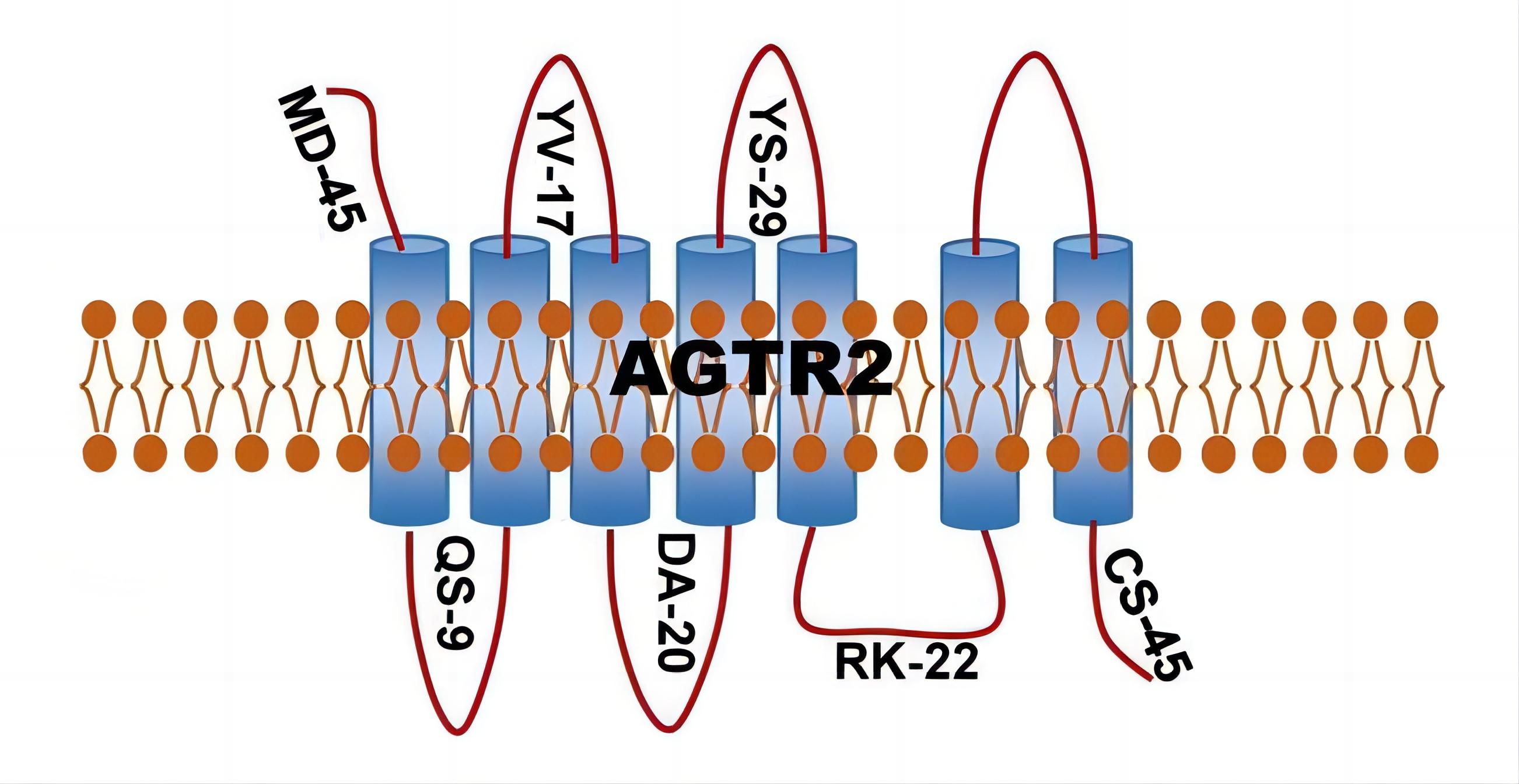 Fig.1 Structure of AGTR2.1
Scientific literature concludes that AGTR2 activation triggers signaling pathways involving protein phosphatases (e.g., MKP-1) and the production of nitric oxide (NO) and cyclic GMP (cGMP). These pathways are essential for tissue repair and inhibiting hypertrophic growth in cardiac cells. Recent research published in genetic and biochemical journals highlights its association with various pathologies, including hypertension, myocardial infarction, and even certain cognitive disorders. Understanding the precise expression levels and functional status of AGTR2 is therefore paramount for developing next-generation therapeutic agonists.
Application: Targeted Research and Clinical Development
Creative Biolabs' analysis services are designed to support a wide range of research objectives, focusing on the functional and structural aspects of the receptor:
- Drug Screening and Lead Optimization: Evaluating the binding affinity and efficacy of novel small molecules or biologics targeting AGTR2 using high-throughput screening.
- Cardiovascular Disease Research: Investigating receptor expression patterns in hypertensive or hypertrophic tissue models to identify restorative mechanisms.
- Neurological Studies: Analyzing the neuroprotective role of AGTR2 in stroke recovery and neurodegenerative disease models.
- Oncology and Cell Proliferation: Studying the anti-proliferative signaling of AGTR2 in various tumor cell lines where the RAS system is dysregulated.
- Biomarker Discovery: Quantifying soluble or membrane-bound AGTR2 in patient samples for potential use as a diagnostic or prognostic indicator.
Service Highlights
Creative Biolabs provides specialized expertise in GPCR analysis, ensuring that your AGTR2 projects benefit from industry-leading precision. Our service highlights include:
One-Stop Service
High-Affinity Detection Reagents
Our proprietary antibodies used in the analysis are optimized for high specificity toward the AGTR2 extracellular domains, minimizing cross-reactivity with AGTR1.
Guaranteed High Purity and Sensitivity
Utilizing advanced detergent-free stabilization methods, we ensure that the receptor remains in its native conformation, providing "Published Data" quality results even in challenging matrices.
Comprehensive QC Analysis
Every analysis undergoes rigorous validation via SDS-PAGE, Western Blot, and ELISA to ensure the highest standards for reproducibility and accuracy.
Powered by Proven Technology
Our platform leverages ultrasensitive detection technologies capable of identifying AGTR2 at picogram levels in tissue lysates.
Expert Technical Consultation
Our Ph.D.-level scientists provide dedicated support, helping you interpret complex signaling data and refine your experimental parameters.
Service Workflow
01Initial Consultation and Project Design
The process begins with a detailed meeting where our team discusses your specific goals, such as determining receptor density or identifying signaling cross-talk. This phase establishes the customized analytical strategy and project timeline.
02Sample Processing and Quality Control
Upon receipt, your materials undergo stringent QC. We perform total protein quantification and integrity checks to ensure that the starting material is suitable for high-resolution GPCR analysis.
03Assay Development and Optimization
Our experts select the most appropriate detection platform (e.g., IHC, Flow Cytometry, or Surface Plasmon Resonance). We optimize buffer conditions and reagent concentrations to maximize the signal-to-noise ratio for AGTR2 detection.
04Data Acquisition and Analysis
Using our state-of-the-art laboratory infrastructure, we perform the core analysis. Whether it is a binding kinetic study or a spatial expression map, data is acquired through multiple replicates to ensure statistical significance.
05Final Report and Consultation
The project concludes with a comprehensive report including raw data, processed graphs, and expert interpretation. We then hold a follow-up consultation to discuss the findings and how they impact your subsequent drug development steps.
FAQs
-
How can AGTR2 be accurately distinguished from the highly similar AGTR1 receptor in co-expression models?
Precise differentiation relies on monoclonal antibodies targeting divergent epitopes, typically within the N-terminal tail or the second extracellular loop (ECL2), where amino acid sequence homology between AGTR1 and AGTR2 is lowest. In functional studies, the use of selective non-peptide antagonists, such as PD123319 for AGTR2 and Losartan for AGTR1, validates receptor-specific signaling through competitive inhibition assays.
-
What methodologies enable the detection of AGTR2 in adult tissues where expression is naturally downregulated?
Detection in low-abundance environments requires ultrasensitive proteomic techniques. Signal amplification methods can visualize rare receptor events. Additionally, enrichment of the plasma membrane fraction via ultracentrifugation increases the relative concentration of the receptor for Western blot or mass spectrometry analysis.
-
Are mammalian cell systems required for the characterization of recombinant AGTR2, or are alternative hosts viable?
While mammalian systems like HEK293 or CHO are preferred for maintaining native post-translational modifications (PTMs) such as N-glycosylation, alternative hosts like Sf9 insect cells are viable for structural biology. However, since AGTR2 function is sensitive to membrane cholesterol content and specific lipid environments, the choice of host must account for the specific PTM requirements and lipid compositions necessary for G-protein coupling.
-
Which biochemical strategies are most effective for stabilizing the AGTR2 seven-transmembrane structure during extraction?
Stabilization is achieved through the use of mild, non-denaturing detergents or synthetic membrane mimetics. Technologies such as Nanodiscs (phospholipid bilayers encircled by membrane scaffold proteins) or Styrene Maleic Acid Lipid Particles (SMALPs) allow the receptor to be extracted directly from the cell membrane with its surrounding lipid annulus intact, preserving the active tertiary conformation and ligand-binding pocket.
-
What factors determine the experimental duration for a comprehensive receptor characterization study?
The timeline is governed by the specific complexity of the biological matrix and the required validation depth. Factors include the optimization of binding kinetics (koff/kon rates), the time required for stable cell line generation if endogenous levels are insufficient, and the rigorous cross-validation across multiple platforms to ensure data reproducibility and statistical power.
Creative Biolabs is dedicated to providing the most accurate and comprehensive AGTR2 Analysis Services in the industry. Our combination of expert scientific knowledge, advanced technological platforms, and a commitment to quality ensures that your research into the Renin-Angiotensin System yields reliable, high-impact results. From basic research to clinical trial support, we are your partner in biological excellence.
Reference
- Liu, Xiaoyan et al. "Pre-miRNA Hsa-Let-7a-2: a Novel Intracellular Partner of Angiotensin II Type 2 Receptor Negatively Regulating its Signals." International journal of biological sciences vol. 18,8 3237-3250. 1 May. 2022, Distributed under Open Access license CC BY 4.0, without modification. https://doi.org/10.7150/ijbs.70455
For Research Use Only.