ATR plays important roles in the DNA damage, multiple signaling pathways, and inhibition of ATR can improve the effectiveness of cancer therapy. Creative Biolabs has been focusing on the research of ATR biomarker for years to support cancer diagnosis research.
ATR Function and Signal Pathway
ATR kinase is one of the major kinases in DNA damage response signaling pathway, responding to replication stress and DNA damage caused by various genotoxic substances, such as chemotherapy, radiation, ultraviolet. Activated ATR kinase regulates multiple cellular responses through signaling pathways, including cell cycle arrest, inhibition of replication initiation, promotion of deoxynucleotide synthesis, initiation of replication forks, and repair of DNA double-strand breaks.
In those signal pathways ATR kinase will be activated rapidly and directly phosphorylates more than 1000 important substrates in cells including the onco-suppressor gene p53 encoding protein, cell cycle regulation protein, etc.
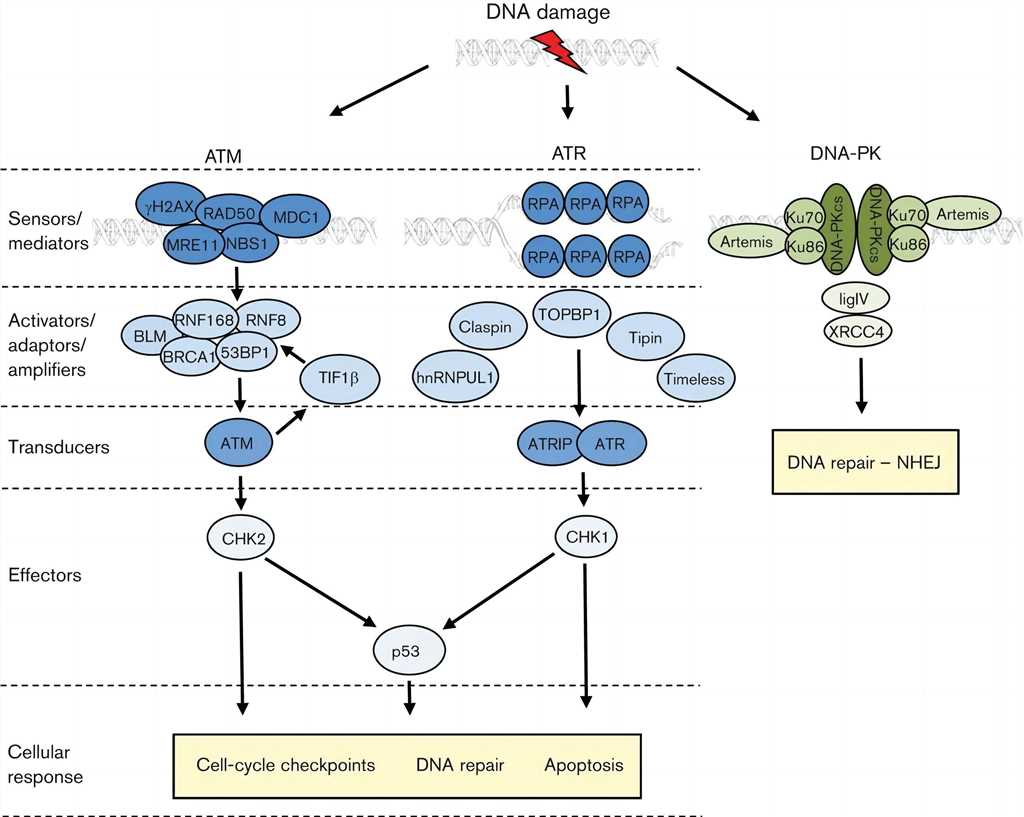 Fig.1 Schematic of the ATR pathway.
ATR Inhibitors
ATR inhibitors are small molecule inhibitors that target ATR kinase, and respond to replication stress by phosphorylation of checkpoint kinase 1 (CHK1), triggering cell cycle arrest at S, G2 and M stages. Many studies have found that ATR inhibitors can selectively affect tumor cells with little interference on normal cells. With this feature, ATR inhibitors are expected to be excellent potential drugs for tumor therapy.
ATR inhibitors alone have limited antitumor efficacy in cancer treatment. Therefore, combining ATR inhibitors with other DNA damage drugs, radiation therapy, and targeted anti-tumor agents based on the principle of synthetic lethality can achieve a superimposed anti-tumor effect.
The following is a brief description of several ATR inhibitors and their effects:
Is the first ATR kinase inhibitor to enter clinical trials, and it shows strong cytotoxic activity against cancer cell lines with ATM kinase defects, but has no effect on normal cells.
It has shown better antitumor activity in P53, ATM kinase deficient models and has been used in trials evaluating the treatment of advanced, relapsed, drug-resistant, and metastatic cancers.
The most effective oral ATR kinase inhibitor reported so far. By effectively inhibiting the phosphorylation of CHK1 driven by ATR kinase, thereby blocking the signal transduction caused by DNA damage and leading to cell death, it has significant antitumor activity.
Is an oral ATR kinase inhibitor that has demonstrated significant antitumor effects on human pancreatic and colon cancer xenograft and patient derived xenograft (PDX) tumors in situ ovary.
Services Provided by Creative Biolabs
ATR and ATP inhibitors play an important role in the genesis, development, and treatment of tumors survival and induces the death of ATR pathology-dependent malignant tumor cells. Creative Biolabs provides one-stop ATR and ATR inhibitors analysis services which can be customized to suit the specific needs of our clients. Popular analysis services targeting ATR include but not limited to the following:
| Cat | Service |
|---|---|
| BAS120-1 | ATR Antibody Development |
| BAS120-2 | ATR Protein Expression |
| BAS120-3 | ATR-KO Cell Line Construction |
| BAS120-4 | ATR Gene Analysis |
| BAS120-5 | ATR Immunohistochemistry Assay |
| Cat | Service |
|---|---|
| BAS120-6 | ATR Inhibitor Screening Assay |
| BAS120-7 | ATR Protein Inhibitory Activity Assay |
| BAS120-8 | ATR Compound Analysis |
| BAS120-9 | ATR DNA-Damaging Cytotoxic Analysis |
| BAS120-10 | ATR Apoptosis Assay |
We are committed to providing the highest quality of custom services and products at the most reasonable prices. Please feel free to contact us for more information and a formal quote.
For Research Use Only.