
Alpha-Naphthylisothiocyanate (ANIT) induced Acute Liver Injury Modeling & Pharmacodynamics Service
Creative Biolabs offers a variety of well-established models to evaluate Acute Liver Injury, ensuring accurate and reproducible results for drug efficacy testing. Our expert team is committed to providing customized solutions for your research needs.
Introduction
Acute liver injury (ALI) refers to a rapid deterioration of liver function, often characterized by hepatocyte death, inflammation, and potential liver failure. It is a severe condition that can result from various causes, including drug toxicity (such as acetaminophen overdose), viral infections, ischemia, and toxins like alcohol or certain chemicals. ALI can progress to chronic liver diseases like fibrosis or cirrhosis if not properly managed, making it a significant area of medical concern. In preclinical research, animal models play a crucial role in understanding the underlying mechanisms of liver injury and in evaluating potential therapeutic interventions. These models help mimic the pathophysiology of human liver diseases, providing insights into drug efficacy, safety, and the mechanisms involved in liver regeneration and repair. Among these, the ANIT (Alpha-naphthylisothiocyanate) induced liver injury model is widely used to simulate cholestasis and drug induced liver toxicity, offering a reliable tool for testing hepatoprotective agents.
Disease Models and Applications
The Alpha-naphthylisothiocyanate (ANIT) induced Acute Liver Injury Model is a well-established experimental model used to simulate cholestatic liver injury, often seen in human drug induced liver diseases. ANIT, a chemical compound, is administered to rodents to induce acute liver damage by inhibiting bile acid transporters, which leads to the accumulation of bile in hepatocytes, resulting in liver cell injury, inflammation, and necrosis. This model closely mimics the pathophysiological features of cholestasis and hepatotoxicity in humans. One of its main advantages is the reproducibility and consistency of the induced injury. However, its limitation is that it does not fully replicate all aspects of human liver diseases, particularly the progression to chronic liver failure. It is, however, an excellent tool for evaluating the early-stage therapeutic effects of potential liver-protective drugs.
- Simulates: The Alpha-naphthylisothiocyanate (ANIT) induced Acute Liver Injury Model simulates cholestatic liver injury and drug induced liver toxicity. It accurately mimics the early stages of liver injury characterized by inflammation, hepatocyte damage, and the onset of cholestasis.
- Evaluates Drugs: This model is commonly used to evaluate drugs that aim to mitigate liver injury, such as anti-inflammatory, anti-fibrotic, and hepatoprotective agents. It is also used to assess the efficacy of compounds that regulate bile acid metabolism and reduce liver damage associated with cholestasis.
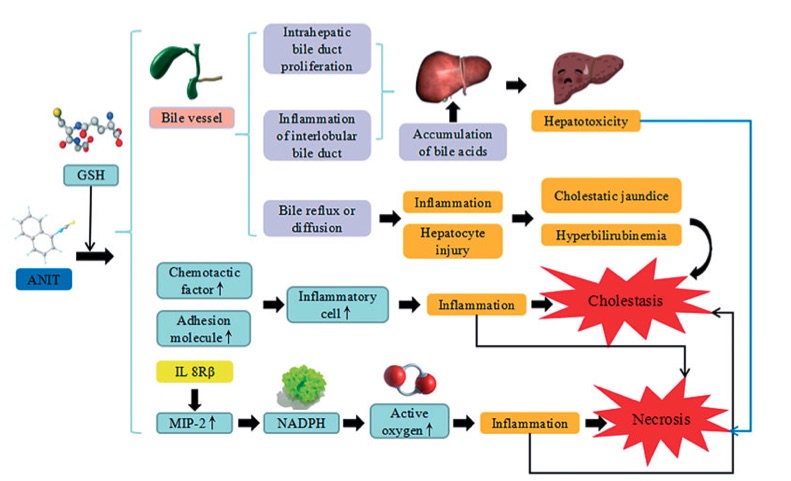 Fig. 1 ANIT induced liver injury.1
Measurements
To assess the therapeutic effects of drugs in the Alpha-naphthylisothiocyanate (ANIT) induced Acute Liver Injury Model, we offer a comprehensive range of measurements and analysis methods:
- General observations: body weight, survival rate, liver function parameters (e.g., ALT, AST), and histopathological examination of liver tissues.
- Immunohistochemistry: Detection of liver inflammation, immune cell infiltration (e.g., neutrophils, macrophages), and tissue injury markers.
- Cytokine profiling: Levels of inflammatory mediators such as TNF-α, IL-1β, and IL-6.
- Liver biomarkers: Serum ALT, AST, alkaline phosphatase (ALP), and bilirubin levels.
- Gene/protein expression: RT-PCR and Western blot to examine liver damage markers, oxidative stress, and inflammatory signaling pathways.
Our scientific team can assist with experimental design and data interpretation to ensure the most relevant and accurate outcomes for your research.
Related Services
In addition to the ANIT induced Acute Liver Injury Model, we offer other liver injury models, including those induced by CCl4, acetaminophen, and ischemia/reperfusion injury. These models provide diverse options for studying different mechanisms of liver damage and evaluating novel therapeutics.
- CCL4 induced Acute Liver Injury Model
- Concanavalin A (Con A) induced Acute Liver Injury Model
- Polyinosinic: Polycytidylic Acid induced Acute Liver Injury Model
- Acetaminophen (APAP) induced Acute Liver Injury Model
- Alcohol induced Acute Liver Injury Model
- Ischemia-Reperfusion induced Liver Injury Model
- DDC (3,5-Diethoxycarbonyl-1,4-Dihydrocollidine) induced Acute Liver Injury Model
Advantages
- Comprehensive model selection: A Wide range of established and custom animal models for liver injury.
- Expert support: Our experienced team assists with every stage, from experimental design to data interpretation.
- Reliable results: Robust and reproducible models ensure high-quality, consistent data.
- Cutting-edge technologies: We utilize advanced diagnostic tools and techniques to provide accurate and detailed analysis.
- Tailored solutions: Custom model development based on specific research needs or therapeutic targets.
Work with Us
- Summarize the project requirements and fill in the information collection form.
- Sign a CDA from both parties to further communicate information, such as targets.
- Select an animal model, discuss experimental design, and determine assay parameters.
- Project costing and project schedule forecasting.
- We provide a detailed project plan, including the required sample quantities, methods, and protocols.
- Both parties confirm the project details and start the project.
- Confirm the timeline of the project.
- We provide periodic results and information on the animal's condition.
- We will work together to make project adjustments as necessary.
- We provide a comprehensive project report promptly.
- We arrange transportation for the produced samples.
- We provide a discussion of the project results and help to arrange the next steps.
- Data storage and archiving.
FAQs
-
1. What is the significance of the ANIT induced model for liver research?
The ANIT induced model is significant for studying cholestatic liver diseases, which are common in drug induced liver injury and certain genetic disorders. It allows for the evaluation of drug efficacy in protecting the liver from bile acid induced damage.
-
2. Can this model be used for chronic liver disease studies?
While primarily used for acute liver injury, the ANIT model can provide insights into early liver damage and inflammatory pathways that may contribute to the progression of chronic liver diseases. However, it is not ideal for studying fibrosis or cirrhosis.
-
3. How long does it take to see results from this model?
Typically, acute liver injury and associated symptoms can be observed within 24-48 hours post-ANIT administration, with peak injury markers detectable in the serum and liver tissue.
Published Data
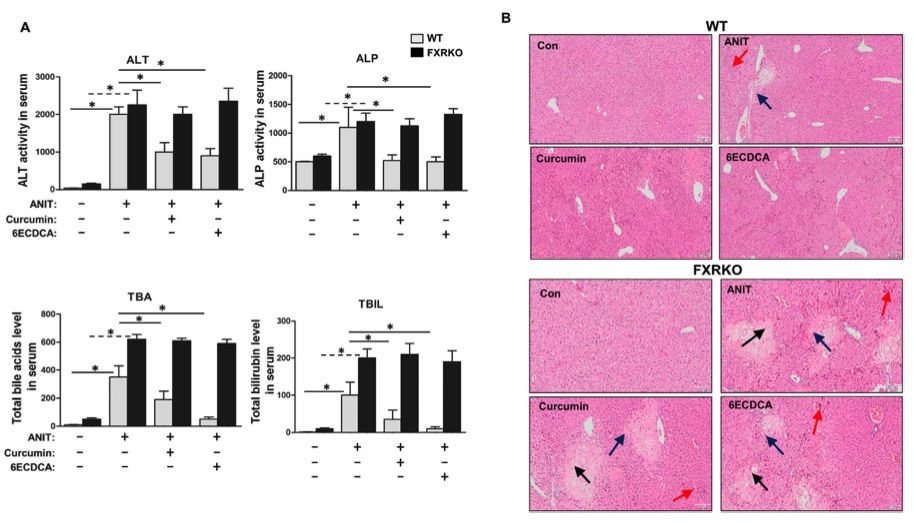 Fig. 2 Curcumin protected ANIT induced liver injury with cholestasis in the presence of FXR by biochemical and histological analysis. 2
Curcumin has been shown to activate FXR in vitro, prompting further investigation into its potential to mitigate cholestasis symptoms through FXR activation in vivo. The protective effects of curcumin against ANIT induced liver injury were evaluated using biochemical and histological analyses. In wild-type (WT) mice, serum levels of cholestasis markers, including ALT, ALP, TBA, DBIL, and TBIL, were significantly elevated following ANIT administration. However, pretreatment with curcumin or 6ECDCA, an FXR agonist, effectively reduced the elevation of these biochemical markers (Fig. 2A). In contrast, no reduction in these markers was observed in FXR knockout (FXRKO) mice, suggesting the involvement of FXR in curcumin's protective effects. Histological examination revealed that ANIT induced liver damage, characterized by inflammatory infiltration and parenchymal necrosis, was alleviated by curcumin or 6ECDCA pretreatment in WT mice (Fig. 2B). However, FXRKO mice exhibited more severe liver injury compared to WT mice after ANIT treatment, and neither curcumin nor 6ECDCA provided protection in these mice (Fig. 2B). These findings indicate that curcumin alleviates ANIT induced cholestasis primarily through activation of FXR.
References
- Zhang, Hong Yang et al. "Molecular mechanism and research progress on pharmacology of traditional Chinese medicine in liver injury." Pharmaceutical biology vol. 56,1 (2018): 594-611. DOI:10.1080/13880209.2018.1517185. Distributed under an Open Access license CC BY 4.0, without modification.
- Yang, Fan et al. "Curcumin protects ANIT induced cholestasis through signaling pathway of FXR-regulated bile acid and inflammation." Scientific Reports vol. 6 33052. 14 Sep. 2016, DOI:10.1038/srep33052. Distributed under an Open Access license CC BY 4.0, without modification.
For Research Use Only.