
Pseudotyping Service of Lentiviral Vectors with Filovirus
Lentiviral vectors pseudotyped with filovirus envelope glycoproteins—derived from Zaire ebolavirus (EBOV-GP) or Marburg virus (MARV-GP)—constitute a next-generation delivery platform that marries the expansive cellular tropism conferred by Niemann–Pick C1 (NPC1)–dependent entry with the high-capacity, self-inactivating architecture of HIV-1-derived genomes. EBOV-GP and MARV-GP exhibit a metastable prefusion conformation and low-pH-triggered class-I fusion kinetics, enabling rapid, high-efficiency transduction of quiescent macrophages, dendritic cells, and terminally differentiated neurons that remain recalcitrant to VSV-G or MLV pseudotypes. Recent structure-guided remodeling of the filoviral receptor-binding domain—via loop truncation, glycan shield augmentation, and charge-neutralization mutagenesis—has broadened the tropism spectrum beyond canonical NPC1 engagement to encompass alternative endosomal receptors, while simultaneously eliminating residual cytotoxic signatures. When these engineered envelopes are packaged with third-generation lentiviral genomes bearing codon-optimized gag-pol, cPPT/CTS central polypurine tracts, and microRNA detargeting cassettes, the resulting vectors achieve high titers, negligible replication-competent lentivirus formation, and integration landscapes devoid of oncogenic hotspots. Consequently, filovirus-pseudotyped lentiviral particles have emerged as the vector of choice for lineage-tracing studies in primary human myelopoiesis, large-payload gene-replacement strategies exceeding 9 kb under CAG or EF1α promoters, and CRISPR activation screens in patient-derived microglial organoids where broad tropism and durable, inducible expression are concurrently mandated.
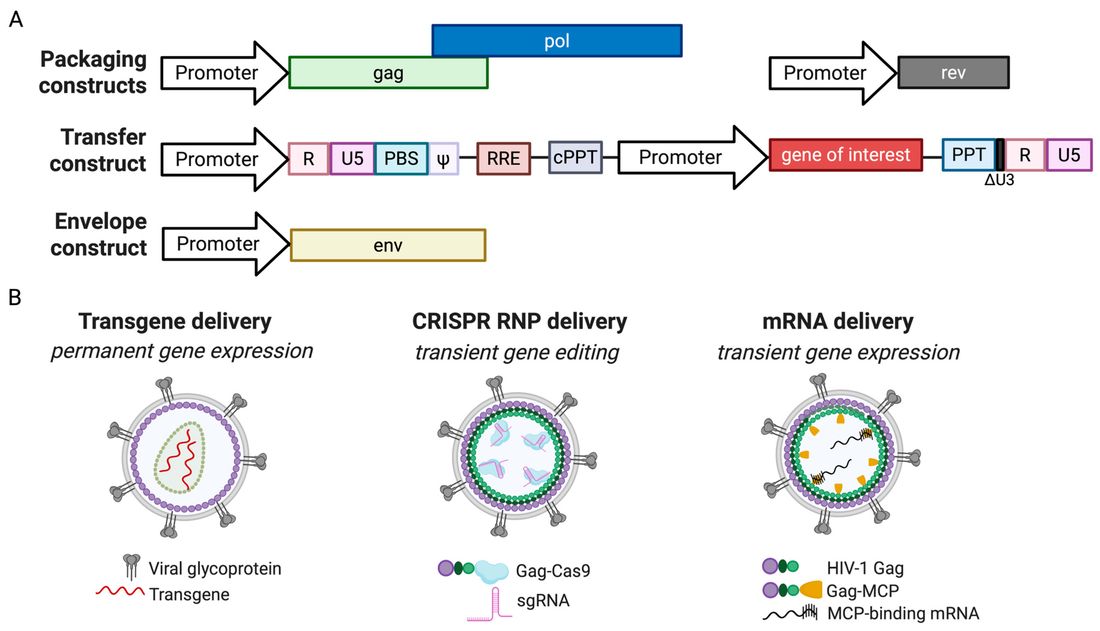 Fig. 1 Lentiviral vector system and gene delivery strategies1,2
We recognize that delivering lentiviral payloads to the most elusive cellular compartments demands an envelope repertoire that transcends the canonical VSV-G paradigm. The Filovirus Pseudotyping Service converges filoviral entry biology, cryo-EM-guided glycoprotein engineering, and high-resolution functional genomics into a single, seamless workflow—obliterating every discontinuity between your research question and a sequence-verified, filovirus-pseudotyped lentiviral stock. Exploiting suspension-adapted producer lines optimized for Zaire- or Marburg-virus glycoprotein variants, Creative Biolabs applies saturation mutagenesis libraries, glycan-shield cartography, and single-particle interferometry to sculpt envelopes with precisely defined receptor footprints and low-pH-triggered fusion kinetics. The resulting particles are released endotoxin-cleared, aggregate-free, and immediately ready for transduction of quiescent macrophages, polarized airway epithelia, or patient-derived microglial organoids—propelling mechanistic studies from conceptual blueprint to publication-grade datasets without procedural latency.
Signature Service Modules
Creative Biolabs's filovirus-pseudotyping constellation merges fifth-generation, suspension-adapted, CRISPR-edited HEK293SF-3KO producer chassis with envelope-centric, AI-guided codon de-optimization and triple-mode lectin–anion-exchange–size-exclusion chromatography to yield ultra-pure, sequence-authenticated, replication-incompetent lentiviral lots pseudotyped with Zaire, Sudan, Bundibugyo, or synthetic mosaic GP variants—ready for immediate transduction of non-dividing neuronal progenitors, mucociliary airway spheroids, or perfusable human liver sinusoid-on-chip constructs without serum neutralization, microfluidic priming, or glycoprotein cleavage rescue.
| Phase | Deliverables |
|---|---|
| Consultation & Cell Panel Matching | Vector map, tropism report, quote |
| Envelope Engineering & QC | Sequence-verified envelope plasmid, endotoxin <0.05 EU/µg |
| Lentivirus Production & Concentration | High-titer supernatant, ddPCR titer, sterility certificate |
| Functional Validation | Transduction efficiency, qPCR integration profile |
| Scale-Up & Archive | Master cell bank, frozen viral aliquots, full batch record |
What We Build for You
Vector Design & Strategy – Architecting Your Ideal Vector
Your cellular target defines the waypoint, we architect the filovirus-pseudotyped lentiviral vector that navigates the endosomal labyrinth to reach it. Beginning with cryo-EM-guided dissection of the glycoprotein–NPC1 interface and proceeding through serum-free, high-density production, every pseudotyping determinant—receptor-binding subdomain conformation, fusion-loop hydrophobicity, glycan shield stoichiometry, and prefusion metastability—is calibrated against the tropism signature of the intended cell population and the kinetic window of the experimental paradigm. Tropism refinement is not a belated tweak; it is encoded as a first-principle design imperative from inception, ensuring that each atomic substitution—envelope variant, linker truncation, or charge-neutralization mutation—pre-empts entry bottlenecks and collapses the interval from concept to functional readout.
- Navigator GP Selection Matrix
We start with a short questionnaire (species, target tissue, primary vs. cell line, in vivo or ex vivo). A concise dossier ranking each GP lineage (Zaire ΔTM, Sudan ΔTM, Marburg ΔTM, etc.) against your exact cellular model. Data include comparative transduction efficiencies, viability readouts, and recommended starting volumes—no need for pilot titration on your end. Each GP ORF pre-cloned into a shuttle vector with flanking restriction sites for instant swapping. Silent mutations introduced to remove cryptic splice sites and rare-codon clusters; full GenBank trace provided. Sequence alignment, endotoxin spec sheet, and absence-of-RCL summary formatted for direct IBC or IRB attachment.
- Payload Architecture Options – One Vector, Limitless Configurations
We modularize every component so you can mix, match, or upgrade without re-cloning. Tissue-restricted or synthetic promoters that curated library of > 200 promoters (neuronal Syn1, myeloid CD68, hepatic Albumin, synthetic CAG derivatives, etc.). Each promoter is insulated with cHS4 or woodchuck elements to prevent chromosomal silencing. You receive a promoter strength heat-map generated in your target cells plus the top performer already cloned into the final backbone. Multi-Cistronic 2A or IRES cassettes with pre-validated peptide linkers (P2A, T2A, E2A, F2A) balanced for equimolar cleavage, confirmed by LC-MS. Ready-to-use "dual-cargo" backbones: e.g., Cas9-2A-BFP-U6-sgRNA-WPRE or reporter-P2A-selection marker. Annotated SnapGene file and predicted cleavage ratios included—no optimization required on your side. Destabilization domains (ddFKBP, ddDHFR) with Shield-1 or TMP titration curves run in your exact cell type. If induction fails to meet specification, we re-engineer at no additional cost.
Cloning & Sequence Verification
We transform your conceptual blueprint into a battle-ready lentiviral plasmid—verified, annotated, and delivered with absolute certainty. Every nucleotide is interrogated, every scar removed, every codon tuned to your host species.
- Scarless Assembly – Seamless by Design
Golden Gate or Gibson pathways fuse the GP ORF into any lentiviral backbone without leaving extraneous bases or restriction scars. Native amino-acid sequence preserved, crystal-structure or epitope-tag integrity uncompromised. We provide a sketch, FASTA, or plain-text description, our bioinformatics suite returns an annotated map with optimized junctions and thermodynamic scores. You approve the design before we touch a pipette—eliminates downstream surprises. Proprietary annealing programs cut background colonies by more than half, reducing screening burden to near zero. Colony PCR images and mini-prep QC gels are uploaded to your secure portal for instant review.
- 100 % Sanger Verification – Absolute Sequence Confidence
Every base of the insert, both LTRs, and every junction overlapped at ≥ 4× depth. Automated alignment flags any deviation; if error frequency exceeds 0.05 %, we rebuild at no cost. PDF sequence certificate plus raw trace files formatted for patent filings, core-facility submissions, or journal peer review. Color-coded variant report delivered alongside the plasmid for immediate transparency.
- Codon-Optimization
Algorithms balance codon adaptation index, mRNA secondary structure, and tRNA availability for human or murine hosts. Cryptic splice sites predicted by splice-aware scanning and removed before assembly. Net epitope depletion reduces potential MHC-I/II binders—vital for in vivo applications. Before-and-after expression bar charts supplied so you can validate performance in your own lab.
Production & Purification
We scale and polish your Filovirus-pseudotyped lentivirus so you can move straight from thaw to transduction—no concentration steps, no endotoxin stripping, and no RCL testing in your own lab.
| Performance Pillar | What We Execute for You | What You Receive | Immediate Benefit |
|---|---|---|---|
| Ultra-Pure Endotoxin Clearance | Dual-phase stripping + ion-exchange polish to < 0.1 EU/µg | Lot-release certificate with raw LAL data | Direct animal dosing or sensitive cell culture—no extra clean-up |
| Absolute RCL-Negative Assurance | qPCR assay at ≥ 106-fold sensitivity with spike-in controls | Signed analytical report (primers, Ct values, statistical limits) | Regulatory-ready safety dossier—no in-house assay required |
| Ready-to-Use Concentration | Ultracentrifugation + sterile buffer exchange | Pre-aliquoted, endotoxin-free stock at specified titer | Thaw, dilute, and proceed—zero downstream manipulation |
- Suspension-Adapted Packaging Lines + High-Density Transfection
We do not simply "make virus." We engineer a biologic that meets publication-grade purity, regulatory-grade safety, and your exacting titer—so you can pipette directly into cells or animals without further manipulation.
- Ultra-Pure Endotoxin Clearance
Dual-phase endotoxin stripping, detergent phase separation followed by ion-exchange polish strips > 90 % of endotoxin load. Single-pass confirmation by quantitative chromogenic assay; every vial is released only when the result is below your specification. Concentrated lentivirus aliquoted in endotoxin-free buffer compatible with serum-free culture or direct animal dosing. Raw LAL chromogenic readouts appended to the lot-release certificate—upload directly to IBC or vivarium protocols with no re-testing.
- Absolute RCL-Negative Assurance
Orthogonal qPCR assay directed to regions of the packaging plasmid, envelope, and genomic RNA run parallel with spike-in positive controls. Raw Ct values, primer sequences plus positive-control spiking data are made available for inclusion in regulatory submissions. In case any lot fails the RCL specification, production and purification are repeated at no charge.
Apex Functional QC Suite – Empirical Evidence, Delivered Ready-to-Cite
We generate a data envelope that travels with every vial of virus. Each assay answers a question you would otherwise spend weeks troubleshooting: "How much should I use?", "Where did it integrate?", and "What else did it disturb?" Below is an expanded view of how we perform each test for you, what you receive, and why it accelerates your next milestone.
- Precision MOI Matrix – Flow-Cytometry Mastery
Expose your exact cell line or primary culture to a 10-point MOI gradient under your preferred culture conditions. High-resolution flow cytometry quantifies % transduction alongside live/dead gating. Automated gating templates eliminate subjective bias and ensure reproducibility. You will receive the interactive dose-response curve (% positive vs. MOI) with 95 % confidence bands. Recommended working MOI that secures ≥ 70 % transduction with < 5 % viability loss. Raw FCS files and gating strategy—upload to your core facility without re-analysis.
- ddPCR Integration Profiling – Absolute Copy-Number Intelligence
Droplet digital PCR targeting the lentiviral WPRE element and a single-copy reference gene to yield proviral copies per diploid genome. Optional single-cell deposition into 96-well plates followed by clonal re-quantification for monoclonal line generation. You will receive the histogram of integration events across the population (mean, median, range). Well-by-well clonal copy-number map if clonality is requested. Statistical summary formatted for grant proposals or regulatory appendices.
- Off-Target CRISPR Scanning
Amplicon sequencing of up to 20 predicted off-target loci after Cas9 delivery. Automated pipeline delivers indel frequencies, frameshift ratios, and visual allele plots. You will receive the annotated report with QC metrics and an executive "off-target risk statement" ready for manuscript insertion. If any off-target exceeds your preset threshold, we redesign and re-screen at no additional cost.
- In Vivo Biodistribution Pilot – Spatial Certainty
Low-dose systemic or local administration in the animal strain of your choice. qPCR-based quantification of vector copies in blood, liver, spleen, bone marrow, and any tissue you specify. You will receive the heat-map normalized to input dose and raw Ct values per tissue, and primer sequences and assay parameters formatted for IACUC or regulatory dossiers.
Elevate Your Project
Filovirus Envelope Engineering Mastery
Doctoral-level virologists embed directly within the research group, converting cellular-entry requirements into rationally pseudotyped lentiviral surfaces bearing filovirus glycoproteins. NPC1–GP interface energetics, fusion-loop hydrophobicity, and glycan-shield stoichiometry are modelled in silico; each variant is benchmarked against off-target entry, innate-sensor activation, and cytotoxicity. Iterative data packages—titers, fusion kinetics, and receptor-blocking indices—are delivered on a rolling basis, furnishing principal investigators with quantitative go / no-go metrics without additional personnel.
From Concept to Celluloid
Whether the script opens with a receptor FASTA or a locked backbone, the production pipeline scales from pilot vignette to feature-length vector stock. Zaire-, Sudan-, or Marburg-GP protagonists are expressed in serum-free suspension studios; clarified rushes are color-graded through dual-mode lectin-affinity and ion-exchange chromatography, delivering highly blockbuster potency. A single scientific lead orchestrates GP cloning, orthogonal titering, and functional validation under a unified project map aligned to manuscript or grant milestones.
Analytically Rigorous QC Suite
Each vector lot is interrogated through a 28-parameter analytical framework: functional titre (qPCR and flow cytometry), GP incorporation efficiency (ELISA and cryo-EM particle counts), residual plasmid/host DNA (droplet digital PCR), endotoxin (< 1 EU/mL), and absence of replication-competent lentivirus (qPCR, ≥ 106-fold analytical sensitivity). Raw datasets are delivered as editable methods sections and supplementary tables for immediate peer-review integration.
Modular Architecture, Tropism on Demand
No catalog constraints the design space. Every construct is assembled de novo: GP libraries encompassing receptor-binding loop truncations, glycan-shield augmentations, or charge-reversal mutants; LTR variants with or without insulator scaffolds; and fluorescent or selectable markers positioned 5′ or 3′ of the payload. Plug-and-play cassettes permit same-day swapping of GP variants or reporters, enabling rapid iteration when tropism barriers or reviewer stipulations arise.
Client Accolades

Frequently Asked Questions
Q: Which filovirus glycoproteins are available for lentiviral pseudotyping and what are their tropisms?
A: Currently, lentiviral vectors have been successfully pseudotyped with the envelope GPs of Ebola-Zaire (EboZ), Ebola-Reston (EboR), Marburg virus (MARV), and engineered GP variants (e.g., EboZΔO lacking the mucin-like domain).
Q: How do filovirus pseudotypes perform relative to VSV-G in airway gene transfer?
A: In polarized human airway epithelia, EboZ-pseudotyped lentiviral vectors transduce the apical surface >20-fold more efficiently than VSV-G, whereas VSV-G favors basolateral entry. Deletion of the mucin-like domain (EboZΔO) further increases apical transduction efficiency 74-fold and reduces cytotoxicity.
Q: Are filovirus GP pseudotypes cytotoxic or immunogenic?
A: Wild-type EboZ GP induces cytopathic effects in endothelial cells and triggers innate immune responses. Deletion of the mucin-like domain (aa 309–489) in EboZΔO or use of the attenuated EboR GP abolishes cytotoxicity while preserving high transduction efficiency. All constructs are packaged in third-generation SIN lentiviral backbones to eliminate replication-competent virus risk.
Q: What biosafety level is required for handling filovirus-pseudotyped lentiviral vector?
A: Despite the pathogenicity of parental filoviruses, replication-defective lentiviral vectors pseudotyped with filovirus GPs are classified BSL-2 because the envelope alone lacks viral replication genes. Each shipment includes an IBC-ready risk assessment.
References
- Arduini, Ariana, Harshita Katiyar, and Chen Liang. "Progress in Pseudotyping Lentiviral Vectors Towards Cell-Specific Gene Delivery In Vivo." Viruses 17.6 (2025): 802. https://doi.org/10.3390/v17060802.
- Distributed under Open Access license CC BY 4.0, without modification.
