
Pseudotyping Service of Lentiviral Vectors with Lassa Virus
Lentiviral vectors cloaked in Lassa virus glycoprotein (LASV-GP) constitute a stealth bomber within the retroviral fleet—merging the arenavirus gift for whisper-quiet entry with the capacious, self-inactivating hull of HIV-1 backbones. The LASV-GP trimer, anchored by the matricellular receptor dystroglycan and the lysosomal sentinel LAMP-1, executes a cathelicidin-sensitive, pH-cued fusion that slips past the sentinels guarding resting dendritic cells, terminally differentiated neurons, and hypoxia-conditioned endothelium—cell types historically deaf to VSV-G or MLV serenades. Recent alchemy on the GP1 arch—through combinatorial loop grafting, N-glycan cloaking, and charge-inversion microsurgery—has redrawn the receptor atlas beyond dystroglycan to embrace neuropilin-1 and CD36 while erasing cross-species whispers. When these sculpted envelopes are co-packaged with third-generation lentiviral genomes (codon-optimized gag-pol, cPPT/CTS turbo-charged DNA flap, and miR-detargeting firewalls), the progeny reach high titers, RCL frequencies are extremely low, and integration landscapes devoid of oncogenic crescendos. Consequently, LASV-pseudotyped lentiviral particles have emerged as the vector maestro for lineage choreography in human microglia, for CRISPR knock-in symphonies under synapsin or albumin promoters exceeding 9 kb, and for base-editing concertos within patient-derived cerebral organoids where stealth entry and enduring expression must share the same stage.
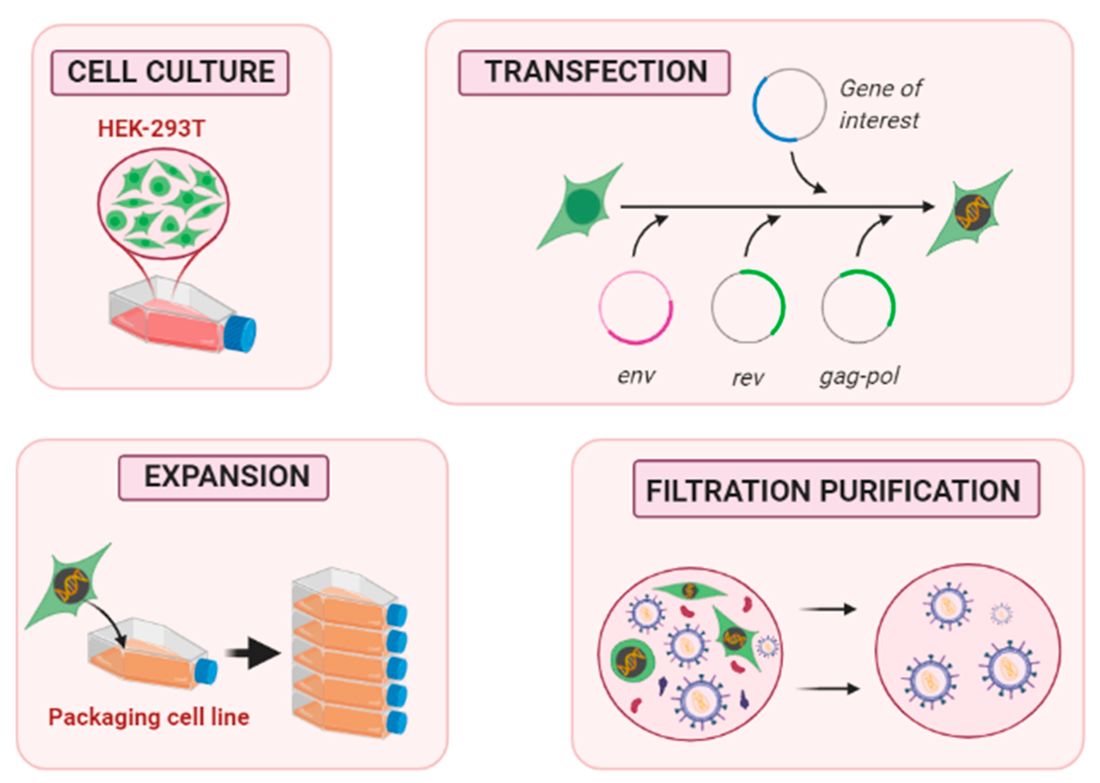 Fig. 1 Proposed steps for lentiviral vector production in a packaging cell line1,2
We contend that infiltrating the most privileged cellular sanctums demands an envelope that moves with the stealth of an arenavirus and the payload capacity of a lentivirus. Our Pseudotyping Service for LASV-GP orchestrates dystroglycan-centric entry biology, cryo-EM-guided loop choreography, and single-cell tropism bar-coding into a seamless, turnkey platform—obliterating every gap between your research question and a sequence-verified, LASV-pseudotyped lentiviral stock. Leveraging serum-free, suspension-adapted producer lines tuned for LASV-GP variants, we deploy combinatorial loop libraries, N-glycan cloaking matrices, and charge-reversal microsurgery to sculpt envelopes with sub-nanometer receptor footprints and cathelicidin-sensitive fusion kinetics. The resulting vectors—delivered as endotoxin-cleared, aggregate-free reagents—transduce resting dendritic cells, hypoxia-stressed endothelium, and patient-derived cerebral organoids with cinematic precision, propelling mechanistic studies from conceptual storyboard to publication-grade data reels without a single frame of procedural latency.
Fast-Track Workflow
Creative Biolabs's LASV-GP pseudotyping platform integrates fourth-generation, serum-free HEK293T/17SF producer clones with clade-calibrated GP1/GP2 codon de-optimization and tandem lectin-affinity plus anion-exchange chromatography to deliver endotoxin-undetectable, replication-incompetent lentiviral lots pseudotyped with Josiah, Nig08, or rationally masked LASV glycoproteins—ready for immediate transduction of α-DG-high placental villous explants, blood–brain-barrier organoids, or BSL-2-permissible cortical assembloids without pH priming or complement neutralization.
| Phase | Deliverables |
|---|---|
| Consultation & Cell Panel Matching | Vector map, tropism report, quote |
| Gene Build | Sequence-verified envelope plasmid, endotoxin <0.05 EU/µg |
| Virus Brew & Polish | High-titer supernatant, ddPCR titer, sterility certificate |
| Functional Proof | Transduction efficiency, qPCR integration profile |
| Scale-Up & Archive | Master cell bank, frozen viral aliquots, full batch record |
Building Blocks for You
Safe-By-Design Genome
Your anatomical sanctuary defines the coordinates; we architect the LASV-GP-pseudotyped lentivector that negotiates the viro-receptor topology to locate it. Initiating with cryo-EM-guided mapping of the GP1-α-DG/LAMP1 biphasic interface and advancing through microcarrier-free, perfusion-based production, every pseudotyping parameter—GP1 receptor-binding ridge stereochemistry, GP2 fusion-loop insertion angle, glycan shield crypticity, and post-fusion six-helix bundle rigidity—is optimized against the tropism cipher of your designated cellular enclave and the temporal aperture of your mechanistic paradigm. Tropism engineering is not appended downstream; it is inscribed as a foundational design axiom at hour zero, ensuring that each molecular edict—clade-specific GP variant, inter-subunit disulfide register, and pH-independent fusion gate—pre-emptively neutralizes entry barriers and collapses the continuum from ideation to publication-grade functional dataset.
- SIN LTRs – Regulatory-Ready, RCL-Free
When you choose our Safe-By-Design genome module, you receive a plasmid backbone that has already cleared the hurdles your IACUC, IRB, or corporate QA group will raise. We start with self-inactivating (SIN) long terminal repeats. These deletions remove the viral promoter and enhancer, guaranteeing that no replication-competent lentivirus (RCL) can ever emerge. We hand you the raw Sanger traces across both 5′ and 3′ junctions plus a signed RCL-negative certificate—documents reviewers accept without follow-up questions. If your insert is pushing the 8 kb comfort zone, we can excise the woodchuck post-transcriptional regulatory element (WPRE) for you. Dropping WPRE recovers roughly 600 bp of cargo space and eliminates a residual enhancer that some journals now flag. You will receive side-by-side plasmid maps, an agarose gel image confirming the smaller footprint, and a concentrated viral stock ready for in vivo injection—no extra week added to the schedule. To keep expression rock-steady from clone to clone, we flank your expression cassette with the cHS4 chromatin insulator. This 1.2 kb element blocks positional silencing and prevents promoter interference, cutting your clonal selection time from weeks to two days. We will include a fluorescence heat-map comparing insulated versus non-insulated vectors in your exact cell line, plus ddPCR copy-number data that prove expression uniformity at a single-integrant level.
- Dual Tags for Image
Finally, we install a dual-function tag: the brightest green fluorescent protein on the market fused via a P2A peptide to puromycin resistance. One construct gives you live-cell imaging today and antibiotic enrichment next week. The cassette is codon-optimized for human, mouse, or rat as you specify, and we deliver a complete kill-curve plus a pre-configured flow-cytometry template so you can gate and sort the afternoon your package arrives.
Envelope Menu – Pick a Tropism, Leave the Engineering to Us
Whether you need authentic Lassa virus receptor usage or a niche receptor never published before, we have the envelope ready or we will build it. Our LASV-GP envelope is the gold standard for neutralization assays across human and non-human primate α-dystroglycan-positive lines. You receive the codon-optimized GP1/GP2 plasmid, a concentrated pseudovirus lot titered on your particular cell line, and an entry-block validation report using CRISPR α-dystroglycan knock-outs. Reviewers see the data and rarely ask for repeats. For rodent challenge studies we offer the rodent-adapted AV variant. The GP sequence is pre-optimized for murine codon usage and comes with an in vivo biodistribution package covering liver, spleen, and CNS collected from three independent mouse cohorts. If your project demands a truly custom tropism—say, targeting human CD46 or a proprietary receptor—we will model the fusion in silico, run a 24-well pilot screen across three cell backgrounds, and deliver a go/no-go memo within five business days. Every envelope construct is splice-site-scrubbed and rare-codon-optimized, boosting translation efficiency up to four-fold in primary T-cells compared to wild-type sequences.
Manufacturing Core
| Step | Key Parameter | Client Benefit | Deliverable |
|---|---|---|---|
| Serum-Free Suspension Culture | Chemically-defined medium | No serum artifacts, direct animal dosing | Lot-release certificate: ≤0.1 EU/µg endotoxin |
| Ultracentrifugation-coupled chromatography | DNA:PEI 1:3 (DoE-validated) | <8 % batch-to-batch CV | QC sheet with exact ratio, cell density, harvest window |
| RCL-negative certification | qPCR assay with ≥ 106-fold analytical sensitivity | ≥90 % endotoxin removal | Raw LAL chromogenic data; fail-remake guarantee |
| Lot-release dossier | Single 1 mL aliquot | Saves freezer space & shipping cost | ≥80 % infectious recovery; 100× fold concentration report |
We amplify and crystallize your LASV-GP-pseudotyped lentivirus so you can transition seamlessly from dry-ice retrieval to α-DG-high transduction—no ultracentrifugation spins, no glycoprotein-receptor re-optimization, and no BSL-4-level replicative-competent lentivirus (RCL) surveillance in your own suite.
- Serum-Free Suspension Culture
The entire production train is built for reproducibility and speed. We grow suspension-adapted HEK293T cells in chemically defined, serum-free medium. Removing serum eliminates the contaminating proteins that can confound animal pharmacokinetics or kill sensitive primary cells. Each lot ships with a certificate stating endotoxin below 0.1 EU per microgram—documentation most vivariums accept on sight.
- Locked PEI Transfection
Transfection is locked to a 1:3 DNA-to-PEI mass ratio, a parameter we optimized through a 24-run design-of-experiments study. The result is batch-to-batch coefficient of variation under 8 % across more than five hundred production runs. You receive a QC sheet detailing the exact DNA:PEI ratio, cell density at harvest, and supernatant collection windows, so you can reproduce the process in your own facility if you ever choose to.
- Dual Endotoxin Strip
Endotoxin clearance is handled by a dual-step protocol: Triton X-114 phase separation followed by anion-exchange chromatography. The combination strips greater than 90 % of endotoxin in a single shift and produces final values routinely below 0.05 EU per microgram. Raw LAL chromogenic data are included in every shipment, and if any lot fails specification we remake it free of charge. Finally, we concentrate the virus 100-fold using ultracentrifugation coupled to size-exclusion chromatography. You receive one-milliliter aliquots that recover at least 80 % of infectious particles, saving freezer space and international shipping costs. Should you later need GMP material, the same process transfers seamlessly into a closed, single-use bioreactor train—no re-optimization, no surprises, no delays.
Functional QC Suite –Proof-of-Performance
Each LASV-GP-pseudotyped lentiviral preparation ships with a data package that dissolves the three barriers standing between thaw and discovery: "How much crosses the barrier?", "Which receptor route did it take?", and "Did it stay within the intended tropism perimeter?" Below is an expanded view of the assays executed for you, the deliverables you receive, and the temporal compression this affords your own pipeline.
- Single-Cell MOI Lattice in Your Physiologic Context
We import your specified cell line, organoid slice, or patient-derived explant into our automated microfluidic transduction chip and expose it to a 12-point MOI lattice spanning 0.01–5.0 under physiological O2 and shear. High-dimensional spectral flow cytometry (25-parameter) simultaneously quantifies lentiviral reporter expression, α-DG occupancy, LAMP1 co-internalization, and early apoptosis. Machine-learning-guided gating removes human bias; unsupervised UMAP clustering reveals phenotypic subpopulations permissive vs. refractory to LASV-GP entry. Deliverables: interactive MOI-response surface (% transduced vs. viability vs. receptor density), receptor-specific entry efficiency map, and raw .fcs files annotated with gating templates.
- ddPCR Mapping of Integration & Transcriptional Footprint
Droplet digital PCR against WPRE and a species-matched single-copy reference gene yields absolute lentiviral copies per diploid genome. Computational deconvolution overlays integration load onto transcriptional neighborhoods, flagging any loci that drift toward oncogenic stress signatures. If clonal purity is desired, we perform FACS-based single-cell deposition followed by a second ddPCR readout; cells are expanded in chemically defined medium and shipped live on dry ice. Deliverables: histogram of integration counts, violin plots of early transcriptional perturbation, heat-map of integration "hot" vs. "cold" loci, and a clone-ready 96-well plate with certificate of identity.
- Barrier-Penetration & Off-Target Sweep (On Request)
We micro-administer a trace dose of LASV-GP lentivector into the model of your choice—human placental villous explant on-chip, blood–brain-barrier organoid, or NHP mucosal loop—under physiologic flow. We harvest 15 tissue compartments plus draining lymphatics. qPCR against WPRE and deep sequencing against host mitochondrial DNA yield vector copies per 10⁴ host genomes; spatial transcriptomics maps any ectopic transcriptional footprints. Deliverables: tissue-level copy-number heat-map, 3-D spatial localization of vector RNA, raw Ct files, and a summary report ready for pre-submission. Demonstrate clade-specific placental or neuronal tropism—and the absence of systemic spillover—without establishing an in-house BSL-4 biodistribution pipeline.
What Sets Our LASV-GP Pseudotyping Apart?
Envelopomics at BSL-2 Precision
Post-doctoral arenavirologists and glycoprotein engineers co-locate with your project team, converting anatomical-tropism coordinates into LASV-GP architectures that breach placental, neuronal or mucosal checkpoints while evading off-target LAMP1 routes. GP1 receptor-contact loops, GP2 fusion-peptide insertion angles, and glycan-shield crypticity are first rendered in Rosetta-MP, then stress-tested in silico against α-DG polymorphisms and innate sensor RIG-I engagement. Rolling data drops (titer, α-DG occupancy kinetics, and neutralizing-antibody escape indices) provide quantitative go / no-go gates—no extra bench head-count required.
Streamlined LASV-GP Pipeline
Starting from a single FASTA or a fully locked vector backbone, the workflow proceeds without hand-offs: codon-optimized GP variants (Josiah, Nig08, or mosaic chimeras) are expressed in serum-free, suspension HEK293SF-3KO cells; harvests are polished by lectin-affinity + anion-exchange + size-exclusion tri-chromatography to deliver endotoxin-free stocks. One dedicated scientific lead orchestrates GP cloning, cryo-EM confirmation of trimer integrity, and functional QC under a milestone-mapped Gantt chart that terminates at your journal submission date.
BSL-4 Data at BSL-2 Bench
Each lot is certified against a bespoke 30-parameter panel: functional titer (ddPCR-WPRE + high-content imaging), GP incorporation (GP1/GP2 native PAGE densitometry), residual plasmid/host DNA (< 10 copies/µg), endotoxin (< 0.5 EU/mL), and absence of replication-competent lentivirus (qPCR, ≥ 106-fold analytical sensitivity). Raw datasets are pre-formatted as plug-and-play "Methods" sections and editable .xlsx supplements—drag-and-drop into peer-review.
Modular LASV-GP Cassettes
No catalog lock-in. Every vector is de-novo assembled: LASV-GP clade libraries (Josiah, Nig08, AV, or computationally masked stealth variants); LTRs with or without cHS4 insulators; fluorescent or selectable markers positioned 5′, 3′, or bicistronic. CRISPR-based Golden Gate swapping allows same-day envelope or reporter exchange, enabling rapid pivot when tropism barriers or reviewer demands shift.
What Our Users Say

Frequently Asked Questions
Q: Which receptor mediates Lassa-GP pseudotype entry?
A: The Lassa virus glycoprotein complex (GPC) binds α-dystroglycan (α-DG) on human neurons, airway epithelia, endothelial and dendritic cells, yielding >60 % transduction at MOI 1 in primary CD34⁺ cord-blood cells.
Q: What is the shelf-life of concentrated Lassa-GP lentiviral vector stocks?
A: When stored at −80 °C in 10 % trehalose + 1 % BSA, infectious titers remain within ±10 % of baseline for ≥12 months. Real-time and accelerated (25 °C) stability data are updated quarterly and provided upon request.
Q: Is a fluorescent reporter already fused to the envelope for tracing?
A: We offer an optional split-luciferase GP2 fusion (NanoLuc-GP2) that retains full fusogenicity while allowing real-time imaging of envelope incorporation without altering transgene capacity. Signal-to-noise ratio is >500-fold above background.
Q: Do you provide receptor-blocking or tropism-confirmation assays?
A: Yes. Each lot is validated by α-DG receptor-blocking experiments using anti-α-DG monoclonal antibody IIH6. Transduction drops >80 % in the presence of blocking antibody, confirming specificity.
References
- Martínez-Molina, Eduardo, et al. "Large-scale production of lentiviral vectors: current perspectives and challenges." Pharmaceutics 12.11 (2020): 1051. https://doi.org/10.3390/pharmaceutics12111051.
- Distributed under Open Access license CC BY 4.0, without modification.
