Proteomic Quantitative Analysis Services
Introduction
The core challenge of modern proteomics has evolved from simply identifying proteins to quantifying their abundance and modifications across different biological states. This transition to a quantitative, systems-level perspective is vital for advancing fields from biomarker discovery to disease mechanism research. However, this is a technically demanding task, requiring robust experimental design and advanced analytical technologies. Creative Biolabs' Glycoproteomics Quantitative Analysis Services are designed to meet this challenge by providing high-quality, reproducible data that uncovers meaningful biological changes with speed and precision.
The principle of proteomic quantitative analysis is to measure and compare the relative or absolute abundance of proteins within and between different biological samples. The fundamental basis for this is mass spectrometry (MS), which allows for the high-resolution detection and quantification of peptides. By comparing the signals of specific peptides, either directly or through stable isotope-labeled tags, we can accurately infer changes in the concentration of their parent proteins. Our proteomic quantitative analysis services help you accelerate drug discovery and streamline trial processes through advanced MS platforms and innovative data analysis techniques. We provide the precise, quantitative data you need to move from hypothesis to impactful results with speed and confidence. We provide a definitive understanding of protein abundance and changes in complex biological systems, which is crucial for identifying novel biomarkers, validating drug targets, and elucidating intricate cellular mechanisms. Our solutions are grounded in established methodologies, including label-free, stable isotope labeling, and targeted quantitative approaches, each tailored to meet the unique requirements of your project and sample types.
Discover How We Can Help
A successful quantitative proteomics project begins with a clear, collaborative plan. Our workflow is designed for transparency and rigor, ensuring that from initial consultation to final report, you are aligned with every step of the process.
1
Project Consultation & Experimental Design
We begin with a detailed discussion to understand your scientific goals. Based on your samples and objectives, we recommend the most appropriate quantitative strategy.
2
Sample Preparation & Digestion
Our experts meticulously handle your samples, performing protein extraction, quantification, and enzymatic digestion. This is a critical stage where technical variability can be introduced, and our rigorous protocols ensure maximum reproducibility.
3
Advanced MS Analysis
Prepared peptides are analyzed on state-of-the-art mass spectrometers, such as Orbitrap instruments. Depending on the chosen strategy, we employ optimized acquisition methods to generate high-quality, information-rich mass spectral data.
4
Bioinformatic Data Processing & Analysis
Raw data is processed using sophisticated software pipelines. We identify and quantify thousands of proteins, performing normalization and statistical analysis to identify proteins with significant fold changes.
5
Quality Control & Reporting
We perform extensive quality control checks throughout the process to ensure data integrity. The final deliverable includes a comprehensive, publication-ready report and a consultation to help you interpret the results and plan next steps.
Based on the above workflow, we provide various types of proteomic quantitative analysis services.
A Brief Comparison of Different Modification Proteome Quantitative Analysis
|
Service
|
Acetylation Proteomics
|
Phosphorylation Proteomics
|
Ubiquitination Proteomics
|
|
Modification Type
|
Lysine (K) acetylation
|
Serine (S), Threonine (T), Tyrosine (Y) phosphorylation
|
Lysine (K) ubiquitination
|
|
Biological Role
|
Gene expression, metabolism, enzyme activity, protein stability, signaling, bacterial adaptation
|
Signal transduction, enzyme activation/inactivation, protein-protein interactions, cell cycle, cell growth
|
Protein degradation, signal transduction, DNA repair, protein trafficking, and immune response
|
|
Enrichment Method
|
Anti-acetyllysine antibody IP, often with fractionation
|
TiO2, anti-phospho-antibody IP
|
Anti-diGlycine (K-ε-GG) antibody IP
|
|
Challenges
|
Low stoichiometry, dynamic, non-enzymatic possibilities, tissue/compartment specificity
|
High dynamicity, transient nature, acid lability, low stoichiometry
|
High complexity (chain types, multiple sites), low abundance, rapid degradation
|
|
Key Applications
|
Metabolic disorders, cancer, neurodegeneration, bacterial resistance, epigenetics
|
Cell signaling, drug mechanism of action, development, disease pathways
|
Cancer, neurodegenerative diseases, immunology, protein quality control, and DNA damage response
|
|
Complementary to Genomics/Transcriptomics
|
High (explains functional changes beyond gene expression)
|
High (explains functional changes beyond gene expression)
|
High (explains functional changes beyond gene expression)
|
Related Services
To help you achieve your research goals, Creative Biolabs offers a range of services that support your quantitative proteomics projects.
-
Protein Expression & Purification: Obtain high-quality recombinant proteins for use as standards or for further functional studies.
-
Custom Antibody Development: Generate highly specific antibodies to your protein targets for use in validation assays like Western blotting or ELISA.
-
Bioinformatics & Data Analysis: Our expert bioinformaticians can provide advanced data analysis, pathway mapping, and custom statistical consulting to help you interpret your proteomic data.
Creative Biolabs' proteomic quantitative analysis services provide the speed, precision, and depth required to make groundbreaking biological discoveries. From large-scale biomarker screening to high-accuracy targeted validation, our comprehensive solutions are designed to deliver actionable, publication-ready data. Ready to advance your research with high-quality quantitative proteomics? Our team of experts is ready to discuss your project needs and Please contact us to obtain more details.
Published Data
Based on the research paper, the authors conducted a pioneering study to understand the roles of protein phosphorylation and acetylation in the intestinal regeneration of sea cucumbers. They compared the PTMs in normal intestines versus those in the early, critical stages of regeneration. Their analysis successfully identified a large number of proteins whose function is likely to be regulated by these two modifications. The study found that these proteins are primarily involved in five key biological processes essential for regeneration: building the cytoskeleton, creating and modifying new proteins, transmitting cellular signals, managing energy, and transporting and metabolizing various substances. A key finding, visually represented in the Figure below, is that phosphorylation and acetylation do not have equal roles; they appear to specialize. The schematic model highlights that phosphorylation plays a significant part in cell signaling and signal transduction, where most of the related proteins were found to have increased modification levels. In contrast, the figure shows that acetylation is the dominant regulatory mechanism in other processes, affecting a much larger number of proteins. For instance, acetylation is heavily involved in protein synthesis and modification, as well as substance transport and metabolism, with a mix of both increased and decreased modification levels. Most notably, acetylation appears to be the primary regulator of energy production and conversion, where the majority of modified proteins were found to have reduced acetylation levels. This suggests that the sea cucumber's regenerative process is a carefully orchestrated effort, with phosphorylation and acetylation working in concert but with distinct responsibilities to control and coordinate cellular activities.
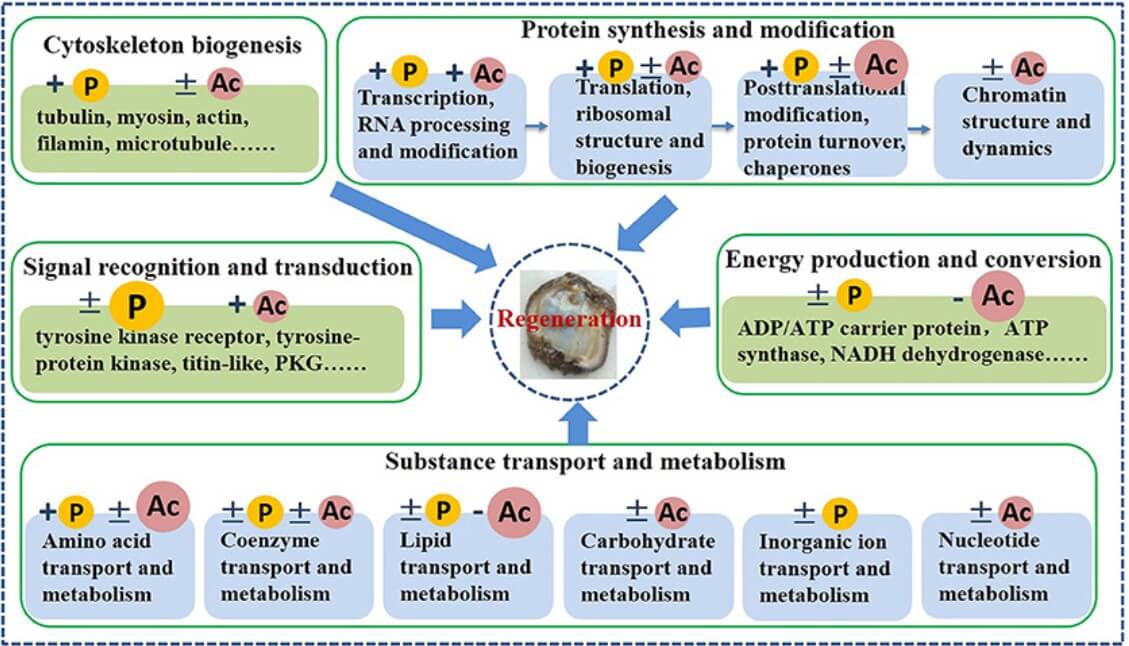 Fig.1 Phosphorylation and acetylation modifications during sea cucumber intestinal regeneration.1
FAQs
Q1: What are the primary advantages of a label-based method over a label-free approach?
A1: Label-based methods offer superior quantitative accuracy and minimize technical variability by allowing multiple samples to be pooled and run simultaneously. This approach is highly recommended for projects where subtle changes in protein abundance need to be reliably detected. For an initial consultation on your specific project, we can help you choose the best approach for your research needs.
Q2: What types of samples can you process for quantitative proteomic analysis?
A2: We are equipped to handle a broad range of biological samples, including cell lysates, frozen tissue sections, purified protein fractions, and body fluids such as serum, plasma, and urine. We work with you to ensure your starting materials are correctly prepared for optimal results. If you have a unique sample type, please reach out to our team to discuss the best approach.
Q3: How do you handle low-abundance proteins and ensure their quantification is reliable?
A3: Our expertise in targeted proteomic methods like PRM and MRM allows us to achieve superior sensitivity for low-abundance proteins. These assays are highly specific and can be designed to validate your proteins of interest with exceptional accuracy. Our advanced data acquisition techniques also improve quantification accuracy for lower-abundance proteins in large-scale studies. To learn more about our low-abundance protein workflows, we encourage you to start a conversation with our specialists.
Customer Review
Streamlined Validation
"We needed to validate dozens of potential biomarkers across hundreds of patient samples. Creative Biolabs's rapid workflow, which builds targeted MRM assays directly from our discovery data, was a game-changer. We moved from initial discovery to a large-scale validation in a fraction of the time we expected. The reproducibility across all samples was excellent." - Prof. O. Gar***a.
Expert Consultation
"The team at Creative Biolabs provided invaluable guidance on our project. Their expertise helped us choose the right label-free strategy for our precious clinical tissue samples, which were limited. They not only delivered a high-quality data set but also helped us interpret the complex results, identifying novel insights we would have otherwise missed." - Dr. F. Mar***z.
Reference
-
Sun, Lina, et al. "Comparative phospho-and acetyl proteomics analysis of posttranslational modifications regulating intestine regeneration in sea cucumbers." Frontiers in Physiology 9 (2018): 836. DOI: 10.3389/fphys.2018.00836. Distributed under an Open Access license CC BY 4.0, without modification.
Related Services
For Research Use Only.