Our skilled team offers a tailored approach to every project, designing and validating specific marker panels for your unique research questions. We collaborate closely to select optimal markers for the perfect fit, including for rare cell populations.
Cardiac Cell Immunophenotyping Service
Creative Biolabs provides a high-resolution analysis of the cardiac cellular landscape, giving you the specific deliverables and problem-solving capabilities needed to advance your research. We help you precisely identify and quantify all major cardiac cell types, including distinct populations of macrophages, T cells, and other immune subsets. Creative Biolabs enables you to characterize cellular phenotypes and uncover rare populations that are often missed by traditional bulk analyses, providing deep insights into cell activation, differentiation, and functional state during inflammation and repair.
Introduction What We Can Offer Workflow Why Creative Biolabs Customer Reviews FAQs Related Services Contact Us
Resolving the Cardiac Immune Landscape
Cardiac cell immunophenotyping is the process of identifying and characterizing the diverse immune cell populations within the heart. These cells, including macrophages, T-cells, and mast cells, play critical, yet complex, roles in cardiac health and disease. The use of traditional isolation methods can lead to cell activation and a loss of function, hindering accurate analysis. Furthermore, recent studies have revealed the profound heterogeneity of these populations, with distinct subsets having different origins, functions, and roles in both inflammation and tissue repair. Understanding these populations is vital for developing targeted cardiovascular therapies.
To learn more about how our services can advance your research objectives, request a consultation.
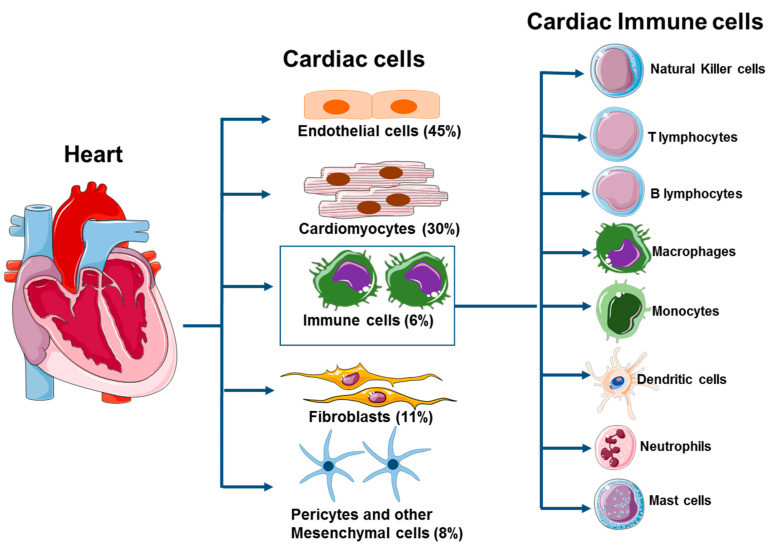 Fig.1 Cellular components of the steady-state heart.1
What We Can Offer
Customized Service
Seamless Workflow from A to Z
We provide a complete, end-to-end solution, offering comprehensive support from initial consultation and experimental design to final report generation. This seamless approach minimizes logistical complexity and ensures a smooth, efficient progression for your entire project.
Scalable Throughput
Our state-of-the-art platforms and streamlined processes enable the efficient processing of multiple samples at once. This high-throughput capability ensures your large-scale projects are completed on time, without compromising data integrity or quality.
Reproducible Results
Our rigorous quality system and strict quality control procedures guarantee the reliability of your data throughout the entire workflow. We perform checks at multiple stages to ensure your results are consistent, reproducible, and ready for you to build your research with confidence.
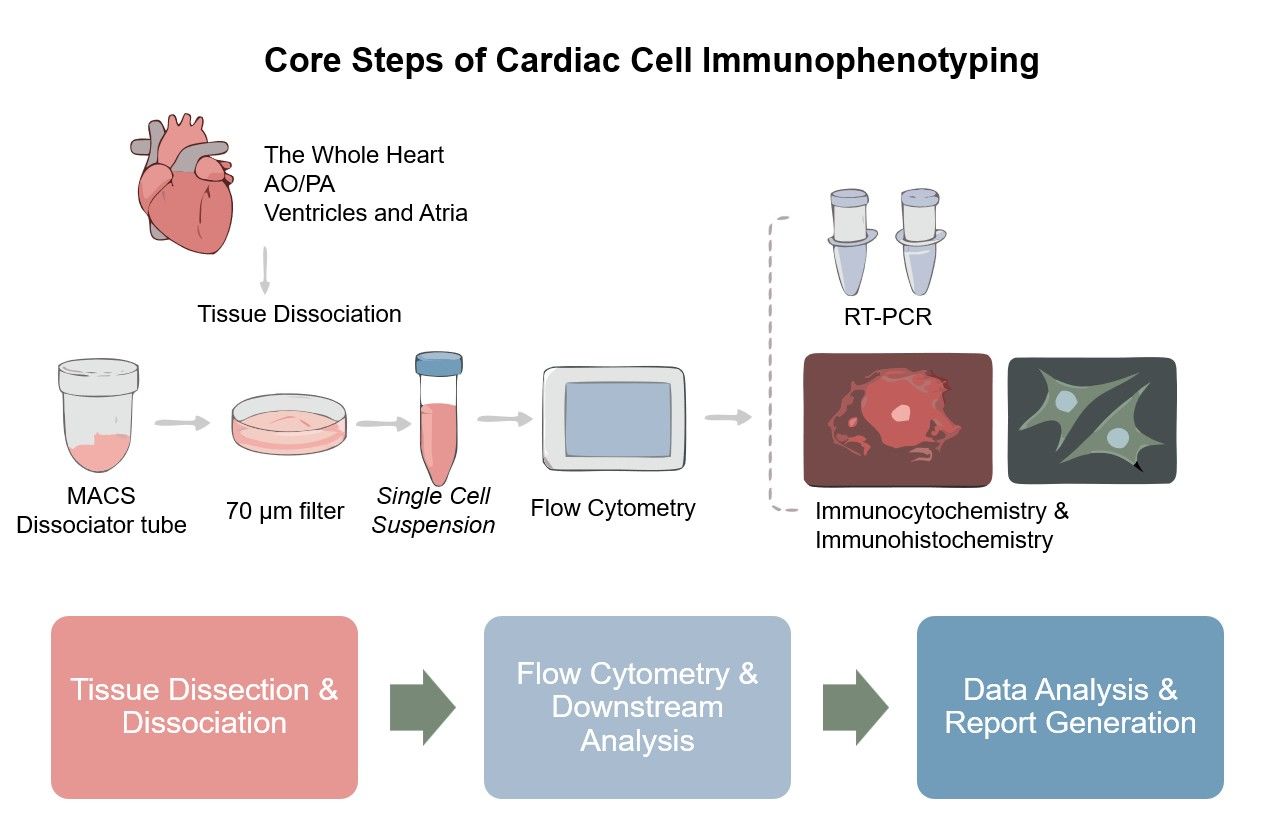
Workflow of Cardiac Cell Immunophenotyping Service
Highlights
Deep Expertise and Technology
Our deep expertise in cardiac biology and access to cutting-edge technology ensure you get the highest quality service. We provide a team of specialists who utilize state-of-the-art platforms for your research.
Robust, Reproducible Results
We employ streamlined workflows and validated protocols to ensure that all of our results are robust and highly reproducible. This is crucial for building confidence in your data, even with difficult sample types.

Comprehensive Cell Identification
Our service allows you to precisely identify and quantify a wide array of cardiac immune cells, including distinct populations with different origins and functions.
Preservation of Cell Function
Unlike traditional methods that can activate cells, our gentle isolation protocols ensure the preservation of cell function for accurate analysis and provide a complete picture of the heart's dynamic cellular ecosystem.
Explore our cardiac cell immunophenotyping services - Get a quote today.
Customer Reviews
-
High-Resolution Macrophage Analysis
Using Creative Biolabs' cardiac cell immunophenotyping service in our research has significantly improved our ability to track subtle phenotypic shifts in resident macrophages, a finding we couldn't have made with our previous bulk analysis. - Dr. L***. -
Unattainable Accuracy for Macrophage Origin
The expertise of the team and the quality of the data were exceptional. We were able to differentiate embryonic-derived macrophages with a previously unattainable accuracy, allowing us to validate our hypothesis about their distinct roles. - D. B***.
FAQs
What types of cells can your service identify?
Our service provides a comprehensive analysis of all major cardiac cell types, including cardiomyocytes and fibroblasts, as well as a broad spectrum of immune cells like macrophages, T-cells, B-cells, neutrophils, and dendritic cells.
How do you ensure the functional integrity of the cells?
Our proprietary protocols are designed to minimize cellular stress during isolation. This gentle approach ensures that the cells remain functional, providing you with a more accurate representation of their in vivo state and making them suitable for subsequent functional studies.
Related Services
Protein & Antibody Development
We offer a full-service solution for protein analysis, from downstream validation of targets identified through our immunophenotyping service to the creation of novel, highly specific antibodies for your unique research needs.
Learn More →Immuno-oncology Flow Cytometry Assay Service
For expert assistance in designing and optimizing custom flow cytometry panels to maximize data quality and avoid antibody fluorophore spectral overlap.
Learn More →How to Contact Us
Creative Biolabs provides the high-resolution, single-cell data needed to unlock the mysteries of the heart's cellular microenvironment. By moving beyond the bulk average, you can gain a precise understanding of cellular heterogeneity and functional roles in cardiac disease, accelerating your path to breakthrough discoveries. Partner with us to accurately characterize the dynamic cardiac cellular landscape. Contact us.
Reference
- Lafuse, William P et al. "Role of Cardiac Macrophages on Cardiac Inflammation, Fibrosis and Tissue Repair." Cells vol. 10,1 51. 31 Dec. 2020. Distributed under an Open Access license CC BY 4.0, without modification. https://doi.org/10.3390/cells10010051
 Download our brochure
Loading case studies...
Online Inquiry