Our facility utilizes large-scale automated extraction systems and library preparation workflows. We efficiently manage extensive research cohorts, ensuring consistent data quality and rapid turnaround times for high-volume projects.
Circulating RNA/miRNA Detection Method Implementation Service
Creative Biolabs' circulating RNA/miRNA detection methods implementation service provides a robust end-to-end framework for high-precision transcriptomic analysis. We provide standardized sample processing, advanced probe chemistry for single-nucleotide discrimination, and specialized bioinformatic pipelines for absolute quantification. Clients can expect to gain highly reproducible data sets, eliminate cross-reactivity between similar RNA species, and gain a deeper understanding of cellular regulatory networks through non-invasive sampling. This service is designed to bridge the gap between initial biomarker discovery and high-confidence laboratory validation.
Introduction What We Can Offer Workflow Why Creative Biolabs Customer Reviews FAQs Related Services Contact Us
Introduction of Circulating RNA/miRNA Detection Methods Implementation Service
Circulating RNAs represent a dynamic window into the physiological state of a biological system. However, their research utility is often hindered by high similarity between species and low concentration. Technical literature emphasizes the necessity of moving toward absolute counts and high-resolution detection. Creative Biolabs' service synthesizes these advancements - utilizing enhanced specificity and molecular sensing - to provide a robust, reliable platform for high-precision molecular biology.
To discover how we can help, request a consultation.
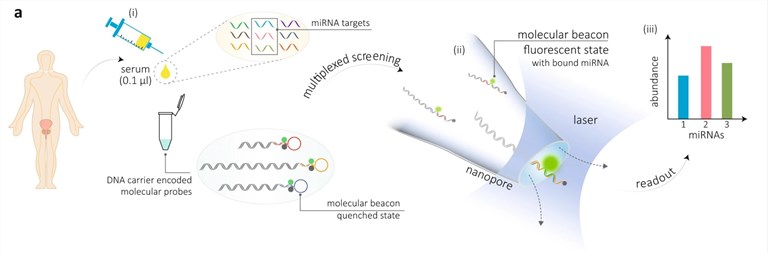 Fig.1 Implementation of the detection of miRNAs directly from patient serum.1
What We Can Offer
High-Throughput Processing
Advanced "Extraction-Free" Options
We provide specialized protocols for direct detection in low-volume or rare laboratory specimens. By utilizing single-molecule sensing, we eliminate extraction-related loss and preserve the integrity of limited biological samples.
Certified Quality Systems
We implement rigorous quality standards and aseptic verification throughout the entire RNA isolation workflow. Our commitment to high-level process control ensures that your research data remains reliable and reproducible.
Extended RNA Repertoire Mapping
Our platform enables deep profiling beyond standard small RNA species. We include high-resolution mapping of stable non-coding fragments and diverse transcript isoforms to provide a complete molecular picture.
Circulating RNA/miRNA Detection Methods Implementation at Creative Biolabs
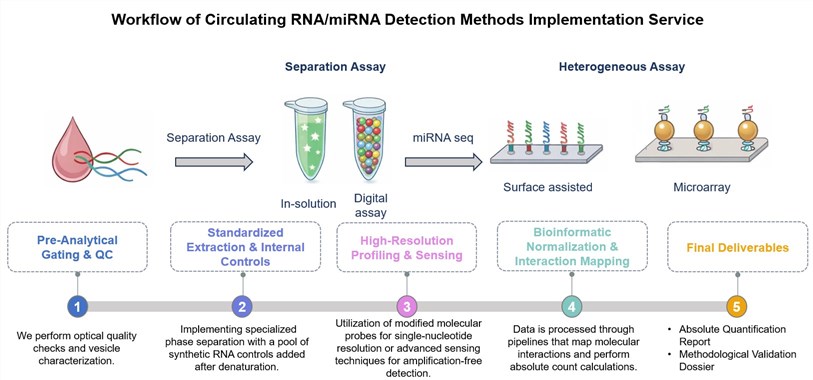
Highlights
Innovative Chemical Design
Creative Biolabs operates at the forefront of chemical and biological synergy. By integrating specialized structural modifications into our molecular probes, we ensure unparalleled precision in identifying specific RNA targets within complex samples.
Targeted Species Accuracy
Our advanced detection framework guarantees the identification of the correct molecular species. This high-resolution approach prevents cross-reactivity issues, allowing researchers to distinguish between highly similar sequences with absolute scientific confidence.

Superior Detection Sensitivity
Built upon proven research, our platform achieves exceptional sensitivity levels. We successfully detect rare molecules in challenging environments, providing deep insights that standard laboratory kits often fail to capture during routine analysis.
Minimized Technical Bias
By utilizing direct sensing in unprocessed fluids, we effectively bypass common extraction biases. This methodology preserves the original molecular distribution, ensuring that your research data reflects true biological conditions without artifacts.
To explore our customized solutions, we invite you to get a quote today.
Customer Reviews
-
High Resolution Specificity
Using Creative Biolabs' integrated probes in our research has significantly improved the discrimination between similar family members, which was a significant challenge with our previous laboratory setup. - Dr. A**n. S. -
Low-Volume Success
The ability to profile small RNA species from extremely low volumes of biofluid using Creative Biolabs' sensing platform facilitated our study, where sample availability was a critical limitation. - Prof. M**c. K.
FAQs
Why is single-nucleotide discrimination so critical for miRNA research?
Many small RNA species belong to families where members differ by only one or two building blocks. Without high-resolution discrimination, you risk "cross-talk" where the signal from a common species masks the low-abundance, research-specific version.
Can you process samples that have been previously frozen?
Yes, provided they were stored at ultra-low temperatures and have not undergone multiple temperature fluctuations. We perform a mandatory quality check on all incoming laboratory samples to assess stability.
Related Services
Gene Expression Profiling Service
We provide high-throughput transcriptomic analysis using advanced sequencing and microarrays. This service facilitates the systematic identification of differentially expressed genes to uncover complex molecular mechanisms in various research models.
Learn More →Microarray-based Tumor Profiling
We utilize high-density microarray platforms to establish molecular fingerprints for various tumor types. This service enables precise cancer classification and the discovery of novel diagnostic markers through genome-wide transcriptomic and methylation profiling.
Learn More →How to Contact Us
Creative Biolabs offers an expert-led service for the implementation of circulating RNA and miRNA detection for basic research. By solving the challenges of specificity, yield, and normalization, we enable our clients to move from discovery to scientific impact with confidence. For detailed information or to discuss your specific research project requirements, please reach out to our technical team.
Reference
- Cai, Shenglin et al. "Single-molecule amplification-free multiplexed detection of circulating microRNA cancer biomarkers from serum." Nature communications vol. 12,1 3515. 10 Jun. 2021. Distributed under an Open Access license CC BY 4.0, without modification. https://doi.org/10.1038/s41467-021-23497-y
 Download our brochure
Loading case studies...
Online Inquiry