We offer a one-stop, fully integrated service from initial target prioritization to final causal MoA mapping, ensuring all parameters-from model choice to assay readout-are custom-tailored to your specific therapeutic target.
Functional Disruption based Longevity Gene Regulatory Network (GRN) Validation Service
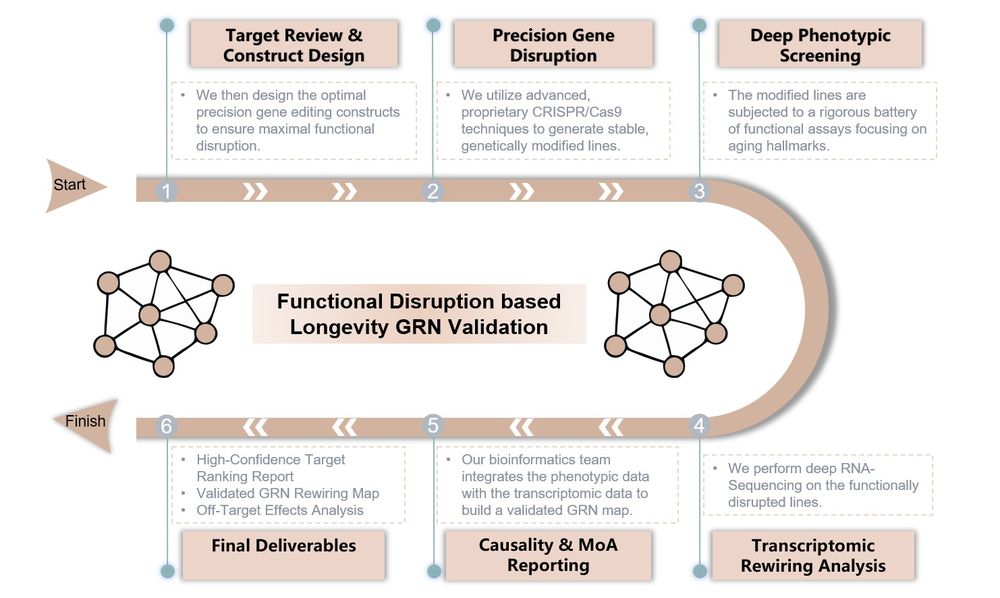
Creative Biolabs provides unparalleled confidence in your longevity targets. We offer a comprehensive functional genomics pipeline anchored in precision CRISPR-based disruption and multi-hallmark phenotypic screening. Our clients gain validated, de-risked therapeutic targets with a confirmed causal mechanism of action (MoA), ensuring minimal attrition and maximum translational speed from discovery to advanced preclinical testing. We eliminate the guesswork, giving you actionable data.
Introduction What We Can Offer Workflow Why Creative Biolabs Customer Reviews FAQs Related Services Contact Us
Validating Longevity GRN Through Functional Disruption
The regulation of longevity is controlled by complex gene regulatory networks (GRNs) involving transcription factors and metabolic sensors. While multi-omic studies provide associative gene lists, recent evidence from model systems like C. elegans shows that chemical or genetic perturbation often yields complex, off-target effects that confound data interpretation. Creative Biolabs' service closes this gap, moving beyond statistical correlation to provide the irrefutable, causal evidence required to validate true therapeutic targets in aging. This functional approach ensures therapeutic potential is confirmed before committing to expensive development.
Initiate engagement: request a detailed consultation.
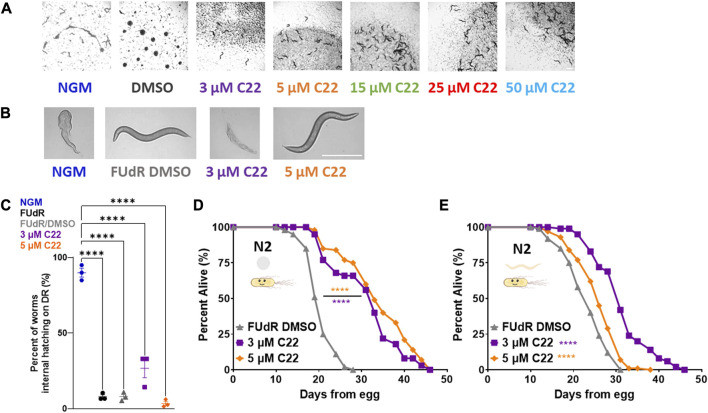 Fig.1 Functional disruption by C22 extends wildtype C. elegans lifespan. 1
What We Can Offer
Bespoke Service Design
Accelerated Functional Validation
Leverage our high-throughput, automated phenotypic screening platforms to drastically reduce the time required to confirm causality across key aging hallmarks (proteostasis, metabolism, senescence).
Causal Data and Network Fidelity Guarantee
We ensure the stability and accuracy of functional disruption across model systems (e.g., C. elegans strains or human iPSCs), rigorously validated by sequencing and multi-site phenotypic verification at key checkpoints.
Expert Project Guidance
You receive direct consultation with our team of longevity geneticists and bioinformatics specialists for bespoke project design, maximizing the functional yield and interpretive power of your data.
Functional Disruption based Longevity GRN Validation Service at Creative Biolabs
Highlights
Causality is Core
We move beyond the limitations of purely statistical association common in multi-omic data, providing irrefutable evidence of a target's functional contribution to aging.
Precision Gene Editing
Our platform goes beyond standard knockouts, employing advanced CRISPR systems to enable tunable, dose-dependent gene modulation, perfectly mimicking the expected action of a therapeutic compound.

Integrated Multi-Hallmark Screening
Our validation focuses on multiple aging hallmarks (metabolism, proteostasis, epigenetics) simultaneously, ensuring the identified target is a true regulator of lifespan, not just an isolated artifact.
Hidden MoA Detection
Our crucial network rewiring analysis is designed to uncover subtle, confounding off-target interactions - like a small molecule intended for one purpose activating a major longevity pathway - which saves millions in late-stage attrition.
Request information to assess comprehensive service capabilities.
Customer Reviews
-
Irrefutable Causal Data.
The utilization of Creative Biolabs' service within our investigative protocols has significantly elevated the confidence level associated with our lead candidates, transitioning the approach from mere transcriptomic correlation to direct functional validation. The quantitative, phenotypic readout provided by the service proves to be an indispensable asset. - J. S***th. -
Mechanism of Action Clarity.
Using Creative Biolabs' service in our research has significantly facilitated the identification of unexpected upstream metabolic signaling in our yeast models, allowing us to redesign our compound before costly optimization. The comparison to previous data was night and day. - A. H***es.
FAQs
Q: What is the primary advantage of your functional disruption approach over standard RNA-Seq screening?
A: Standard RNA-Seq screening provides correlation (what genes change expression). Our functional disruption service provides causality. We physically alter the gene function and then measure the direct, downstream functional consequence on aging hallmarks. This eliminates false positives caused by mere co-regulation.
Q: Which model systems do you typically use for the validation service?
A: We prioritize robust, highly validated models that offer short lifespans and genetic tractability, including C. elegans, S. cerevisiae (yeast), and various human cell lines, including iPSCs and primary cell cultures, depending on the complexity of your GRN and target class.
Related Services
Saccharomyces cerevisiae Model
Leverage the genetic tractability and short lifespan of yeast for rapid, high-throughput validation of genetic perturbations and compound effects on core longevity pathways.
Learn More →C. elegans Model
Utilize the transparent body and well-characterized genetics of the worm model for comprehensive in vivo assessment of lifespan, motility, and stress resistance phenotypes.
Learn More →How to Contact Us
Creative Biolabs ensures your longevity targets are functionally validated, de-risked, and ready for accelerated drug development by combining precision CRISPR/Cas9 editing with multi-hallmark phenotypic screening and advanced network rewiring analysis. Our expert team is prepared to guide you through the process, from initial gene list submission to final MoA report. Please contact us.
Reference
- Beydoun, Safa et al. "C22 disrupts embryogenesis and extends C. elegans lifespan." Frontiers in physiology vol. 14 1241554. 18 Sep. 2023. Distributed under an Open Access license CC BY 4.0, without modification. https://doi.org/10.3389/fphys.2023.1241554
 Download our brochure
Loading case studies...
Online Inquiry