Move past correlative data using our advanced, custom algorithms that definitively establish the directionality and strength of regulatory influence, transforming targets into high-confidence research leads.
Genomic Instability based Longevity Gene Regulatory Network (GRN) Validation Service
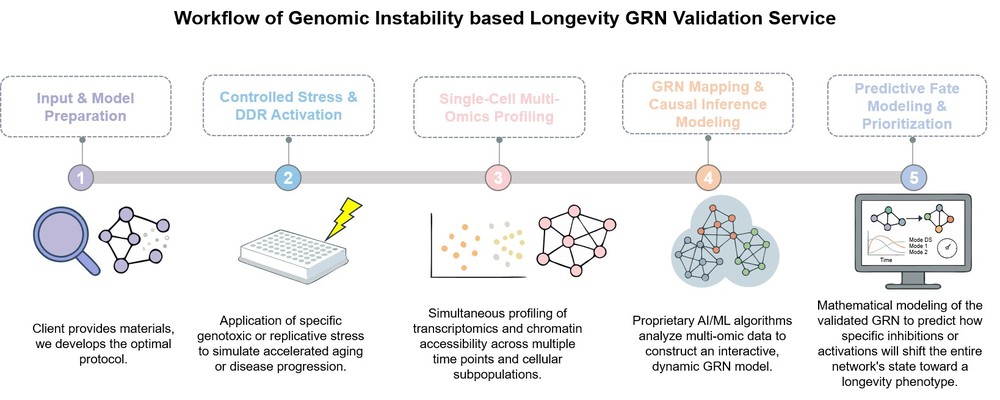
Creative Biolabs' GRN validation service is a complete, predictive platform revolutionizing target discovery. We provide controlled genomic stress induction, high-resolution single-cell multi-omics, and proprietary causal inference modeling. This process precisely maps the gene regulatory network (GRN) governing cellular fate during DNA damage. Clients gain an actionable causal validation report featuring rank-ordered, de-risked research targets with verified causal links to longevity, eliminating the correlation trap and significantly accelerating your discovery phase timeline.
Introduction What We Can Offer Workflow Why Creative Biolabs Customer Reviews FAQs Related Services Contact Us
Validating Longevity GRNs by Targeting Genomic Instability
Genomic instability (GI) is universally recognized as a foundational hallmark of aging, acting as the primary source of stress that dictates the lifespan of an organism. Our service is built on the scientific consensus that cellular fate - whether it enters repair, senescence, or apoptosis - is regulated by a vast, complex gene regulatory network, of which over 10% of the yeast genome is known to contribute to its maintenance. By screening the DDR under controlled GI conditions, we apply causal inference modeling to locate the essential, leveraged nodes.
Initiate an exploration of service capabilities: schedule a confidential consultation.
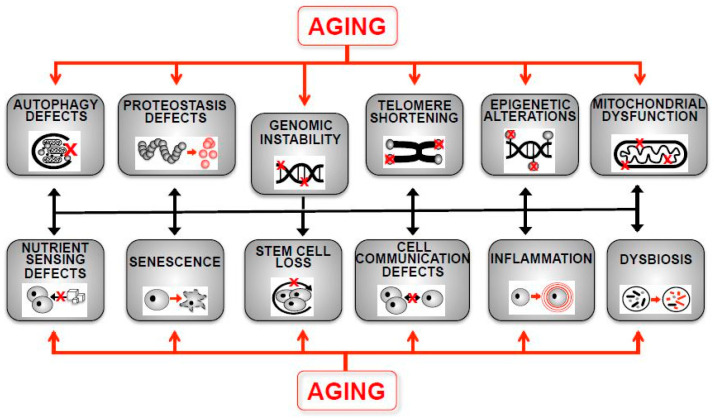 Fig.1 The hallmarks of aging and the central role of genomic instability. 1
What We Can Offer
Proprietary Causal Inference Modeling
Fully Customizable Service
Tailor the entire workflow, from selecting specific genomic stress Inducers and client-provided cell lines (iPSCs, primary tissues) to focusing the analysis on specific sub-networks, ensuring maximum translational relevance.
Single-Cell Multi-Omics Resolution
Guarantee precision by mapping the gene regulatory network at the single-cell level, successfully resolving cellular heterogeneity and identifying rare, critical cell subpopulations missed by bulk sequencing.
End-to-End Scientific Partnership
We offer consultation and support from initial hypothesis formulation through to the final data interpretation, providing the expert guidance necessary for successful research translation.
Genomic Instability based Longevity GRN Validation Service at Creative Biolabs
Why Choose Us?
Causal Inference First
Causal Inference Modeling utilizes custom algorithms to move beyond co-expression data, definitively demonstrating that targeting a network node causes a desirable shift in cellular fate, providing robust therapeutic leads.
Single-Cell Resolution
Mapping the GRN at single-cell resolution captures essential tissue heterogeneity, distinguishing distinct cellular subpopulations and enabling the detection of critical biphasic signaling dynamics.
Mechanistic Validation
Our methodology is based on established data proving that master regulators, are causal drivers of senescence. This approach confirms therapeutic relevance for targets delaying aging phenotypes.
To evaluate the Creative Biolabs advantage, we invite you to request a formal quotation.
Customer Reviews
-
Causal Confirmation
The implementation of the Creative Biolabs service significantly enhanced the conviction regarding our target investigational molecule by furnishing definitive causal and mechanistic evidence concerning its influence on the regulation of the cellular senescence pathway. This resultant level of mechanistic certainty substantially surpasses data derived from conventional bulk RNA sequencing methodologies. - Sera R***. -
Predictive Power
Using Creative Biolabs' genomic instability based longevity GRN validation service in our research has significantly facilitated our ability to predict the efficacy of compound combinations by modeling their simultaneous impact on the GRN switch points. The predictive success rate was ~ 20% higher than our previous in silico modeling. - Pul F**.
FAQs
Q: Which model systems and cell types are suitable for the GRN Validation Service?
A: We routinely process primary human cells (e.g., fibroblasts, stem cells), primary-derived induced pluripotent stem cells (iPSCs), and established mammalian cell lines. Our protocols are also adaptable for tissue samples from accelerated aging mouse models, ensuring the relevance of the GRN map to human healthspan diseases.
Q: What type of research targets is the GRN Validation Service most effective at identifying?
A: The service is optimal for de-risking and identifying novel targets across all age-related pathologies where GI is implicated, including oncology (tumor suppression), neurodegenerative diseases, cardiovascular disease, and systemic senescence-associated disorders. It excels at identifying regulators of the SASP and DNA repair complexes.
Related Services
Longevity Gene related Proteasome Feedback Circuit Design
A specialized service for synthetic circuit design that computationally optimizes the functional manipulation of proteasome activity or other protein turnover machinery identified as a causal node in the GRN analysis.
Learn More →Proteostasis Loss
A dedicated service mapping the GRN governing protein quality control, including unfolded protein response and autophagy, to identify causal nodes for proteotoxicity-related aging phenotypes.
Learn More →How to Contact Us
Creative Biolabs transforms speculative targets into validated, actionable research targets, dramatically reducing attrition and accelerating your translational path by providing causal, single-cell resolution of the networks governing cellular fate. Contact our team for more information and to discuss your project.
Reference
- López-Gil, Lucía et al. "Genomic Instability and Epigenetic Changes during Aging." International journal of molecular sciences vol. 24,18 14279. 19 Sep. 2023. Distributed under an Open Access license CC BY 4.0, without modification. https://doi.org/10.3390/ijms241814279
 Download our brochure
Loading case studies...
Online Inquiry