Histone Deacetylase (HDAC) Panel Screening Service
Our Histone Deacetylase (HDAC) Panel Screening Service offers a specialized platform for identifying inhibitors of HDAC enzymes, a family of proteins responsible for removing acetyl groups from histone proteins and other non-histone substrates. Our comprehensive screening service allows researchers to screen large compound libraries or biologics, identify potent HDAC inhibitors, and explore their therapeutic potential in a variety of disease models.
Histone Deacetylase (HDAC) Overview
HDACs are important modulators of gene expression and chromatin structure. By removing acetyl groups from histones and other proteins, HDACs reverse acetylation, a post-translational modification that is generally associated with gene silencing. The acetylation-deacetylation cycle plays a critical role in cellular processes such as DNA repair, transcription, cell cycle regulation, and apoptosis. There are 18 known human HDACs, classified into four main classes:
- Class I (HDAC1, HDAC2, HDAC3, HDAC8): Mainly found in the nucleus, these proteins regulate the expression of genes.
- Class II (HDAC4, HDAC5, HDAC6, HDAC7, HDAC9, HDAC10): Shuttles between the nucleus and cytoplasm, with roles in development and disease.
- Class III (Sirtuins, SIRT1-7): NAD+-dependent HDACs that control aging, stress response, and cellular metabolism.
- Class IV (HDAC11): Shares similarities with both Class I and III HDACs, with a yet to be fully understood role in cellular processes.
Histone Deacetylase (HDAC) Panel Screening Service at Creative Biolabs
We offer:
Our HDAC Panel Screening Service provides comprehensive assays for the screening of HDAC inhibitors across multiple classes.
- Broad HDAC Panel: A panel covering the most commonly studied HDAC enzymes from Class I, II, and IV, including HDAC1, HDAC2, HDAC3, HDAC6, HDAC8, and HDAC11, as well as Class III sirtuins (SIRT1-7).
- Enzyme Activity Assays: Measure the enzymatic activity of HDACs by detecting the deacetylation of histone substrates or synthetic peptides, typically using fluorescence or colorimetric methods.
- Inhibition Assays: Test compounds for their ability to inhibit HDAC activity by measuring the reduction in deacetylase activity in the presence of small molecules or biologics.
- Cell-Based Assays: Evaluate the functional effects of HDAC inhibitors in cultured cells, such as changes in histone acetylation, gene expression, cell cycle progression, and apoptosis. These assays are designed to mimic physiological conditions and assess the compound's potential in vivo.
- Selectivity and Potency Profiling: Assess the specificity and potency of compounds against individual HDAC isoforms, helping to identify the most selective inhibitors and determine the dose-response relationship.
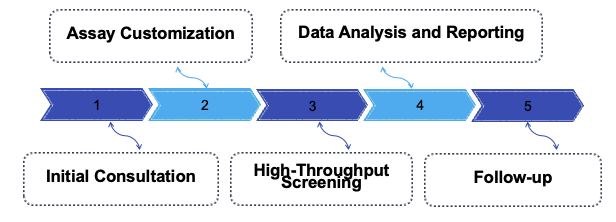
Service process:
Why Choose Us
- Comprehensive HDAC Coverage: Our panel includes HDACs from multiple classes, enabling the evaluation of a wide range of compounds for their ability to modulate different HDAC isoforms.
- Customization and Flexibility: Assays are tailored to meet the specific needs of your research, whether it's targeting a specific HDAC isoform, investigating selectivity, or testing compounds in cellular models.
- High-Throughput Screening: Drug development initiatives benefit greatly from the quick, high-throughput screening of vast compound libraries made possible by advanced screening technologies.
- Precise Data: We provide detailed and precise data, including IC50 values, inhibition profiles, and selectivity ratios, so you can make informed decisions about compound efficacy.
- Cell-Based Functional Assays: In addition to biochemical assays, our cell-based assays assess the functional effects of HDAC inhibitors, providing insights into their potential therapeutic applications.
Frequently Asked Questions
A1: Which HDAC isoforms are included in your screening panel?
Q1: Our panel includes HDAC1, HDAC2, HDAC3, HDAC6, HDAC8, and HDAC11 from Class I, II, and IV, as well as sirtuins (SIRT1-7) from Class III. Additional HDACs can be included upon request.
A2: What data will I receive from the screening?
Q2: You will receive a detailed report with IC50 values, dose-response curves, inhibition profiles, and selectivity information, helping you identify the most promising HDAC inhibitors for your research.
Contact Us
We invite you to connect with our specialized team for any inquiries related to our Histone Deacetylase (HDAC) Panel Screening Service. Whether you need detailed information about our testing methods, sample requirements, or data analysis, our dedicated experts are here to assist you. Your research is our priority, and we look forward to collaborating with you to advance your studies on HDAC dynamics and their implications in various biological contexts.
 Download our brochure