Creative Biolabs provides state-of-the-art flow cytometry based apoptosis assay services. We use gold-standard assays like Annexin V/PI and methods to detect DNA fragmentation, caspase activation, and mitochondrial depolarization to study cellular death.
Learn More →Human Breast Cell MCF-7 based Proliferation Assay Service
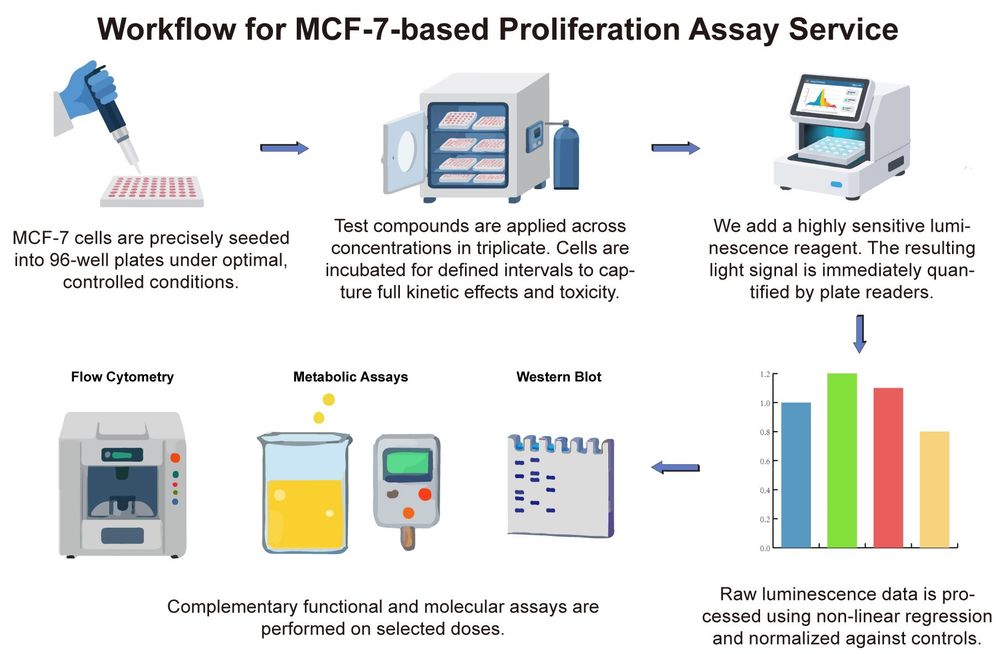
At Creative Biolabs, we employ a quantitative, high-throughput luminescence based methodology for superior sensitivity and dynamic range in cell assessment. This ATP based method offers a far cleaner signal and ensures higher fidelity and accuracy compared to older, less sensitive colorimetric assays like MTT. Since MTT is often prone to compound interference, our luminescence based approach effectively eliminates false positives and negatives, guaranteeing reliable determination of a treatment's effect on cellular viability and proliferation.
Background What We Can Offer Workflow Publication Why Choose Us FAQs Customer Review Related Services Contact Us
Leveraging the Gold Standard Human Breast Cell MCF-7 Proliferation Assay
The MCF-7 cell line is the definitive in vitro model for estrogen receptor-positive (ER+) breast cancer research due to its robust estrogen receptor expression. Its translational relevance is supported by literature showing that factors like cell-to-cell interactions drive doxorubicin resistance, and oncogenic drivers like c-Myc control proliferation. Our service utilizes high-sensitivity ATP quantification to accurately assess compound potency. We complement this with advanced molecular and metabolic assays to validate efficacy against key targets, ensuring your research yields translationally relevant results.
Specific Solutions and Deliverables
Quantitative Potency Ranking
We deliver highly accurate IC50 and EC50 values, enabling precise, numerical ranking and objective compound prioritization for downstream studies.
Validated Mechanistic Confirmation
We confirm if your agent works via intended pathways and validate key outcomes, such as apoptosis induction via the Bax/Bcl-2 ratio or modulation of oncogenes.
Early Resistance Profiling in Complex Models
Our core assays can be adapted to complex models to profile early resistance, identifying compounds that fail due to EGF-driven drug resistance or poor tissue penetration.
Discover How We Can Help - Request a Consultation
Workflow
Our workflow at Creative Biolabs is built on a foundation of scientific rigor and operational efficiency, guaranteeing transparent and actionable results suitable for regulatory submission and publication.
Publication
This study investigated the anti-tumor mechanism of emodin, a natural anthraquinone, in MCF-7 breast cancer cells, finding that it significantly inhibits proliferation and induces apoptosis. Network analysis identified the aryl hydrocarbon receptor (AhR) as the key target. Experimental validation confirmed Emodin acts as an AhR agonist, upregulating CYP1A1 expression. The AhR inhibitor CH223191 attenuated these effects, providing compelling evidence that Emodin exerts its anti-tumor activity primarily through the AhR-CYP1A1 signaling pathway.
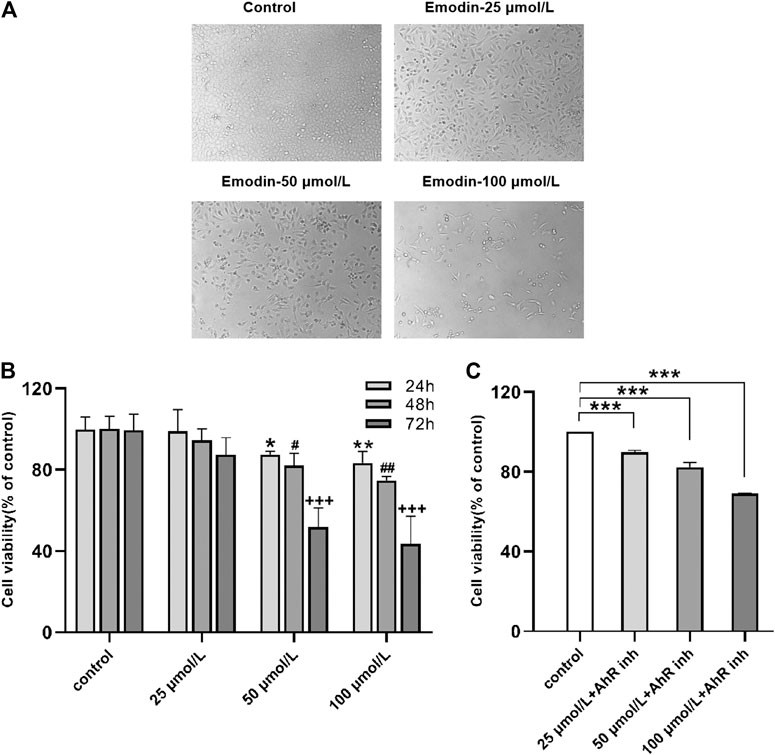 Fig.1 Emodin suppresses the proliferation and growth of MCF-7 breast cancer cells. 1
Why Choose Us
As a globally recognized leader in immuno-oncology and preclinical services, Creative Biolabs is uniquely equipped to manage your critical screening projects. Our exceptional scientific pedigree provides decades of experience in tumor cell biology, understanding nuances like EGF-driven resistance and Warburg effect metabolic reprogramming in the MCF-7 model. We adhere to unparalleled quality control standards for reproducibility and reliability. Our services offer integrated solutions, seamlessly combining the proliferation assay with xenograft model generation, biomarker analysis, and complementary techniques like clonogenicity assays, flow cytometry, and metabolic assays to fully validate your drug's mechanism of action.
Partner with Precision. Experience the Creative Biolabs Difference – Get Your Quote.
FAQs
Q1: Is it possible to test my compound for selectivity against non-cancerous cells to establish a safety window?
A1: Absolutely. We strongly recommend including the non-tumorigenic breast epithelial cell line in your screening panel. This provides a crucial therapeutic index and selectivity profile, which is vital for de-risking your compound early in development.
Q2: What materials do I need to supply to begin the project and ensure rapid commencement?
A2: We require the test compound stock and any available preliminary data or a specific molecular target hypothesis. Providing your target IC50 range helps us optimize the assay design immediately.
Q3: Can this assay definitively differentiate between cytotoxic (killing) and cytostatic (growth arrest) effects?
A3: While the IC50 primarily measures the net loss of viable cell mass, we recommend performing an additional clonogenicity assay and cell cycle analysis to definitively distinguish between a compound that kills cells and one that merely halts their division.
Customer Review
-
Metabolic Insights
Using Creative Biolabs' service in our research has significantly facilitated the screening of glycolytic inhibitors. Their optional metabolic assays (glucose/lactate) quickly verified that our compound directly suppresses the Warburg Effect. - Sa M**r -
Superior Selectivity Screening
Using Creative Biolabs' human breast cell MCF-7 based proliferation assay service in our research has significantly improved/facilitated establishing the therapeutic index for our small molecule library. - D*n Pl
Related Services
To maximize the mechanistic and translational value of your MCF-7 proliferation assay data, Creative Biolabs offers several highly complementary services:
Cell Apoptosis Assessment Services
Oxidative Stress Analysis Service
Creative Biolabs offers oxidative stress-induced cardiotoxicity analysis services. We use sensitive methods to evaluate the effects of anticancer agents on heart health, assessing oxidative stress levels, apoptosis, and myocardial cell damage.
Learn More →Contact Us
Creative Biolabs delivers more than just proliferation numbers; we provide mechanistic certainty. Our human breast cell MCF-7 based proliferation assay service leverages the gold standard cell line and advanced analytical techniques to accelerate your breast cancer therapeutic discovery process, ensuring your resources are focused on the most promising lead candidates with validated profiles.
Ready to validate your next oncology breakthrough? Contact Our Team for More Information and to Discuss Your Project
Reference
- Zhang, Ning, et al. "Emodin inhibits the proliferation of MCF-7 human breast cancer cells through activation of aryl hydrocarbon receptor (AhR)." Frontiers in Pharmacology 11 (2021): 622046. Distributed under Open Access license CC BY 4.0, without modification. https://doi.org/10.3389/fphar.2020.622046
 Download our brochure
Loading case studies...
Online Inquiry