Creative Biolabs' service utilizes multi-omic platforms (metabolomics, gene/protein profiling) and live metabolic flux analysis to unravel the Warburg effect and pentose phosphate pathway in cancer cells.
Learn More →Human Leukemia Cell K562 based Proliferation Assay Service
The K562 platform at Creative Biolabs offers dual utility for small molecule and cell therapy programs: providing precise IC50 determination for novel agents and serving as a validated feeder system for high-yield NK cell expansion. Our core solutions deliver definitive proof of concept, reducing translational risk. Deliverables include quantifying inhibitory potential against the BCR-ABL signaling cascade, confirming cytotoxicity in drug-sensitive and drug-resistant variants, and manufacturing clinical-ready NK cells. Our rigorous assays provide the essential mechanistic clarity required for IND submission.
Background Workflow Publication Why Choose Us FAQs Customer Review Related Services Contact Us
The Strategic Importance of the K562 Model
The K562 cell line is a foundational leukemia model, characterized by the Philadelphia chromosome and the BCR-ABL fusion gene. This genetic hallmark makes it exquisitely relevant for screening agents, particularly tyrosine kinase inhibitors (TKIs), targeting the BCR-ABL pathway. Beyond TKI testing, K562's robust growth and susceptibility to apoptotic signals make it a versatile platform for determining IC50 of novel small molecules, investigating modulatory effects on pathways like AKT and NF-κB, and serving as a crucial target cell line in co-culture assays for evaluating immunotherapy efficacy (CART and NK cells).
Ready to launch your pre-clinical validation? Discover How We Can Help - Request a Consultation.
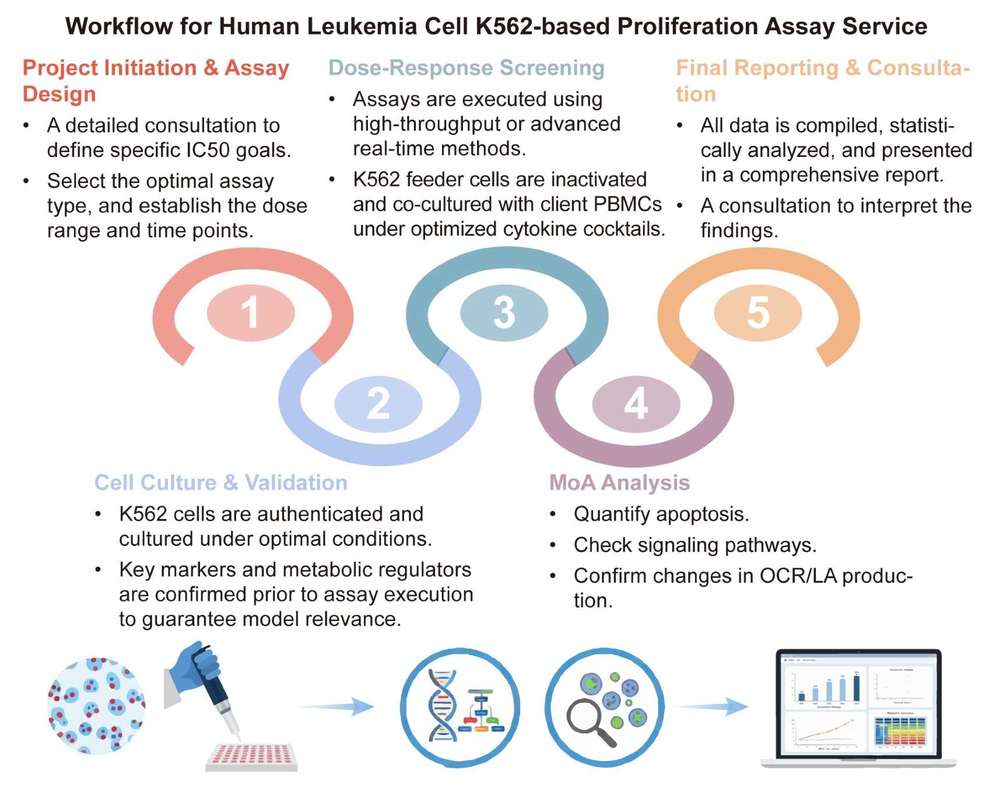
Workflow: Comprehensive Evaluation from Design to Delivery
Our process is designed for clarity, efficiency, and full client transparency, ensuring every project yields actionable data suitable for visualization as a comprehensive flowchart.
Publication
This study investigates the anti-leukemic potential of ampelopsin (dihydromyricetin), a natural flavonoid, using HL60 and K562 human leukemia cell lines. Ampelopsin effectively suppresses proliferation and exhibits low toxicity to normal cells. Its mechanism is multifaceted: it induces cell cycle arrest (sub-G1 or S phase) and triggers mitochondrial-mediated apoptosis through reactive oxygen species (ROS) generation and caspase activation. Furthermore, ampelopsin downregulates the pro-survival AKT and NF-κB pathways and suppresses leukemia stemness markers. These results position ampelopsin as a promising chemotherapeutic candidate for leukemia.
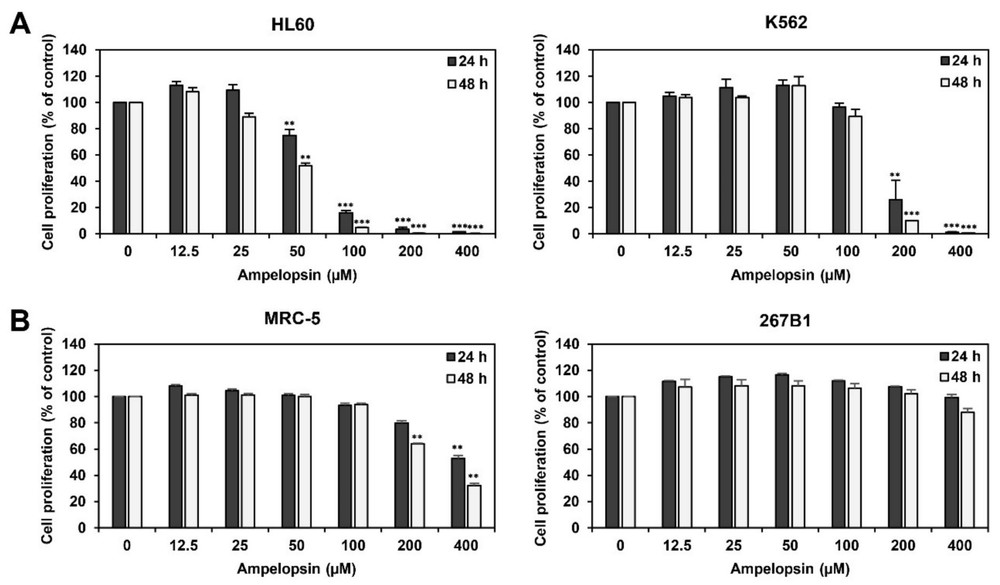 Fig.1 Ampelopsin inhibits the proliferation of leukemia cells. 1
Why Choose Us
Creative Biolabs' multifaceted K562 platform moves beyond simple viability, providing deep mechanistic insights. We offer an unmatched NK cell feeder system, using K562 cells to drive NK cell expansion by almost 20-fold, accelerating cell therapy development. Our integration of real-time cell analysis (RTCA) provides continuous drug-cell interaction profiles, precisely differentiating cytostatic from cytotoxic agents. We offer integrated metabolic and resistance profiling using variants like K562/imaR to identify multidrug resistance (MDR) early. This comprehensive validation and mechanism-of-action (MoA) clarity (e.g., via AKT/NF-κB profiling) is crucial for robust IND submission.
Experience the Creative Biolabs Advantage - Get a Quote Today
FAQs
Q: Is the K562 feeder platform suitable for my specific NK cell source?
A: Yes, the platform is highly flexible. The K562 feeder protocol is validated for use with CD3+-depleted PBMCs and is easily adaptable to other sources like cord blood-derived NK cells. We ensure superior expansion and enhanced cytotoxicity regardless of the initial source.
Q: Can you help us confirm the specific MoA for our compound?
A: Absolutely. Our service is designed for MoA clarification. We routinely perform advanced analysis to provide definitive, multi-dimensional evidence of your compound's action. If you have a novel target, inquire today about customizing our MoA panel.
Q: How does the K562 model handle drug resistance comparisons?
A: We maintain and utilize specialized cell lines, such as imatinib-resistant K562/imaR variants. This allows direct comparison between drug-sensitive and drug-resistant models to help identify and circumvent potential MDR mechanisms right at the pre-clinical stage.
Customer Review
-
Real-Time Kinetics
Using Creative Biolabs' service in our research has significantly facilitated differentiating between cytostatic and cytotoxic effects. The continuous RTCA data eliminated the need for multiple endpoint assays and saved us weeks. – Dr. Sam*l -
NK Cell Manufacturing
Using Creative Biolabs' service in our research has significantly improved the scale-up of our NK cell therapeutic candidate. The 20-fold expansion rate and high NKG2D expression provided a superior manufacturing platform that we couldn't achieve with standard methods. – Ptr J*n
Related Services
Creative Biolabs offers complementary services to ensure seamless progression through your oncology research goals, maximizing the data gained from the K562 platform.
Tumor Glucose Metabolic Pathway Analysis Service
Function Assays for Immune Checkpoint
Creative Biolabs offers a novel, one-stop service for immune checkpoint functional assays, leveraging advanced technology and deep IO understanding to identify target molecules that modulate immune function.
Learn More →Contact Us
Creative Biolabs' human leukemia cell K562 based proliferation assay service provides a holistic solution for drug screening and cell therapy manufacturing. By leveraging the model's unique BCR-ABL genetics, metabolic insights, and superior NK cell feeder capability, we deliver the high-fidelity data required to confidently advance your therapeutic candidates with speed and precision.
Contact Our Team for More Information and to Discuss Your Project
Reference
- Han, Jang Mi, Hong Lae Kim, and Hye Jin Jung. "Ampelopsin inhibits cell proliferation and induces apoptosis in HL60 and K562 leukemia cells by downregulating AKT and NF-κB signaling pathways." International Journal of Molecular Sciences 22.8 (2021): 4265. Distributed under Open Access license CC BY 3.0, without modification. https://doi.org/10.3390/ijms22084265
 Download our brochure
Loading case studies...
Online Inquiry