This service concentrates on the temporal activity and binding kinetics of critical transcription factors that govern global gene expression. The analysis models the time-dependent changes in TF activity and how these shifts contribute to the destabilization of the healthy regulatory phenotype.
Learn More →Longevity Gene Regulatory Network (GRN) Model Optimization Services
Creative Biolabs' longevity gene regulatory network (GRN) model optimization services provide a highly specialized, systems biology approach to therapeutic target identification in aging. What we provide is a complete, one-stop workflow: we take your complex multi-omics data, rigorously filter and process it, and utilize our proprietary algorithms to build a dynamic, causal model of the aging network. What our clients gain is the ability to bypass traditional screening bottlenecks and focus immediately on master regulator targets-genes and proteins with maximum leverage over the aging process. We offer fully customizable modeling modes to perfectly match your specific research requirements.
Introduction What We Can Offer Workflow Why Creative Biolabs Customer Reviews FAQs Related Services Contact Us
Conceptual Overview of the Longevity GRN Model Optimization Services
Aging is a complex systems failure driven by the collapse of the Longevity GRN. This network, comprising thousands of molecular interactions, dictates cellular homeostasis. Our service moves beyond reductionist correlations to utilize advanced computational systems biology and dynamics to model these interactions. This approach, strongly supported by recent literature on network topology and biological modularity, focuses on identifying master regulators and stabilizing homeostatic "attractor states."
Initiate partnership: request a formal consultation.
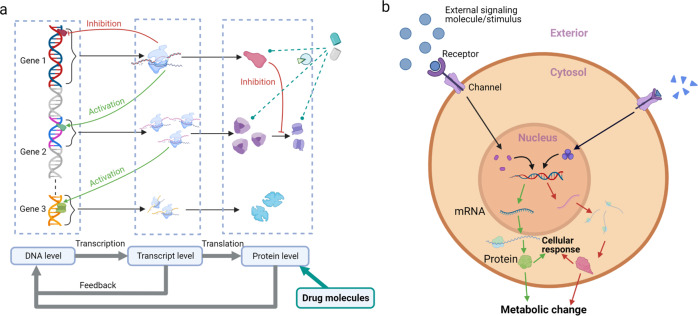 Fig.1 Schematic diagrams of dynamics analysis for Longevity GRN optimization.1
What We Can Offer
Transcription Factor Activity Dynamics Analysis
Multiprotein Kinase Node Dynamics Analysis
This modality provides a rigorous analysis of the dynamic phosphorylation and signaling output profiles of essential regulatory nodes driven by kinase activity. This service is pivotal for comprehending rapid cellular adaptive responses and signaling cascade failure associated with aging.
Learn More →Cellular Metabolic Activity Dynamics Analysis
This offering systematically integrates metabolomics data with the GRN topology. The modeling objective is to elucidate how perturbations in cellular energy homeostasis and nutrient-sensing pathways function as upstream drivers of aging-related transcriptional alterations.
Learn More →How We Can Help
Highlights
Comprehensive End-to-End GRN Analysis
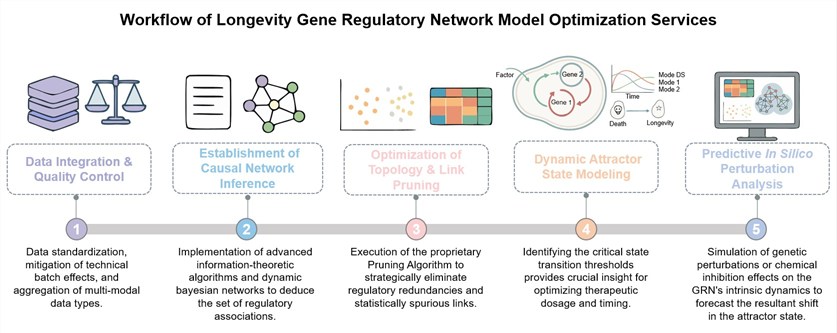
We provide an integrated service spanning initial multi-omics data standardization, stringent quality control, data aggregation, final Master Regulator identification, and extensive in silico perturbation analyses.
Delivery of Validated Master Regulators
Clients are supplied with a quantitatively ranked inventory of high-confidence Master Regulator genes and proteins, rigorously validated for their capacity to exert maximal influence over the stability of the aging network, thereby assuring the highest potential for therapeutic efficacy.

Predictive-by-Design Framework
Our architectural framework incorporates proprietary topology optimization, stringent quality assurance protocols, and specialized Pruning Algorithms to substantiate the causal rigor of the network and minimize the resource-intensive investigation of irrelevant or false positive targets.
Expedited Target Qualification
Preclinical screening timelines are substantially reduced by employing our models to predict the success of an intervention in shifting the cellular state from senescent/pathological attractors toward a resilient, homeostatic phenotype.
To fully understand the Creative Biolabs' advantage, we invite you to get a quote today.
Customer Reviews
-
Enhanced Specificity
The application of the service within our experimental protocol has demonstrably improved the specificity of our transcription factor binding analysis. The integrated epigenetic step resulted in a reduction of the false positive rate exceeding 40%. - J. ***s, Ph.D. -
Causality in Discovery
Integration of the service has significantly facilitated the transition from correlative observation to causal target identification. The dynamic attractor modeling capability allowed for the efficient circumvention of an estimated six months of repetitive in vitro screening by accurately predicting system-level perturbation response. - A. ***k, Research Director.
FAQs
If our organization already possesses a prioritized list of targets derived from conventional transcriptomic studies, what additional value does this service provide?
We utilize existing targets for predictive in silico perturbation analysis. This rigorous process validates whether the target's influence on the GRN is sufficient to shift the system toward the healthy attractor state, confirming potential efficacy and leverage.
What constitutes the principal methodological distinction between this service and standard pathway enrichment analysis?
Pathway enrichment is descriptive; our service is fundamentally predictive and causal. We generate a dynamic network map that articulates how regulatory interactions unfold across time, enabling the precise identification of high-leverage master regulators.
Related Services
Bispecific Antibody Engineering
This offering leverages the validated master regulators identified through the GRN analysis to inform the rational design of highly specific bispecific antibodies or other novel biologics, targeting the identified network nodes or their essential upstream/downstream regulatory effectors.
Learn More →Multi-omic Analyses
Provides expert data cleaning, normalization, and standardization of disparate multi-omics datasets to ensure optimal input quality and analytical integrity for the GRN construction and modeling phases.
Learn More →How to Contact Us
Creative Biolabs represents a transformative methodological advancement in aging research, effectively converting the challenge of complex biological system failure into clear, actionable, and executable therapeutic strategies. By maintaining a rigorous focus on dynamic causality, topological robustness, and predictive simulation, we empower research teams to effectively circumvent data noise and low-leverage targets, thereby enabling direct intervention at the core regulatory mechanisms of biological aging. Please contact us.
Reference
- Yue, Rongting, and Abhishek Dutta. "Computational systems biology in disease modeling and control, review and perspectives." NPJ systems biology and applications vol. 8,1 37. 3 Oct. 2022. Distributed under an Open Access license CC BY 4.0, without modification. https://doi.org/10.1038/s41540-022-00247-4
 Download our brochure
Loading case studies...
Online Inquiry