We manage the entire pipeline from initial discovery and pilot validation to large-scale research cohort screening, providing a cohesive workflow that eliminates technical gaps between early and late-stage research.
miRNA Diagnostic/Prognostic Classifier Construction Service
Creative Biolabs provides a complete end-to-end computational and biological pipeline for identifying robust molecular signatures. We provide high-fidelity miRNA profiling, advanced feature selection, and machine-learning model development. Clients can expect to gain highly accurate, mathematically validated classifiers that facilitate precise sample stratification, identify potential research leads, and provide a deep understanding of regulatory RNA networks within their specific experimental models.
Introduction What We Can Offer Workflow Why Creative Biolabs Customer Reviews FAQs Related Services Contact Us
The Role of miRNA Research Classifier Construction
MicroRNAs (miRNAs) are pivotal regulators of gene expression. Recent findings emphasize that multi-miRNA signatures outperform single biomarkers in research sensitivity and specificity. By leveraging advanced modeling and rigorous pre-analytical standards, Creative Biolabs converts these small RNAs into powerful research classifiers. We conclude that integrating miRNA signatures with research tools provides the most effective transition for modern molecular analysis.
Discover How We Can Help - Request a Consultation.
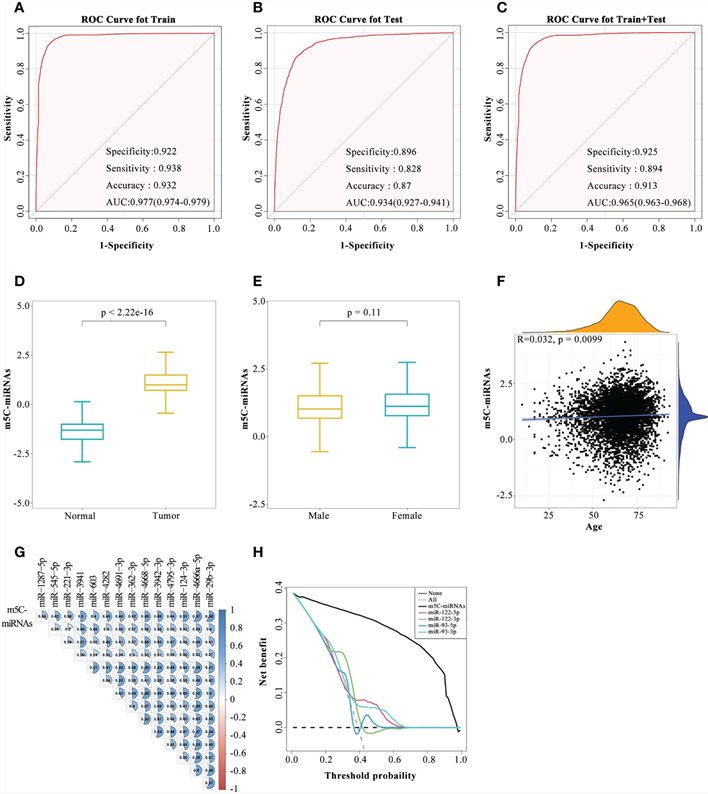 Fig.1 Construction of the diagnostic model based on the candidate m5C-miRNAs.1
What We Can Offer
One-stop biomarker research service
Highly customized analytical solutions
Our methodologies are tailored to specific research areas, including comparative oncology studies, neurobiology research, and metabolic profiling, ensuring that the resulting classifiers are relevant to your unique biological context.
Standardized quality systems
We incorporate advanced process analytical techniques for robust model training, ensuring that every model is built upon high-quality data and follows rigorous principles to prevent over-fitting and bias.
Strict pre-analytical validation
We utilize automated quality scoring and RNA integrity verification for every biofluid sample to prevent common contaminants from skewing your results, ensuring that only the highest quality data enters the pipeline.
Strategic Integration of Creative Biolabs' miRNA Research Classifier Construction Service
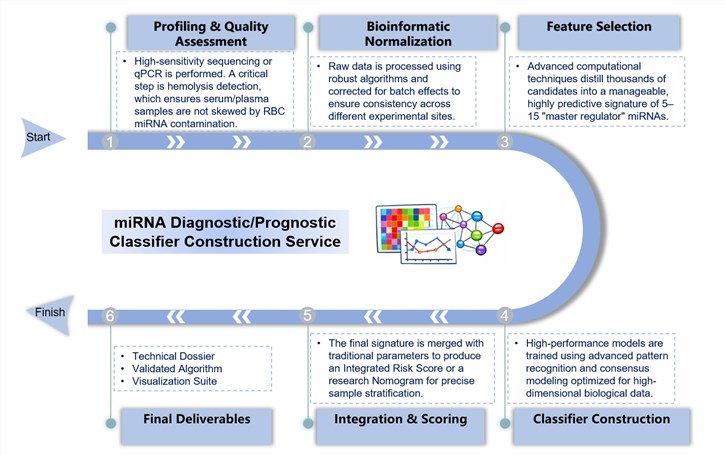
Highlights
Multidisciplinary Expertise
Creative Biolabs stands at the intersection of deep molecular biology and advanced data science, allowing us to bridge the gap between complex laboratory findings and sophisticated computational modeling for research.
Proprietary Descriptor Systems
Our unique advantage lies in our Multi-miRNA Descriptor System, which incorporates not only expression levels but also sequence-based descriptors and target-gene connectivity to enhance model accuracy and stability.

Biological Context Integration
Unlike generic bioinformatic services, we prioritize the biological sense of every classifier, ensuring that each selected marker has a documented and meaningful role in the specific research pathways.
Rigorous Analytical Validation
We ensure that every miRNA in your final research signature is backed by solid evidence, providing a robust and reproducible tool that meets the highest standards of scientific inquiry.
To leverage the analytical advantages provided by Creative Biolabs' specialized methodologies, we invite you to get a quote today.
Customer Reviews
-
Distinction of Histological Subtypes
Employment of the miRNA Classifier Construction Service facilitated by Creative Biolabs has yielded substantial improvements in our resolution of closely related histological subtypes. This refined discriminatory power proved instrumental within our thyroid research models. - Dr. A**n. L. -
Optimization of Liquid Biopsy Analysis
The integration of Creative Biolabs' specialized construction protocols significantly expedited our development of a non-invasive screening framework. Consequently, we achieved enhanced detection stability in colorectal research models. - Prof. M***e. S.
FAQs
Can you build classifiers from archived FFPE research samples?
Yes. Owing to the inherent structural stability of miRNAs within formalin-fixed, paraffin-embedded matrices, these molecules remain viable for analysis over extended durations. We employ refined isolation techniques to ensure high-fidelity recovery from even long-term archival specimens.
How do you ensure the signature isn't just a statistical artifact?
Each identified signature undergoes comprehensive cross-referencing against established regulatory pathways and protein-interaction networks. This verification step ensures the selected candidates possess clear biological connectivity, thereby reducing the likelihood of identifying spurious correlations.
Related Services
PCR-based Tumor Profiling
We utilize high-sensitivity polymerase chain reaction techniques to map the molecular heterogeneity of research models, providing detailed insights into mutational patterns and expression profiles across diverse experimental specimens.
Learn More →Reporter Tumor Cell Line Construction Service
We engineer specialized reporter systems within various cell lines to facilitate real-time monitoring of transcriptional activity and signaling pathways, providing researchers with sensitive tools for high-throughput screening and mechanistic studies.
Learn More →How to Contact Us
Creative Biolabs provides an end-to-end solution for turning miRNA expression data into validated, research-grade classifiers. By combining over 20 years of biological expertise with cutting-edge computational analysis and rigorous pre-analytical standards, we help you overcome the complexities of molecular discovery. To learn more about how our services can protect your research and to get a personalized project quote, please contact us.
Reference
- Tang, Fuzhou et al. "Construction of a serum diagnostic signature based on m5C-related miRNAs for cancer detection." Frontiers in endocrinology vol. 14 1099703. 27 Jan. 2023. Distributed under an Open Access license CC BY 4.0, without modification. https://doi.org/10.3389/fendo.2023.1099703
 Download our brochure
Loading case studies...
Online Inquiry