We specialize in high-throughput screening (HTS) to efficiently identify novel PARP inhibitors from vast compound libraries. Following initial hit identification, our services extend to comprehensive compound profiling, including the determination of half-maximal inhibitory concentration (IC50) values and detailed selectivity assessments across various PARP isoforms. This meticulous approach is crucial for minimizing off-target effects and identifying compounds with optimal therapeutic windows. We also offer lead generation and structure-activity relationship (SAR) studies to systematically optimize compound potency and pharmacokinetic properties.
Poly(ADP-ribose) Polymerase (PARP) Panel Screening Service
Background Service Highlights FAQs Contact Us
Introduction to Poly(ADP-ribose) Polymerase (PARP) and its Therapeutic Significance
Poly(ADP-ribose) Polymerase (PARP) represents a family of 17 distinct proteins, each playing a pivotal role in maintaining cellular homeostasis. These enzymes are fundamentally involved in crucial biological processes, including DNA damage repair, chromatin remodeling, gene transcription, cell division, and programmed cell death. Their primary mechanism involves the transfer of ADP-ribose units from NAD+ to target nuclear proteins, forming poly(ADP-ribose) (PAR) chains. This intricate process is indispensable for recruiting repair enzymes to sites of DNA damage, particularly in response to single-strand DNA breaks. While essential for cellular integrity, dysregulation or excessive activation of PARP can have detrimental effects, potentially leading to cell death. Furthermore, certain PARP proteins have been implicated in inflammatory responses and can even promote tumor cell proliferation through pathways like Wnt signaling. Given their central role in DNA repair and cellular regulation, PARP enzymes have emerged as highly significant targets for therapeutic intervention, especially in oncology.
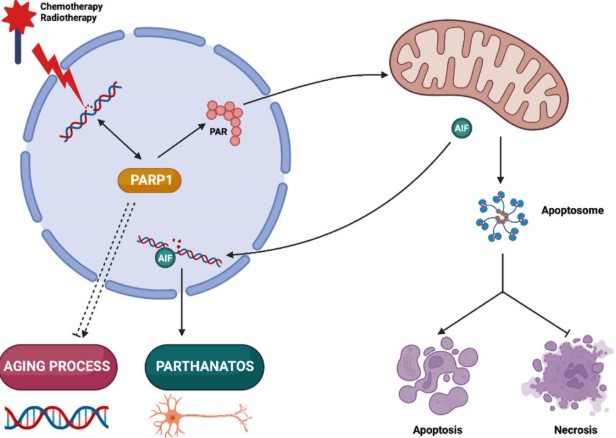 Fig.1 PARP1 functions in cellular life and death.1
Our Poly(ADP-ribose) Polymerase (PARP) Panel Screening Service
At Creative Biolabs, we understand the immense potential of PARP inhibition in modern medicine. Our dedicated PARP Panel Screening Service is engineered to support drug developers at every stage, from initial hit identification to lead optimization. Leveraging our extensive expertise and state-of-the-art facilities, we provide fast, reliable, and cost-effective solutions for characterizing PARP inhibitors. Our commitment is to deliver precise and actionable data that guides informed decision-making and significantly expedites epigenetic drug research programs.
Comprehensive Service Content for PARP Inhibitor Development
Creative Biolabs offers a multifaceted approach to PARP inhibitor screening, encompassing a wide array of advanced biochemical and cell-based assays. Our service content is designed to provide a holistic understanding of compound efficacy, selectivity, and mechanism of action.
High-Throughput Screening (HTS) and Compound Profiling
Advanced Assay Technologies
Our service portfolio incorporates a diverse range of cutting-edge assay technologies, ensuring robust and reproducible results:
-
Biochemical Activity Assays: These in vitro assays quantify PARP enzymatic activity by measuring the consumption of NAD+ or the transfer of ADP-ribose to histone proteins. Our capabilities include:
- Fluorescence Polarization Assays: Utilized for PARP trapping, where an inhibitor prevents ribosylation and effectively traps PARP onto a fluorescent oligonucleotide duplex, leading to a measurable increase in signal.
- Bioluminescent Assays: These homogeneous, add-and-read formats are ideal for HTS, detecting NAD(+) and NADH levels consumed during PARP activity or measuring AMP produced from enzymatic reactions.
- Kinase Assays: While primarily for kinases, this universal biochemical assay can be adapted to monitor the activity of enzymes that produce ADP, including certain PARPs, and is valuable for inhibitor profiling and mode of action studies. Our standard biochemical assays typically utilize histone substrate and biotin-labeled NAD+, with activity detected by adding Strep-horseradish peroxidase (HRP) and a chemiluminescent substrate, ensuring high sensitivity and reliability.
-
Cell-Based Target Engagement Assays: For a more physiologically relevant assessment, we employ live-cell assays:
- Target Engagement Assays: This powerful biophysical method assesses compound binding to target proteins directly within live cells using bioluminescent resonance energy transfer.
- Immunoassay Cellular Systems: These no-wash bioluminescent immunoassays are designed to measure target analytes directly in cell lysates or culture media, making them ideal for secondary screening and lead optimization.
- Cell Viability Assays: We utilize sensitive assays for measuring cell health and cytotoxicity in live cells, including 3D cultures, which are scalable for high-throughput primary screening.
Extensive PARP Panel and Data Delivery
Creative Biolabs boasts access to one of the largest PARP protein panels on the market, enabling comprehensive efficacy comparisons across a broad spectrum of the PARP family. This extensive panel, encompassing over 10 different PARP isoforms, allows for unparalleled selectivity profiling. For every project, clients receive detailed reports including raw data, percentage enzyme activity, and control compound IC50 values in an easily accessible Excel format.
Our Advantages
With over 20 years of dedicated experience in the biological industry, Creative Biolabs stands as a paragon of scientific excellence and service reliability. Our advantages are multifaceted:
- Extensive PARP Panel
- Unparalleled Expertise
- Comprehensive Capabilities
- Integrated Drug Discovery Support
- Global Reach
FAQs
Q1: What is PARP and why is it a significant drug target?
A1: PARP (Poly(ADP-ribose) Polymerase) is a family of 17 enzymes crucial for DNA damage repair, chromatin remodeling, and gene expression. They are significant drug targets, especially in cancer, because inhibiting their activity (particularly PARP-1) can prevent cancer cells with DNA repair deficiencies from repairing their DNA, leading to cell death.
Q2: What types of compounds can Creative Biolabs screen for?
A2: Creative Biolabs screens for a wide range of compounds, primarily focusing on inhibitors of various PARP isoforms. We also support the optimization of molecular degraders targeting PARP.
Q3: Why should I choose Creative Biolabs for my PARP screening needs?
A3: Creative Biolabs offers unparalleled expertise, comprehensive capabilities across a wide range of assay technologies, access to the largest PARP protein panel for thorough selectivity profiling, and a commitment to quality, reliability, and expedited project timelines. Our services are designed to provide precise, actionable data to accelerate your drug discovery programs.
Q4: What kind of data will I receive from Creative Biolabs' PARP screening service?
A4: You will receive comprehensive reports including raw data, percentage enzyme activity, and control compound IC50 values, typically provided in an Excel format for easy analysis.
Contact Us
For specific service needs, custom assay development, or to discuss how Creative Biolabs' PARP Panel Screening Service can advance your research, please do not hesitate to contact us directly. Our experienced team is ready to provide tailored solutions and expert guidance.
Reference
- Castedo, Maria et al. "Poly(ADP-ribose) polymerase-1 and its ambiguous role in cellular life and death." Cell stress vol. 7,1 1-6. 23 Jan. 2023, doi:10.15698/cst2023.01.275. Distributed under Open Access License CC BY 4.0, without modification.
 Download our brochure
Loading case studies...
Online Inquiry