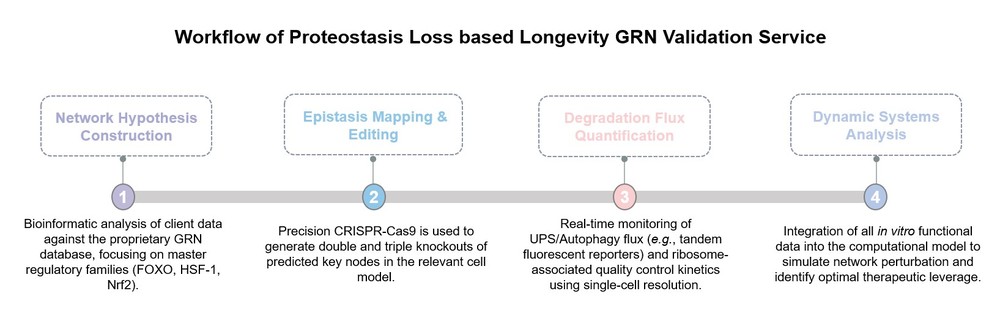
We replace high-risk correlative data with definitive causal proof using our proprietary CRISPR-Cas9 epistasis mapping. This scientifically robust approach ensures your targets are the true, rate-limiting master switches of the proteostasis GRN, not just downstream noise.
Proteostasis Loss based Longevity Gene Regulatory Network (GRN) Validation Service
Creative Biolabs provides expert-level, mechanistic validation services designed specifically for complex longevity targets implicated in proteostasis loss. We deliver definitive, high-resolution data on gene regulatory networks (GRNs) using proprietary CRISPR-Cas9 epistasis mapping and dynamic systems analysis. Clients gain unambiguous causal proof that transforms correlative hits into robust drug candidates. Our service culminates in a causal GRN interaction map and report, guaranteeing de-risked therapeutic strategies, accelerated IP generation, and validated predictive biomarkers for research and discovery.
Introduction What We Can Offer Workflow Why Creative Biolabs Customer Reviews FAQs Related Services Contact Us
Targeting Proteostasis Loss to Validate Longevity GRN
Proteostasis (protein homeostasis) is the cellular machinery that maintains the integrity and function of the proteome. Its failure is a hallmark of aging and an early molecular event that drives chronic diseases, including neurodegeneration and cancer. Our service targets the complex GRNs (governed by factors like FOXO, Nrf2, HSF-1) that regulate the essential degradation pathways - the ubiquitin-proteasome system (UPS) and autophagy - to provide high-resolution, causal validation of therapeutic targets. This approach is grounded in the analysis that proteostasis collapse accelerates age-related damage.
Initiate a confidential consultation to explore project-specific causal validation strategies.
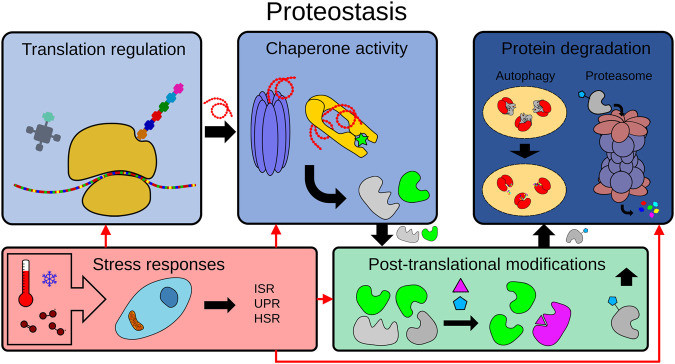 Fig.1 The proteostasis network in C. elegans. 1
What We Can Offer
Causal Validation Precision
Customizable Disease Modeling
Our service is built around your specific needs. We offer fully tailored experiments utilizing your iPSC lines or engineered C. elegans strains, guaranteeing the highest translational relevance for your specific chronic disease area.
Actionable Predictive Biomarkers
Clients receive the quantitative report (efficiency of modulation). This unprecedented metric directly quantifies the restoration of cellular degradation flux - a critical, biologically-relevant endpoint - and serves as your internal gold standard for drug efficacy.
Dynamic Therapeutic Optimization
We leverage dynamic systems analysis and in silico modeling to identify optimal combination strategies and minimal effective dosages. This protects your therapeutic pipeline by ensuring network stability and providing guidance that avoids detrimental feedback loops.
Proteostasis Loss based Longevity GRN Validation Service at Creative Biolabs
Highlights
Causal Distinction
The core methodology directly addresses the critical risk in longevity therapeutic research by providing an unequivocal distinction between mere biological correlation and confirmed, actionable causation for therapeutic targets.
GRN Mapping
We implement proprietary CRISPR-Cas9 epistasis mapping, a unique platform component engineered to precisely decipher complex hierarchical gene dependencies within the core Proteostasis Gene Regulatory Network architecture.

Degradation Flux Analysis
The platform utilizes the direct, quantitative measurement of degradation flux to provide high-resolution functional data. This approach offers a precise assessment of the status and capacity of cellular protein quality control mechanisms.
Fundamental Efficacy
Creative Biolabs uniquely quantifies therapeutic efficacy through the validated restoration of fundamental biological processes, specifically the ubiquitin-proteasome system and autophagy, recognized as key cellular aging drivers.
Determine the Creative Biolabs' value proposition: initiate a formal inquiry.
Customer Reviews
-
Reduced R&D Time
The CRISPR-Cas9 epistasis mapping revealed that our primary target's longevity effect was conditional on a secondary gene. This insight saved us months of R&D by guiding us to a dual-target strategy immediately, something standard screening entirely missed. - Sh Rs**l. -
Superior Data Quality
We compared their dynamic systems analysis to an alternative approach, and the Creative Biolabs model provided far superior predictive accuracy regarding network stability and minimal off-target effects. The quantitative metric is now our gold standard biomarker. - La Jn**s.
FAQs
Q: How is your GRN validation different from standard genetic screens?
A: Standard screens only find correlation. We use CRISPR-Cas9 epistasis mapping to demonstrate causality and map hierarchical gene dependence. This identifies the critical network nodes that truly control longevity pathways, not just genes that are responsive to them, giving you far higher confidence in your target selection.
Q: What is the required sample input?
A: We are flexible but generally require either validated iPSC lines (cell models) or robust, established C. elegans strains expressing key reporter constructs. We collaborate closely with your team to select the most disease-relevant model, ensuring the most meaningful results.
Related Services
Nutrient Sensing Dysregulation
A complementary validation platform focused on confirming the causal role of therapeutic targets within key nutrient-sensing pathways (e.g., mTOR, AMPK, Sirtuins).
Learn More →Mitochondrial Dysfunction
A focused validation platform to determine the causal effect of therapeutic candidates on core mitochondrial integrity and communication pathways, including the mitochondrial UPR.
Learn More →How to Contact Us
Creative Biolabs' proteostasis loss based longevity GRN validation service is the essential tool for de-risking age-related therapeutics. Partner with us to transform promising hits into robust, fully validated therapeutic leads backed by superior mechanistic proof, please contact us.
Reference
- Zhang, William Hongyu et al. "Insights Into the Links Between Proteostasis and Aging From C. elegans." Frontiers in aging vol. 3 854157. 18 Mar. 2022. Distributed under an Open Access license CC BY 4.0, without modification. https://doi.org/10.3389/fragi.2022.854157
 Download our brochure
Loading case studies...
Online Inquiry