We provide custom synthetic biology services, including targeted gene deletions, inducible expression systems, and fluorescent reporter strains, ensuring the validation platform perfectly models your target's proposed role in the conserved longevity GRN.
Saccharomyces cerevisiae Model based Longevity Validation Service
Creative Biolabs' longevity validation service offers specialized, functional validation for research candidates targeting aging pathways. We provide scientists with definitive in vivo proof of concept by leveraging the highly conserved gene regulatory networks (GRNs) in Saccharomyces cerevisiae. Clients gain accelerated target de-risking through high-throughput lifespan assays and deep, quantitative mechanistic data, including metabolic flux and autophagy induction measurements. This essential data package directly informs and justifies prioritization before costly mammalian and non-human primate studies.
Introduction What We Can Offer Workflow Why Creative Biolabs Customer Reviews FAQs Related Services Contact Us
Yeast Model based Longevity Validation
Aging is governed by conserved GRNs centered on nutrient sensing (e.g., RAS and TOR). The budding yeast, Saccharomyces cerevisiae, offers high genetic tractability and shares orthologs with over 30% of human disease genes. Its quantifiable chronological lifespan (CLS) is an ideal, high-throughput model for validating research candidates that target these networks. Literature confirms that master regulators like SCH9 are profoundly potent (up to threefold CLS extension), demonstrating that target validation in this model is highly predictive and credible for de-risking mammalian studies.
To explore the comprehensive scope of potential engagement, initiate contact and request a detailed consultation.
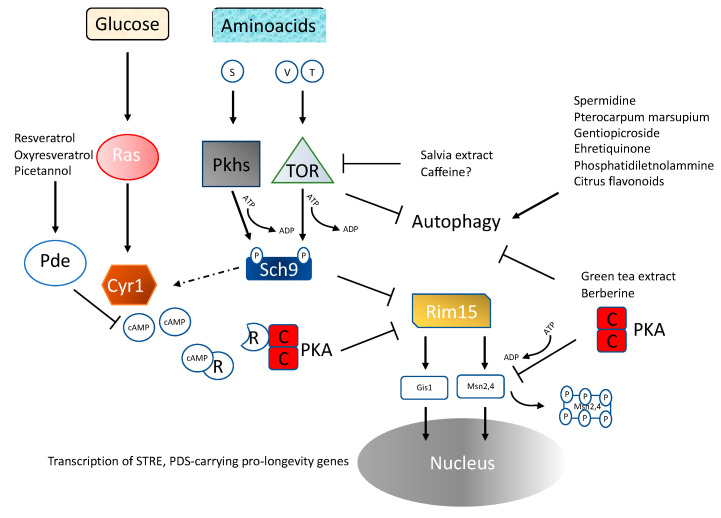 Fig.1 A schematic of natural compounds modulating yeast longevity and nutrient pathways. 1
What We Can Offer
Custom-Engineered Strains for Network Specificity
Modular, Optimized Validation Workflow
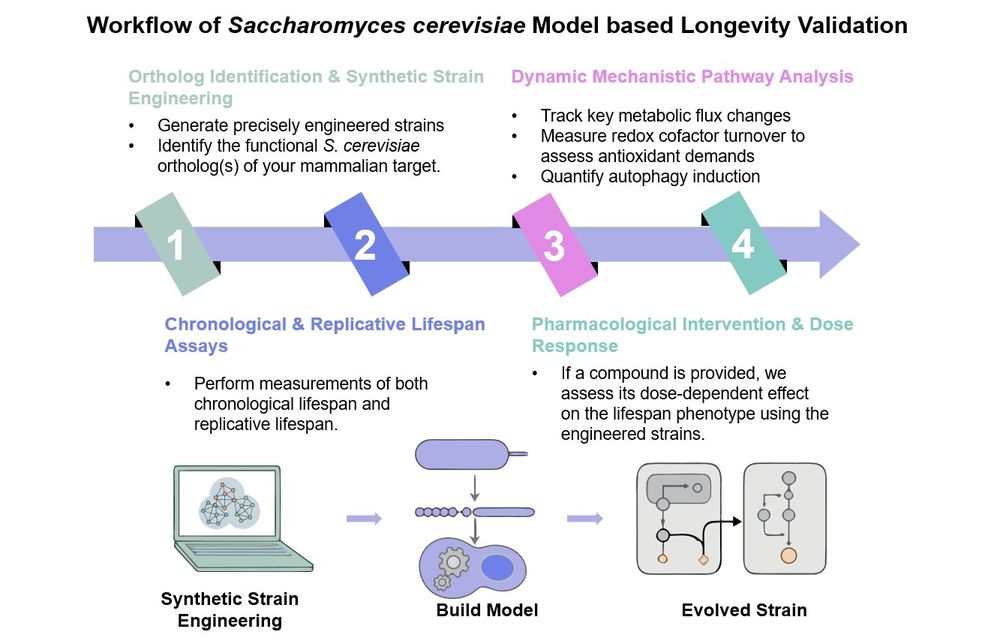
Our process is streamlined, integrating high-throughput phenotypic screening with advanced mechanistic analysis (metabolic flux, autophagy), allowing for rapid, comprehensive data acquisition and clear go/no-go decisions.
Guaranteed Data Traceability and QbD
We implement rigorous quality controls and documentation procedures throughout the assay process, assessing the stability and functional integrity of all engineered strains and ensuring quantifiable, reproducible data suitable for high-level scientific review.
Flexible Assay Configuration and Mode
We run lifespan and mechanistic assays in batch, fed-batch, or continuous modes as required, allowing us to mimic specific nutrient environments or compound exposure kinetics relevant to your research candidate's profile.
Workflow of Saccharomyces cerevisiae Model based Longevity Validation
Why Choose Us?
| Output Feature | Unique Advantage |
|---|---|
| Unparalleled GRN Focus | We don't just measure survival; we measure the network stability. We are experts in functionally mapping your candidate gene onto the highly conserved RAS-TOR-SCH9 signaling hub, which governs lifespan across species. |
| High-Confidence Translation | By targeting evolutionarily conserved pathways, the functional data we provide possesses the highest possible confidence level for translation into mammalian systems. |
| Proven Results | Our proprietary protocols minimize experimental noise in CLS and RLS assays, allowing us to accurately detect even subtle, yet scientifically relevant, lifespan extensions. |
Formal requests for service engagement and comprehensive quotation submission are welcome. We invite you to get a quote today.
Customer Reviews
-
Mechanism Validation
Using Creative Biolabs' service in our research has significantly improved our confidence in our lead compound. Dynamic redox cofactor turnover data conclusively evidenced that our test agent relieves age-associated oxidative stress, a mechanistic clarity unattainable through standard cell culture methodologies. - Dr. C**l. -
Target Prioritization
The precise CLS and RLS analysis enabled definitive filtering of research targets. Benchmarking against the sch9 deletion model eliminated low-impact candidates, resulting in a significant reduction in subsequent animal model costs. - S*n K**g.
FAQs
Q: How does the yeast CLS assay truly relate to human aging?
A: The CLS measures how long yeast cells survive in a non-dividing (quiescent) state, which accurately models the aging process in human post-mitotic cells like neurons and muscle cells. By validating targets that extend CLS, you are testing their efficacy against fundamental mechanisms of cellular maintenance and survival relevant to degenerative conditions.
Q: What is the main advantage of using the Saccharomyces cerevisiae model over mammalian cell culture?
A: The primary advantage is genetic tractability and speed. We can quickly engineer precise genetic knockouts or conditional expression systems to test specific network hypotheses in a whole, living organism (yeast), a process that is months faster and significantly less expensive than doing the same in vivo in mammalian models. Furthermore, yeast's pathways are highly conserved, maximizing translatability.
Related Services
Nutrient Sensing Dysregulation
Dedicated analysis of the phosphorylation status and activity of key metabolic checkpoint kinases (e.g., TOR, AMPK orthologs) to precisely map nutrient-sensing dysregulation.
Learn More →Proteostasis Loss
Comprehensive assessment of protein folding capacity, chaperone activity, and quantification of age-related protein aggregate formation using fluorescent reporters and biochemical assays.
Learn More →How to Contact Us
Creative Biolabs' Saccharomyces cerevisiae model based longevity validation service provides rapid, high-confidence functional proof that your research target influences conserved GRNs, offering deep mechanistic clarity via advanced assays like metabolic flux and redox turnover analysis. Reach out to our team today to transform your genomic insights into validated research strategies.
Reference
- Mirisola, Mario G, and Valter D Longo. "Yeast Chronological Lifespan: Longevity Regulatory Genes and Mechanisms." Cells vol. 11,10 1714. 23 May. 2022. Distributed under an Open Access license CC BY 4.0, without modification. https://doi.org/10.3390/cells11101714
 Download our brochure
Loading case studies...
Online Inquiry