
Creative Biolabs is offering the most comprehensive services for antibody development projects. With strict regulation and effective execution, we are dedicated to providing the most valuable solutions to complete your projects.
HighlightsCreative Biolabs is offering the most comprehensive services for antibody development projects. With strict regulation and effective execution, we are dedicated to providing the most valuable solutions to complete your projects.
HighlightsCreative Biolabs has established a broad range of platforms for developing novel antibodies or equivalents. These cutting-edge technologies enable our scientists to meet your demands from different aspects and tailor the most appropriate solution that contributes to the success of your projects.
HighlightsWith deep understanding in antibody-related realms and extensive project experience, Creative Biolabs offers a variety of references to help you learn more about our capacities and achievements, including infographic, flyer, case study, peer-reviewed publications, and all kinds of knowledge that can assist your projects. You are also welcome to contact us directly for more specific solutions.
HighlightsGet a real taste of Creative Biolabs, one of the most professional custom service providers in the world. We are committed to providing highly customized comprehensive solutions with the best quality to advance your projects.
HighlightsCreative Biolabs delivers precision-engineered antibodies targeting ISGylation through its High-Affi™ platform. These reagents detect endogenous ISG15 in conjugated states across ELISA, Western blotting, IHC, and immunoprecipitation applications. Rigorous validation confirms exclusive specificity—no cross-reactivity observed with ubiquitin, SUMO isoforms, or NEDD8—ensuring reliable detection even in complex biological matrices.
ISGylation represents a post-translational modification process where the ubiquitin-like protein ISG15 (ubiquitin cross-reacting protein, UCRP) forms covalent bonds with lysine residues on target proteins within nuclear and cytoplasmic compartments. Lipopolysaccharide exposure triggers ISG15 expression, with subsequent secretion from monocytes and lymphocytes conferring antiviral properties. Though mechanistically analogous to ubiquitination through its reversible enzymatic nature, ISGylation's complete regulatory framework retains unresolved aspects. The modification cascade initiates through UBE1L, an E1-activating enzyme, progressing via the E2-conjugating enzyme UbcH8 before E3 ligases, including EFP/TRIM25 and HERC5, mediate substrate ligation. Deconjugation relies on UBP43, alternatively termed USP18. Evolutionary analyses reveal ISG15's absence in yeasts, nematodes, insects, and plants, indicating functional specialization within higher eukaryotes.
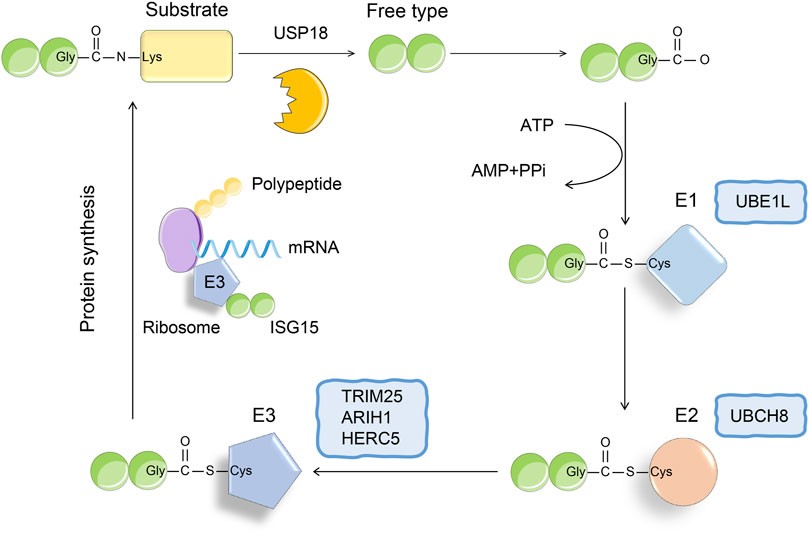 Fig.1 The conjugation of ISG15.1,3
Diverging from ubiquitination's proteasomal targeting, ISGylation predominantly modulates protein activity rather than stability. Documented substrates encompass type I interferon-induced effectors like MxA and PKR, alongside signaling mediators such as JAK1 and STAT1. Expanding research identifies ISG15 conjugation events influencing diverse pathways—from glycolytic regulation and stress adaptation to intracellular transport mechanisms. These discoveries position ISGylation as a multifaceted regulator spanning innate immunity to core cellular functions. During mycobacterial infections, for instance, IFNα/β induction promotes ISG15 synthesis, whose extracellular form enhances IFNγ production through NK cell activation, thereby amplifying antimicrobial responses. Dysfunctional ISGylation pathways correlate with oncogenic progression and persistent bacterial infections, underscoring their pathophysiological significance across disease states.
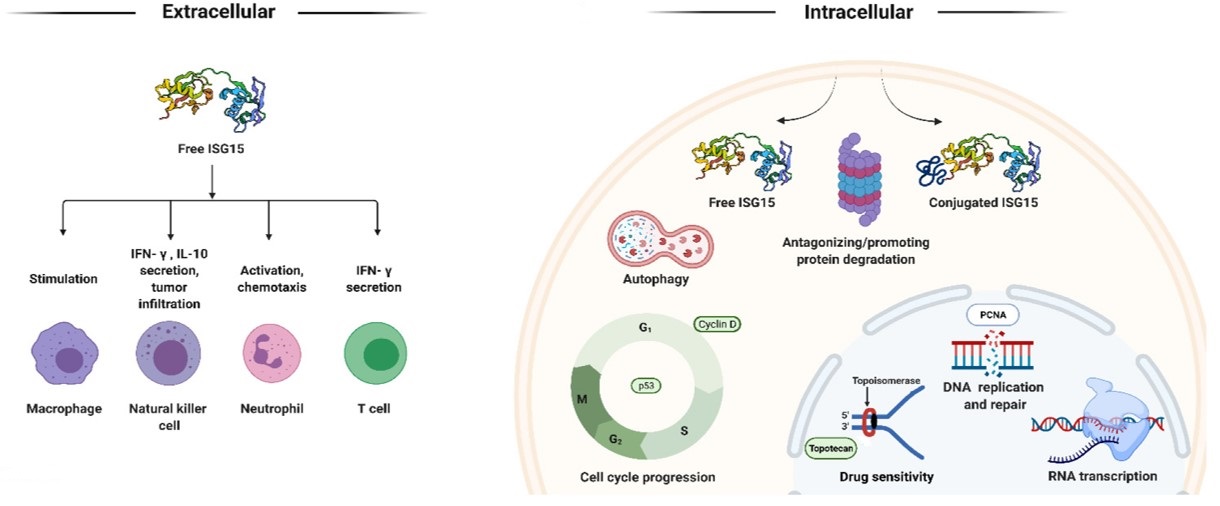 Fig.2 Functions of free and conjugated ISG15.2,3
Polyclonal Antibodies: Sourced from immunized host animals, these polyclonal antibodies detect ISG15 modified antigens. Their multi-epitope binding capacity frequently enhances detection sensitivity through cumulative avidity effects, particularly valuable in initial screening phases requiring broad target identification.
Monoclonal Antibodies: Originate from a group of identical B cells, they are designed to precisely target a single, specific part of an antigen. Because they come from the same genetic source, you get consistent results every time you produce them. This consistency is really important for things like standardized diagnostics and studies that need reliable data over long periods.
Site-Specific Anti-ISGylation Antibodies: Engineered to identify ISG15 exclusively when conjugated to predetermined residues, these specialized reagents—available as polyclonal or monoclonal formats—enable precise localization studies of modification sites. Their development typically employs immunogens mimicking structural contexts of site-specific ISGylation events essential for functional pathway analysis.
Pan Anti-ISGylation Antibodies: Capable of detecting ISGylation regardless of targets and modification sites, these tools facilitate comprehensive modification profiling. Researchers utilize them to monitor total ISGylation while evaluating dynamic conjugation patterns across experimental conditions, serving as vital reagents for system-level ISGylation assessments.
Monospecific Anti-ISGylation Polyclonal Antibody Production
To develop polyclonal antibodies targeting ISGylation, animals receive immunizations with ISGylated peptides. Post-immune serum undergoes sequential purification: initial isolation via ISGylated peptide-coupled affinity chromatography followed by negative adsorption against unmodified peptide, ubiquitin and related UBLs. This dual-phase purification yields antibody pools with enhanced specificity while retaining multi-epitope avidity advantages. The approach balances cost-efficiency with robust detection capabilities, particularly effective for applications requiring broad epitope coverage without compromising target discrimination.
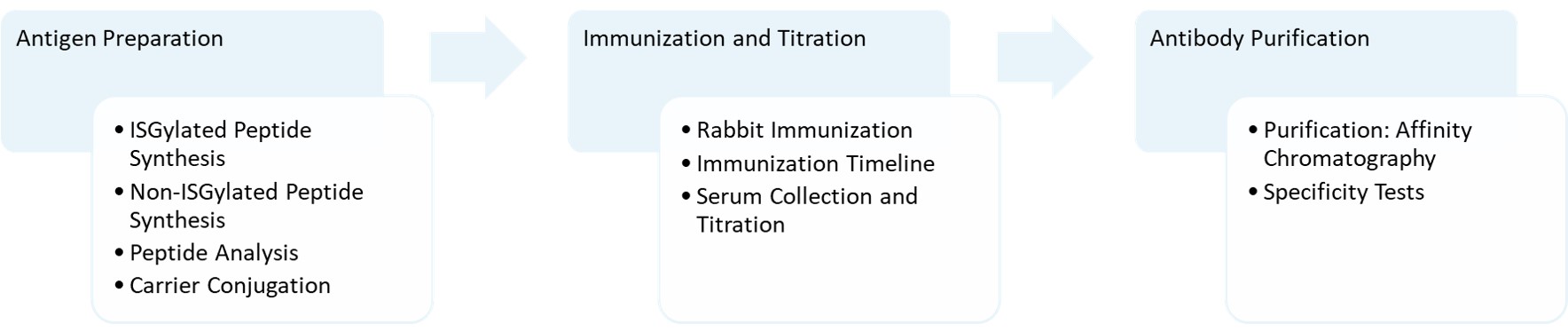
Phage Display Strategy for Anti-ISGylation Monoclonal Antibody Discovery
This in vitro methodology screens bacteriophage libraries displaying antibody fragments against ISGylated targets. Through iterative biopanning cycles—target binding, stringent washing, and competitive elution—high-affinity clones get enriched. Post-screening molecular characterization identifies fragments meeting predefined specificity parameters. The technique allows the screening of both immune and non-immune pre-made antibody libraries, enabling antibody generation against poorly immunogenic targets. It facilitates direct selection of desired binding characteristics, including conformation-specific recognition of ISG15 structural motifs inaccessible through traditional methods.

Hybridoma Strategy for Anti-ISGylation Monoclonal Antibody Discovery
The established hybridoma protocol begins with animal immunization using ISGylated antigens. Harvested spleen cells fuse with myeloma partners to create immortalized antibody producers. High-throughput ELISA screening identifies ISGylation-specific clones, which undergo subcloning to ensure monoclonality. While resource-intensive, this method reliably generates mammalian-glycosylated antibodies with native structural integrity, critical for functional studies requiring natural post-translational modifications. Its proven track record in producing stable, high-titer monoclonal antibodies makes it preferred for therapeutic development and applications demanding strict batch consistency.

Custom Immunogen Design: Tailored immunogens (ISGylated peptides, modified proteins) maximize specific antibodies for ISGylation epitopes, minimizing off-target binding.
High-Affinity Antibody Maturation: Advanced phage display and hybridoma methods generate monoclonal and polyclonal antibodies with exceptional affinity for ISGylated targets.
Epitope Mapping: Detailed mapping pinpoints antibody binding sites, emphasizing epitopes unique to ISG15 or present only upon target protein ISGylation.
Stringent Validation: Rigorous assays (ELISA, Western blot, IHC) on ISGylated/non-ISGylated samples confirm high specificity for ISGylation and reliable performance.
Site-Specific Antibody Expertise: Specialized services generate antibodies specifically recognizing ISG15 conjugation at particular lysine residues, crucial for analyzing site-specific ISGylation.
Q: How specific are your ISGylation antibodies given similarities among ubiquitin-like proteins?
A: Ensuring specificity forms the cornerstone of our ISGylation antibody development. Our protocols integrate custom immunogens targeting ISG15's unique structural motifs paired with counter-screening against ubiquitin, SUMOs, and NEDD8 during purification. Validation includes parallel testing across ubiquitin-like proteins (UBLs) to exclude cross-reactivity. While biological systems preclude absolute guarantees, we furnish extensive validation data demonstrating selective recognition of ISG15 conjugates under standardized assay parameters.
Q: What production formats and scales are available post-discovery?
A: We accommodate diverse experimental needs through multiple formats: monoclonal isotypes (IgG, IgM), recombinant fragments (scFv, Fab), or full-length IgGs. Post-validation, scale-up options range from small-batch research quantities to bulk preclinical/diagnostic volumes. Collaborating with certified facilities, we ensure GMP-compliant production without compromising antibody integrity, regardless of scale.
Q: What characterization data accompanies your antibodies?
A: Each antibody ships with exhaustive validation reports: specificity profiles (cross-reactivity matrices), affinity metrics (KD via SPR/ELISA), isotype data, and application-optimized protocols. Custom projects include detailed screening logs, clone selection criteria, and raw assay datasets. This transparency enables informed experimental planning and reproducibility across labs.
Q: What if initial antibodies lack required performance?
A: Our iterative optimization framework addresses underperforming candidates. Hybridoma projects may involve alternative immunization regimens or supplementary fusion rounds. Phage display allows affinity maturation or stringent biopanning adjustments. Throughout, we prioritize open dialogue to recalibrate strategies—whether modifying immunogens, enhancing screening stringency, or exploring alternative display libraries—ensuring alignment with your objectives.
References
All listed services and products are For Research Use Only. Do Not use in any diagnostic or therapeutic applications.








