Cetirizine Liposome & In Situ Gel Preparation
Introduction Research Insights Products & Services Resources
Ocular drug delivery represents one of the most demanding frontiers in pharmacology, where the eye's natural defense mechanisms, ranging from rapid tear turnover to the impermeable corneal barrier, constantly undermine therapeutic efficacy. For powerful antihistamines like Cetirizine hydrochloride, traditional aqueous solutions are often inadequate, necessitating high-frequency dosing that impacts patient compliance and safety. Innovative lipid-based drug delivery systems offer a transformative path forward, providing the structural integrity needed to enhance bioavailability and prolong residence time. Creative Biolabs possesses world-class expertise in the design, characterization, and validation of these advanced liposomal systems, ensuring your research translates into preclinical success.
Innovation in Allergic Conjunctivitis Therapy
The management of allergic conjunctivitis is currently limited by the low retention time of topical applications, which significantly reduces the therapeutic window of Cetirizine hydrochloride. Lipid-based drug delivery systems, particularly liposomal in situ gels (ISG), emerge as a promising solution to these challenges by combining the protective encapsulation of lipids with the retentive properties of thermosensitive polymers. To appreciate the significance of this technology, it is essential to understand the foundational principles and the scientific "why" behind the development of liposomal in situ gels.
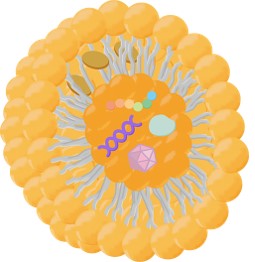 Fig. 1 Schematic diagram of the structure of drug-loaded liposomes.
Overcoming the Ocular Wash-Out
The primary challenge in ophthalmic therapy is the rapid clearance of topical formulations. The tear film is replaced every 2-3 minutes, meaning standard eye drops are flushed into the nasolacrimal duct almost immediately upon instillation. This "wash-out" effect necessitates a delivery system that can:
-
Adhere to the ocular surface despite blinking and tear flow.
-
Encapsulate the drug to protect it from enzymatic degradation in the tear film.
-
Release the active ingredient at a controlled, predictable rate.
The Relevance: Why Cetirizine Liposomes?
Cetirizine hydrochloride is a potent receptor antagonist, but its hydrophilic nature makes it difficult to penetrate the lipid-rich corneal epithelium. By encapsulating Cetirizine within a liposome—a biomimetic phospholipid bilayer—we achieve:
-
Enhanced Permeability: The liposome's surface interacts with the cell membranes of the cornea, facilitating transcellular transport.
-
High Payload Stability: Active loading techniques allow for high concentrations of the drug within a microscopic carrier.
-
Biocompatibility: Using natural phospholipids reduces the risk of ocular irritation compared to synthetic surfactants.
The Purpose: Thermosensitive In Situ Gelation
The "In Situ Gel" (ISG) component serves as the physical anchor for the liposomes. Using polymers like Poloxamers, the formulation remains a liquid at room temperature for easy application but solidifies upon contact with the eye.
-
Theme: "Liquid-to-Solid" stimulus response.
-
Mechanism: Thermal gelation occurs as polymer chains entangle at physiological temperatures (34-35 °C).
-
Significance: This transition turns a simple drop into a semi-solid matrix, creating a sustained-release reservoir in the conjunctival sac.
Experimental Insights from Cetirizine Liposomal In Situ Gel Development
The following analysis examines the methodologies and outcomes of key research projects focused on Cetirizine hydrochloride liposomal (CTZL) in situ gel systems, offering strategic insights for future development.
Optimization of Active Loading Strategies and Morphology
This project focused on maximizing the encapsulation of hydrophilic Cetirizine HCl using a sophisticated active loading strategy. By leveraging the ammonium sulfate gradient method in conjunction with ethanol injection, the research successfully overcame the entrapment limitations typical of water-soluble APIs. The resulting liposomes demonstrated a stable, single-chambered spherical morphology and achieved a high therapeutic payload. This paradigm confirms that active gradient techniques are essential for developing high-performance liposomal nanocarriers capable of maintaining optimal drug density within the internal aqueous core.
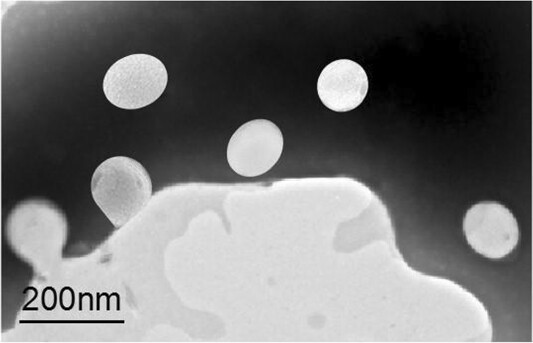 Fig. 2 TEM image of cetirizine hydrochloride liposome (CTZL). 1
In Vitro Release Kinetics and Controlled Liberation Profile
This phase of the study characterized the drug liberation mechanisms of the liposomal gel system through comprehensive in vitro release studies. The results established a stable zero-order release pattern, demonstrating that the formulation effectively suppresses the initial burst effect common in conventional formulations. This controlled delivery profile ensures a steady release of the API over an extended period, maintaining therapeutic levels at the target site and significantly mitigating the impact of rapid nasolacrimal clearance.
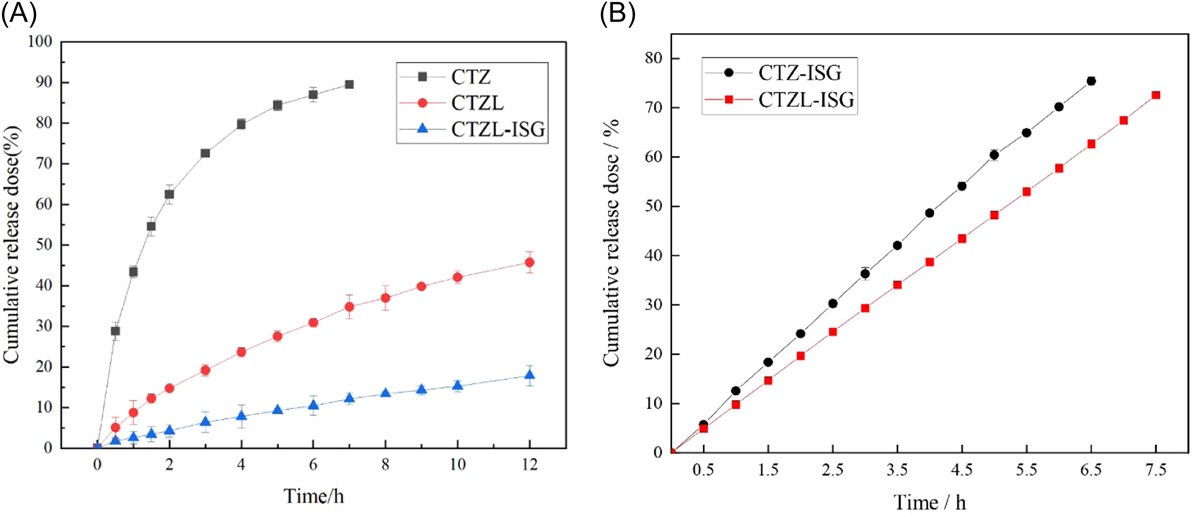 Fig. 3 In vitro release curve of dialysis (A) and in vitro release curve of membraneless dissolution method (B). 1
In Vivo Pharmacodynamics and Biocompatibility Validation
To validate the transition from laboratory formulation to clinical potential, comprehensive in vivo evaluations were conducted using animal models. The results highlighted the synergy of the liposomal gel system, which significantly extended the drug's ocular residence time compared to traditional aqueous formulations. Crucially, the studies established a superior safety profile, with the matrix showing excellent biocompatibility and no signs of ocular irritation. These findings reinforce the clinical viability of the platform for long-term management of chronic allergic conditions.
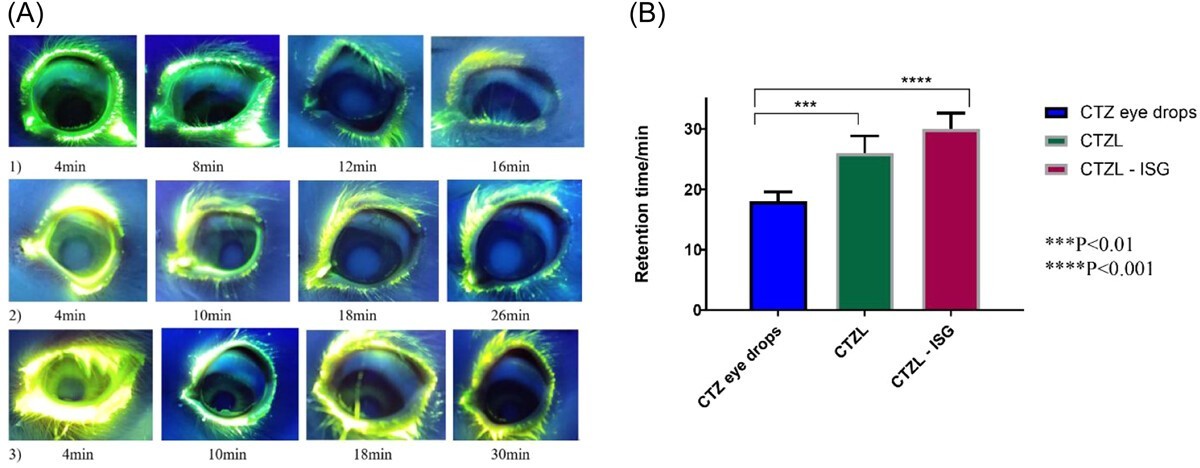 Fig. 4 Examination of rabbit eye retention time. 1
Creative Biolabs offers specialized services related to cetirizine liposomes, lipid-based drug delivery systems, and advanced ocular applications. Our comprehensive R&D platform supports your project from initial concept through to high-precision liposome development and process optimization. We possess the analytical capabilities for rigorous characterization, including size, PDI, and zeta potential, and the infrastructure for In Vitro/In Vivo validation to ensure your formulation meets the highest industry standards. Contact our expert team today to discuss how we can support your specific project needs in Cetirizine Liposomes and lipid-based drug delivery.
Related Services & Products
Creative Biolabs provides key products that facilitate research and development in lipid-based systems and ocular drug delivery. Our high-purity components and Pre-formulated Liposome Kits are designed to ensure reproducibility and stability in your experimental workflows. These products support the implementation of innovative Topic-related technologies and provide the foundational materials for advanced drug carrier studies.
Resources
Reference
-
Zhang, Jing, et al. "Preparation and intraocular evaluation of cetirizine hydrochloride ophthalmic liposomes and a liposome in situ gel." MedComm–Biomaterials and Applications 2.2 (2023): e39. https://doi.org/10.1002/mba2.39. Distributed under Open Access license CC BY, without modification.

For Research Use Only. Not For Clinical Use