Creative Biolabs is offering the most comprehensive services for antibody development projects. With strict regulation and effective execution, we are dedicated to providing the most valuable solutions to complete your projects.
HighlightsCreative Biolabs is offering the most comprehensive services for antibody development projects. With strict regulation and effective execution, we are dedicated to providing the most valuable solutions to complete your projects.
HighlightsCreative Biolabs has established a broad range of platforms for developing novel antibodies or equivalents. These cutting-edge technologies enable our scientists to meet your demands from different aspects and tailor the most appropriate solution that contributes to the success of your projects.
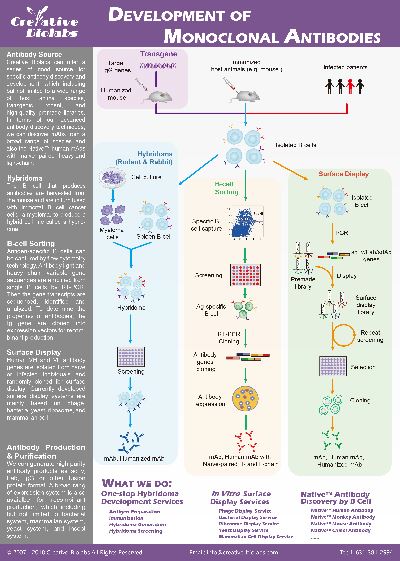
HighlightsWith deep understanding in antibody-related realms and extensive project experience, Creative Biolabs offers a variety of references to help you learn more about our capacities and achievements, including infographic, flyer, case study, peer-reviewed publications, and all kinds of knowledge that can assist your projects. You are also welcome to contact us directly for more specific solutions.
HighlightsGet a real taste of Creative Biolabs, one of the most professional custom service providers in the world. We are committed to providing highly customized comprehensive solutions with the best quality to advance your projects.
HighlightsUnderstanding the immune landscape at the level of individual lymphocyte populations has become an essential part of modern immunological research. Creative Biolabs' Quantitative Immune Repertoire Profiling Service for Small Lymphocytes offers an advanced platform to decode the diversity, abundance, and dynamic balance of immune receptors across small lymphocyte subsets, including B and T cells.
Unlike conventional repertoire sequencing, which focuses primarily on qualitative diversity, Creative Biolabs' quantitative approach integrates high-resolution sequencing with rigorous molecular barcoding and absolute quantification strategies. This enables researchers to not only identify clonotypes but also to measure their real abundance, providing an accurate picture of immune cell distribution and expansion patterns.
By applying this service, scientists gain unparalleled insight into the clonal architecture of lymphocyte repertoires, immune adaptation, and repertoire remodeling under various biological conditions. At Creative Biolabs, every project is designed with precision, transparency, and scientific integrity-delivering publication-ready data that advances foundational immunology.
To achieve highly accurate quantitative profiling, Creative Biolabs integrates multiple advanced technologies into a single streamlined workflow. Each element is optimized for reproducibility, scalability, and sensitivity-crucial for studying small lymphocyte populations where the total RNA or cell number may be limited. Key Components of the Platform:
Each transcript molecule is tagged with a unique barcode during cDNA synthesis, allowing correction for PCR amplification bias and ensuring precise quantification of original RNA molecules.
Creative Biolabs combines high-throughput short-read platforms for deep coverage with long-read sequencing technologies to capture full-length receptor sequences without truncation or assembly artifacts.
Using advanced FACS or magnetic enrichment strategies, small lymphocyte subsets-such as naïve, memory, or regulatory B/T cells-are isolated before library preparation, guaranteeing subset-specific repertoire resolution.
Creative Biolabs' proprietary algorithms are designed to detect rare clonotypes, compute absolute frequencies, and assess public versus private clonotype representation.
Contact Creative Biolabs' specialists to discuss which sequencing configuration best suits your sample type and research objective.
Creative Biolabs provides a streamlined yet flexible workflow that accommodates both standard and custom project requirements. Our team maintains transparency at every stage, keeping clients informed of progress and data quality.
To receive a detailed workflow guide and sample data preview, please contact Creative Biolabs' project consultation team.
When choosing Creative Biolabs, you are selecting a partner with deep technical experience and a proven track record of accuracy in immune repertoire studies.
 Quantitative Precision at Molecular Level
Unlike qualitative sequencing services, Creative Biolabs' method delivers absolute molecular counts, allowing reliable quantification even in low-frequency clonotypes.
Specialized Expertise in Small Lymphocyte Profiling
Creative Biolabs has optimized its extraction and amplification protocols for limited input material, ensuring representative coverage from small cell subsets.
Seamless Data Integration
Quantitative repertoire data can be easily merged with transcriptomic or proteomic datasets for multi-omics immune landscape analysis.
Rigorous Quality and Reproducibility Control
Each experiment includes built-in standards, technical replicates, and cross-batch calibrations.
Start a discussion with our scientific team today to explore how Creative Biolabs' quantitative immune repertoire profiling can strengthen your next project.
"Creative Biolabs' quantitative repertoire data were incredibly clean and consistent, even with small input lymphocyte numbers. Their bioinformatics support was exceptional."
- Dr. L. SchXXX
"We were able to validate clonal expansion trends that had been previously obscured in traditional repertoire sequencing. Creative Biolabs' quantitative pipeline made a real difference."
- Prof. H. LinXXX
"Our collaboration with Creative Biolabs provided detailed immune diversity metrics with publication-ready graphs. The communication throughout was professional and transparent."
- Dr. R. AlvXXX
Read more testimonials or share your experience by connecting with Creative Biolabs' client relations team.
At Creative Biolabs, we understand that immune repertoire quantification is more than data collection-it's about revealing the underlying logic of immune adaptability. Every project is handled with meticulous care, using validated workflows and expert interpretation. Our team continuously refines both wet-lab and computational methods to deliver data that withstands peer review and reproducibility standards.
Creative Biolabs remains committed to providing high-quality, accessible, and transparent solutions for fundamental immunology research worldwide. Whether you are characterizing small lymphocyte subsets or integrating repertoire data into broader immunological models, Creative Biolabs stands as your trusted research partner. Reach out today to initiate your Quantitative Immune Repertoire Profiling project with Creative Biolabs, where data accuracy meets scientific excellence.
Use the resources in our library to help you understand your options and make critical decisions for your study.

All listed services and products are For Research Use Only. Do Not use in any diagnostic or therapeutic applications.