
Applications
Online Inquiry
For research use only. Not intended for any clinical use.
This site is protected by reCAPTCHA and the Google Privacy Policy and Terms of Service apply.
Non-Human Primate (NHP) Applications in Immunology & Biomarker Research
Are you currently facing complex challenges in translating preclinical data to clinical success? Our NHP Applications in Immunology & Biomarker Research services from Creative Biolabs help you accelerate drug discovery by leveraging the unparalleled human-like biology of non-human primates. We provide a robust platform for identifying and validating key biomarkers, ensuring a smoother transition from research to clinical trials through advanced analysis and predictive modeling.
Unlock your therapy's full potential with translational NHP data.
NHP models are essential for bridging the translational gap in drug development, providing crucial data on immune responses and disease mechanisms that are highly predictive of human outcomes.
Overview of NHP Applications
What Are Our Research Areas?
Immunology and biomarker research are critical for understanding disease progression and the efficacy of therapeutic interventions. This field is particularly vital for developing drugs that modulate the immune system, such as vaccines, gene therapies, and immunotherapies. In this context, preclinical research with non-human primates (NHPs) offers a powerful platform to study complex biological systems that closely mimic human physiology. Creative Biolabs' services in this area are designed to support and accelerate your research by providing a comprehensive and integrated approach.
- Cross-Species Immune Mapping: We provide services to map and understand immune responses across different species, with a focus on the similarities between NHPs and humans. This is crucial for predicting how a new drug will affect the human immune system.
- Biomarker Discovery, Validation & Assay Development: We help you identify, validate, and develop assays for novel biomarkers. Our approach, including comprehensive transcriptome analysis, allows for the discovery of critical markers that can predict survival and therapeutic efficacy, as demonstrated in our analysis of the recent study on thoracic radiation.
Why Choose Us?
Non-human primates are an irreplaceable model in biomedical research, particularly for complex immunological and biomarker studies. Their close genetic and physiological similarity to humans provides a level of translational relevance that cannot be matched by other models.
- Genetic and Immunological Similarities: NHPs share a high degree of genetic homology with humans, leading to similar immune system components and responses, making them ideal models for studying immunomodulatory drugs and vaccines.
- Clinical Translational Relevance: Data from NHP studies are highly predictive of human clinical outcomes, reducing the risk of failure in later clinical trial phases.
- Data Types Required for Regulatory Submissions: Regulatory bodies often require NHP data for Investigational New Drug (IND) applications, especially for large molecule biologics and advanced therapies.
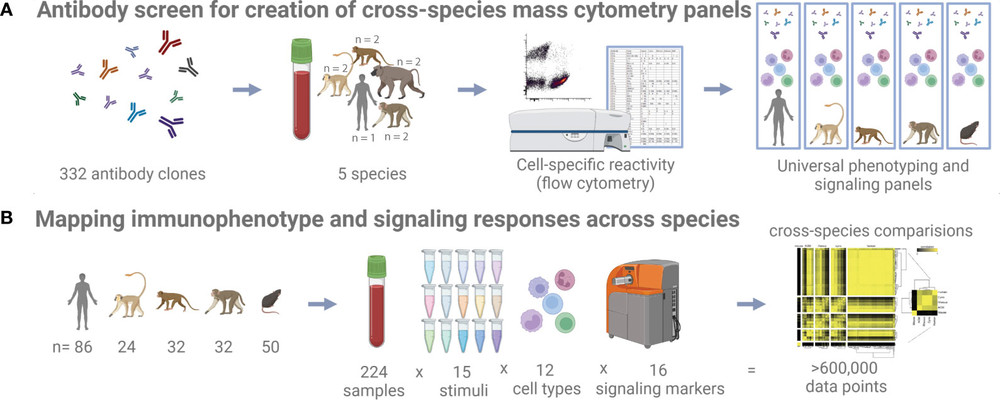 Fig.1 Flow cytometry analysis of antibody clones across five species to identify cross-reactivity.1
Key Applications
NHPs are uniquely suited for a range of critical applications in immunology and biomarker research, allowing for the comprehensive evaluation of novel therapies.
- Vaccine and Infectious Disease Research: NHPs are used to model the host-pathogen interaction and evaluate the safety and efficacy of vaccines and antiviral therapies, providing critical data on viral dynamics and immune responses.
- Immuno-Oncology: They serve as a vital model for understanding the tumor microenvironment and assessing the efficacy of immunotherapies, such as CAR-T therapies and checkpoint inhibitors, in a system that more closely mirrors human response.
- Biomarker Discovery and Validation: With their physiological similarity to humans, NHPs are a powerful platform for discovering and validating biomarkers for diagnosis, disease progression, and therapeutic response, as seen in the radiation study on RNA biomarkers.
- Safety and Toxicology for Biologics: NHPs are the preferred non-rodent species for assessing the safety and immunogenicity of biologics, including monoclonal antibodies and gene therapies, due to their relevant biological and immune systems.
How Do Creative Biolabs Support Your Projects?
Creative Biolabs offers a suite of services designed to support every stage of your research, from sample acquisition to data analysis. We provide the expertise and infrastructure necessary to generate high-quality, regulatory-compliant data.
| Service Capability | Corresponding Application Area |
| ADA/Immunogenicity Testing | Immunogenicity assessment for biologics and advanced therapies. |
| Multi-Omics & Data Reporting | Integrated, systems-level understanding of biological pathways. |
| NHP Bio-specimen Bank | Multiple bio-specimen available to accelerate the success of your project. |
| Advanced Therapy Efficacy Studies | Evaluating the therapeutic effect of gene and cell therapies |
Translational Impact
The predictive power of NHP models is a critical component of successful drug development. By leveraging these models, clients can achieve more reliable early proof of concept, enable the early detection of immune responses or toxicity, and ultimately reduce the risk of costly IND failure. For example, NHP biodistribution data is often a requirement for regulatory agencies submissions for gene therapy products, highlighting their regulatory significance.
Frequently Asked Questions
Q: What is the resolution/sensitivity of your biomarker assays?
A: Our assays are developed with a focus on high sensitivity and specificity, using state-of-the-art platforms to ensure reliable and reproducible results. We can work with you to tailor assays to meet the specific requirements of your project.
Q: What is the cell source/sample stability for your bioanalysis services?
A: Our biospecimens are sourced from well-characterized NHP colonies, ensuring consistent quality and full traceability. We adhere to strict cold-chain protocols to maintain sample integrity from collection to analysis, guaranteeing the highest quality data for your study.
Q: What is the turnaround time/data format for your services?
A: We understand the need for efficiency. Our team works to provide timely data delivery in a clear, integrated, and comprehensive format. The turnaround time can vary based on study design, but we prioritize clear communication and a seamless process to meet your project deadlines.
Q: How do NHP models compare to other animal models, like mice, for immunological research?
A: While mice are valuable for certain studies, NHPs provide a more accurate and translational model for complex human immunology due to their closer genetic and physiological resemblance, which is crucial for assessing drug safety and efficacy for human-specific diseases.
Contact Us
Creative Biolabs' utilization of NHP models in immunology and biomarker research is crafted to guide you through the intricacies of contemporary drug development. Eager to harness our expertise for your forthcoming study? Connect with our team for further details and project consultations.
Reference
- Bjornson-Hooper, Zachary B., et al. "A comprehensive atlas of immunological differences between humans, mice, and non-human primates." Frontiers in immunology 13 (2022): 867015. Distributed under Open Access license CC BY 4.0, without modification. DOI: https://doi.org/10.3389/fcimb.2024.1493885