
Applications
Online Inquiry
For research use only. Not intended for any clinical use.
This site is protected by reCAPTCHA and the Google Privacy Policy and Terms of Service apply.
Non-Human Primate (NHP) Applications in Vaccine & Infectious Disease
Are you currently facing long drug development cycles, challenges in obtaining translatable preclinical data, or difficulties in assessing the immunogenicity of next-generation vaccines? Our NHP models and specialized services help you accelerate vaccine discovery, develop robust immune profiles, and streamline the journey to clinical trials through advanced infectious disease models and comprehensive immunogenicity assessments.
Utilizing NHP models in vaccine and infectious disease research to expedite your drug discovery journey!
NHP models provide essential translational data for vaccine safety, immunogenicity, and efficacy.
Overview of NHP Applications
What Are Our Research Areas?
In the dynamic field of vaccinology and infectious disease, the preclinical research phase is critical for determining a candidate vaccine's potential for clinical success. This involves more than just verifying a response; it requires a deep and nuanced understanding of the immune system's reaction to a new therapeutic agent. Our services in this area focus on providing a comprehensive research background to support your program. This includes:
- Immunogenicity Profiling (Humoral & Cellular): A thorough evaluation of the immune response, including both antibody-mediated (humoral) and T-cell-mediated (cellular) immunity. As demonstrated by the bivalent COVID-19 and influenza vaccine study, a robust T-cell response is crucial for protection. Our capabilities assess the breadth and durability of these responses.
- Challenge Models & Protection Studies: Direct evaluation of vaccine efficacy by challenging vaccinated subjects with the target pathogen. This is a powerful tool for modeling human disease and providing critical proof-of-concept data that cannot be obtained from in vitro studies.
- Durability of Immune Response: Assessing how long a vaccine's protective effect lasts. This is particularly important for next-generation vaccines, such as the influenza stem antigen, where the goal is to induce long-lasting, broad immunity that negates the need for annual updates.
Why Choose Us?
NHP models are not just an option—they are a necessity for key stages of vaccine development. Their close biological and immunological similarities to humans make them an indispensable asset for obtaining the data required for regulatory submissions.
- Genetic & Immunological Similarities: NHPs share a high degree of genetic and physiological similarity with humans, resulting in immune responses that closely mimic those seen in clinical settings. This minimizes the risk of preclinical findings failing to translate to human trials.
- Clinical Translational Relevance: Data from NHP studies provides essential proof-of-concept for efficacy and safety, directly informing clinical trial design and increasing the likelihood of a successful Investigational New Drug (IND) application.
- Data Required for Regulatory Submissions: Regulatory bodies often require NHP data for the approval of new vaccines, particularly for those targeting pathogens where no other suitable animal model exists.
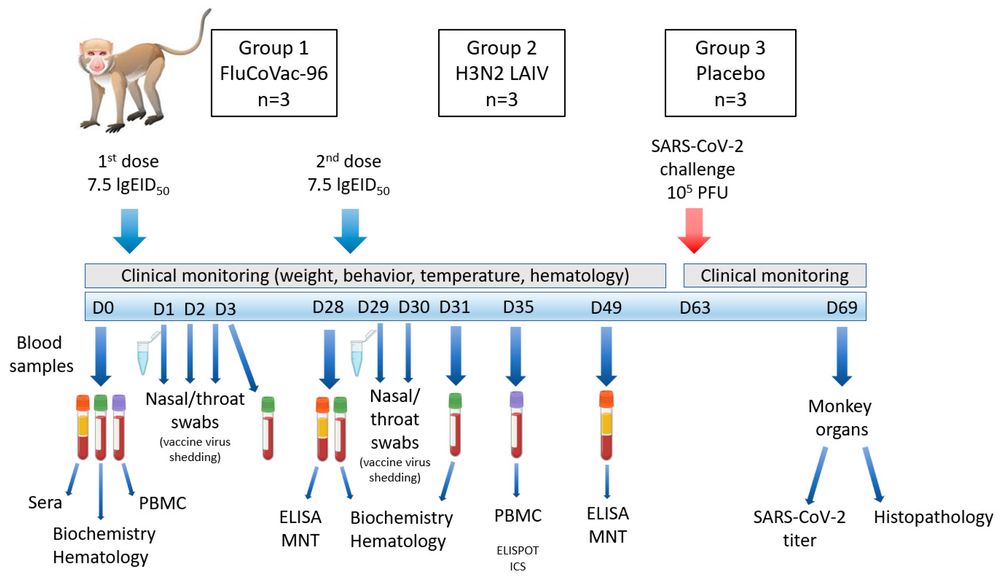 Fig.1 Diagram of the experimental design evaluating the safety and immunogenicity of the SARS-CoV vaccine in rhesus macaques.1
Key Applications
Creative Biolabs' NHP models are uniquely suited to address the most pressing challenges in vaccine and infectious disease research. Here's what NHPs can specifically do:
- Vaccine Immunogenicity and Efficacy Studies: NHPs are used to evaluate how a vaccine stimulates an immune response and whether it protects against subsequent infection.
- Modeling Novel Pathogens and Complex Co-infections: For pathogens that do not infect or cause symptomatic disease in smaller animal models, NHPs offer a superior alternative.
- Evaluation of Next-Generation Vaccine Platforms: NHPs are essential for testing advanced vaccine concepts, such as universal influenza vaccines or bivalent vaccines for COVID-19 and influenza. These studies in NHPs provide crucial data on the safety and immunogenicity of multi-component vaccines before they progress to human clinical trials.
- Assessment of Maternal Antibody Transfer & Early Life Immunity: The NHP model allows for the detailed study of immune responses in early life, including the transfer of maternal antibodies. This research is critical for developing safe and effective vaccines for vulnerable infant populations.
How Do Creative Biolabs Support Your Projects?
Our comprehensive services are designed to address the specific needs of vaccine and infectious disease research, leveraging our NHP expertise.
| Service Capability | Corresponding Application Area |
| Disease Model Development | To create a platform for studying disease pathogenesis and testing therapeutic interventions. |
| Vaccine Challenge & Protection Studies | To determine if a vaccine provides protection against a specific pathogen. |
| ADA & Neutralizing Antibody (NAb) Assays | For measuring the development of anti-drug antibodies that can impact drug efficacy. |
| Immunotoxicity & Cytokine Release Assays (CRAs) | For evaluating the risk of cytokine storms and other immune-related adverse events. |
Translational Impact
Utilizing NHP models in preclinical vaccine development has a significant translational impact. They provide a more reliable early proof of concept, enabling the early detection of immune responses and potential toxicities that might be missed in smaller animal models. This reduces the overall risk of IND application failure. For instance, NHP biodistribution data is often required for gene therapy and vaccine IND submissions, making the data generated in these models indispensable for regulatory success. Our comprehensive approach ensures that your data is robust and ready for submission.
Frequently Asked Questions
Q: What are the key advantages of using NHP models for vaccine development compared to other animal models?
A: NHPs offer a closer genetic and immunological parallel to humans, making them ideal for modeling complex human diseases and immune responses. They are particularly valuable for pathogens that do not affect other species, as seen with diseases like Zika, Ebola, and pertussis.
Q: What types of immunogenicity data can your NHP models provide?
A: We provide comprehensive data on both humoral and cellular immunity, including the quantification of specific antibodies (ADA, NAb) and the analysis of T-cell responses. This allows you to gain a full understanding of the immune profile induced by your vaccine.
Q: How do you ensure the durability of the immune response is accurately assessed?
A: Our study designs include longitudinal and repeat sampling protocols, allowing for the long-term tracking of immune markers and the assessment of how long protective immunity lasts. This is crucial for demonstrating the long-term efficacy of a vaccine candidate.
Q: Can you support studies for complex, next-generation vaccines?
A: Yes, our expertise and NHP models are perfectly suited for complex projects, including bivalent vaccines and those requiring unique adjuvant formulations. Our capabilities allow us to test multiple variables to optimize your vaccine candidate for future clinical trials.
Contact Us
Our expertise in NHP models and infectious disease research provides the crucial translational data you need to bring your vaccine candidate to the clinic with confidence. To learn more about our NHP services and to discuss a customized plan for your project, please contact our team.
Reference
- Stepanova, Ekaterina, et al. "Safety and immunogenicity study of a bivalent vaccine for combined prophylaxis of COVID-19 and influenza in non-human primates." Vaccines 12.10 (2024): 1099. Distributed under Open Access license CC BY 4.0, without modification. DOI: https://doi.org/10.3390/vaccines12101099.