AhR based Protein Degrader Ligand Screening Service
BackgroundWhat We Can Offer?WorkflowWhy Us?FAQRelated Services
Harnessing conditional E3 ubiquitin ligase machinery requires recruiters engineered to exploit unique transcription factor degradation pathways. Creative Biolabs provides customized hit discovery, biophysical characterization, and bifunctional molecule synthesis targeting the Aryl Hydrocarbon Receptor (AhR). Collaborate with our multidisciplinary TPD team to build tissue-selective degrader architectures capable of clearing challenging disease targets through AhR's nucleocytoplasmic trafficking and E3 ligase machinery.
Background of AhR in Protein Degradation
The Aryl Hydrocarbon Receptor (AhR) is a ligand-activated transcription factor belonging to the basic helix-loop-helix/Per-Arnt-Sim (bHLH-PAS) superfamily, traditionally recognized for its central role in xenobiotic metabolism, mucosal immunity, and cellular responses to environmental signals. Beyond its canonical transcriptional functions, AhR operates as a unique, ligand-inducible substrate-recognition component of a Cullin 4B (CUL4B)–RING E3 ubiquitin ligase super-complex. Under basal conditions, AhR resides in the cytoplasm within an inactive multiprotein complex containing HSP90, XAP2, and p23. Upon binding to specific small-molecule ligands, AhR undergoes a conformational rearrangement that induces its nuclear translocation and simultaneously triggers the assembly of the CUL4B–RBX1 E3 ubiquitin ligase machinery. By recruiting target proteins into close proximity with AhR, heterobifunctional degraders can hijack this conditional ubiquitinating engine to catalyze polyubiquitination and subsequent proteasomal destruction of refractory pathogenic targets.
In the protein degrader design, AhR presents great advantages:
Ligand-Induced Inducible E3 Machinery: AhR exists natively as a cytosolic multiprotein complex. Upon ligand engagement, AhR undergoes conformational activation and functions as the substrate-recognition component of a Cullin 4B (CUL4B)-RING ubiquitin ligase assembly, providing an inducible degradation trigger.
Exceptionally Druggable bHLH-PAS Cavity: Unlike flat, non-canonical E3 interfaces, the PAS-B domain of AhR possesses a naturally evolution-tuned hydrophobic cavity that readily accommodates high-affinity, drug-like small molecules and hydrophobic tags.
Immuno-Oncology & Epithelial Enrichment: AhR displays elevated expression within specific immune cell lineages (such as barrier TH17 cells, regulatory T cells, and dendritic cells) as well as epithelial tissues (gut, skin, lung), opening up possibilities for organ- and immune-selective protein clearing.
Nuclear & Cytoplasmic Target Accessibility: Because AhR translocates dynamically from the cytoplasm into the nucleus upon activation, AhR-recruiting degraders can capture and destroy target proteins in both cellular sub-compartments.
Restoration of E3 Function in Refractory Cancers: Utilizing the CUL4B–AhR axis bypasses loss-of-function point mutations, genomic deletions, or transcriptional silencing of classical E3 ligase genes in therapy-resistant cell lines.
Fig.1 The AhR-mediated protein degradation.
How Creative Biolabs' AhR based Protein Degrader Ligand Screening Service Can Assist Your Project?
Translating AhR biology into functional, cell-permeable degraders requires precise optimization of ligand affinity, receptor activation state, and ternary complex dynamics. Creative Biolabs delivers an end-to-end technical infrastructure to support your discovery objectives:
De Novo AhR Recruiter Identification: We utilize multi-billion compound DNA-encoded libraries (DELs), target-focused fragment collections, and virtual docking algorithms to discover non-toxic, highly selective AhR binders.
Conformational & Activation Profiling: We evaluate whether candidate recruiters act as full agonists, selective AhR modulators (SAhRMs), or neutral binders, ensuring the recruiter drives E3 assembly without triggering unwanted transcriptional toxicity.
Cooperativity & Ternary Complex Assessment: Efficacy in bifunctional molecules hinges on positive binding cooperativity (α). We measure real-time ternary complex dynamics (POI-Degrader-AhR) to optimize linker exit vectors and spatial geometry.
Custom Synthetic Chemistry & Linker Optimization: Our medicinal chemistry team synthesizes custom matrix series of heterobifunctional molecules, tuning linker length, composition, and rigidity to maximize cellular degradation rates (DC50).
Workflow of AhR based Protein Degrader Ligand Screening Service
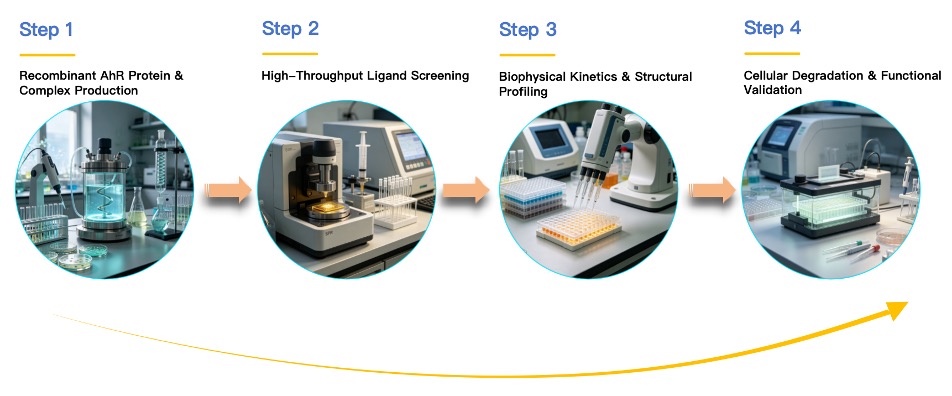
Our AhR screening and validation pipeline integrates structural biology, high-throughput kinetics, and cell-based degradation profiling:
Stage 1
Recombinant AhR Protein & Complex Production
High-yield expression of human AhR PAS-B domain constructs or reconstituted AhR–HSP90–XAP2 multiprotein complexes across insect and mammalian systems, verified via SEC-MALS for native ligand-binding competence.
Stage 2
High-Throughput Ligand Screening
Parallel hit discovery using DEL selections, SPR-based fragment profiling, and competitive TR-FRET ligand-displacement assays against functional AhR constructs.
Stage 3
Biophysical Kinetics & Structural Profiling
Quantification of binding parameters (KD, Kon, Koff) via SPR and MST. Structural biology services (X-ray/cryo-EM) delineate exact binding topologies within the PAS-B cavity to guide rational linker attachment.
Stage 4
Cellular Degradation & Functional Validation
Lead bifunctional degraders are conjugated and tested in disease-relevant cell models. Target depletion metrics (DC50, Dmax) and proteome-wide selectivity are quantified using Western blotting and multiplexed quantitative proteomics.
Advantages of Our Services
Navigating non-canonical E3 ligases like AhR demands deep domain mastery in nuclear receptor biology, protein-protein interaction analysis, and specialized synthetic conjugation. Creative Biolabs offers an integrated scientific platform engineered to de-risk your TPD campaign and accelerate your path to lead candidate selection:
Specialized bHLH-PAS Domain Expertise
Deep technical command over AhR conformational states, CUL4B complex assembly, and ligand-driven nucleocytoplasmic translocation mechanics.
Streamlined Reagent Inventory
Direct access to purified, structurally verified AhR PAS-B domain constructs and pre-established biophysical assay setups, eliminating setup delays.
Integrated Chemistry-to-Biology Workflow
Single-site execution spanning primary hit selection, custom synthetic linker conjugation, structural modeling, and cell-based degradation profiling.
Focus on Productive Cooperativity
Early-stage prioritization of ternary complex thermodynamics (α) ensures only functional, high-efficiency degraders advance into lead optimization.
Tailored Contractual Models
Flexible project design adaptable to your specific therapeutic goals, ranging from targeted hit discovery to full hit-to-lead campaigns.
Frequently Asked Questions
Q: What makes AhR an advantageous E3 ligase target compared to CRBN or VHL?
A: AhR features a well-defined, highly druggable bHLH-PAS ligand-binding pocket, displays enriched expression in specific immune and epithelial cells, and operates via the CUL4B machinery. This provides a distinct degradation pathway that bypasses classical E3 resistance and offers clean commercial patent space.
Q: Does ligand binding to AhR trigger undesirable xenobiotic transcription (e.g., CYP1A1 upregulation)?
A: Not necessarily. During our screening and optimization assays, we profile candidates to identify "partial agonists" or "selective AhR modulators" (SAhRMs) that efficiently induce CUL4B-mediated degradation of the target protein while minimizing or avoiding classical AhR-driven transcriptional gene activation.
Q: Which AhR protein constructs are utilized during primary ligand screening?
A: We primarily utilize recombinant human AhR PAS-B domain constructs (which contain the core ligand-binding cavity) for high-throughput biophysical and crystallographic screens, alongside co-expressed full-length AhR complex assemblies for functional confirmation.
Q: Can Creative Biolabs perform custom synthetic conjugation using client-supplied target ligands?
A: Yes. Clients can provide their proprietary target-binding small molecules or peptides. Our synthetic chemists will design and synthesize a matrix of heterobifunctional molecules combining your target binder with newly identified AhR recruiters across varied linker chemistries.
Creative Biolabs provides tailored AhR recruiter discovery platforms, advanced biophysical characterization, and custom degrader synthesis to advance your targeted protein degradation programs. Contact our technical team today to consult with our scientists, discuss project specifications, or request a detailed proposal.
Contact Our Team for More Information and to Discuss Your Project →


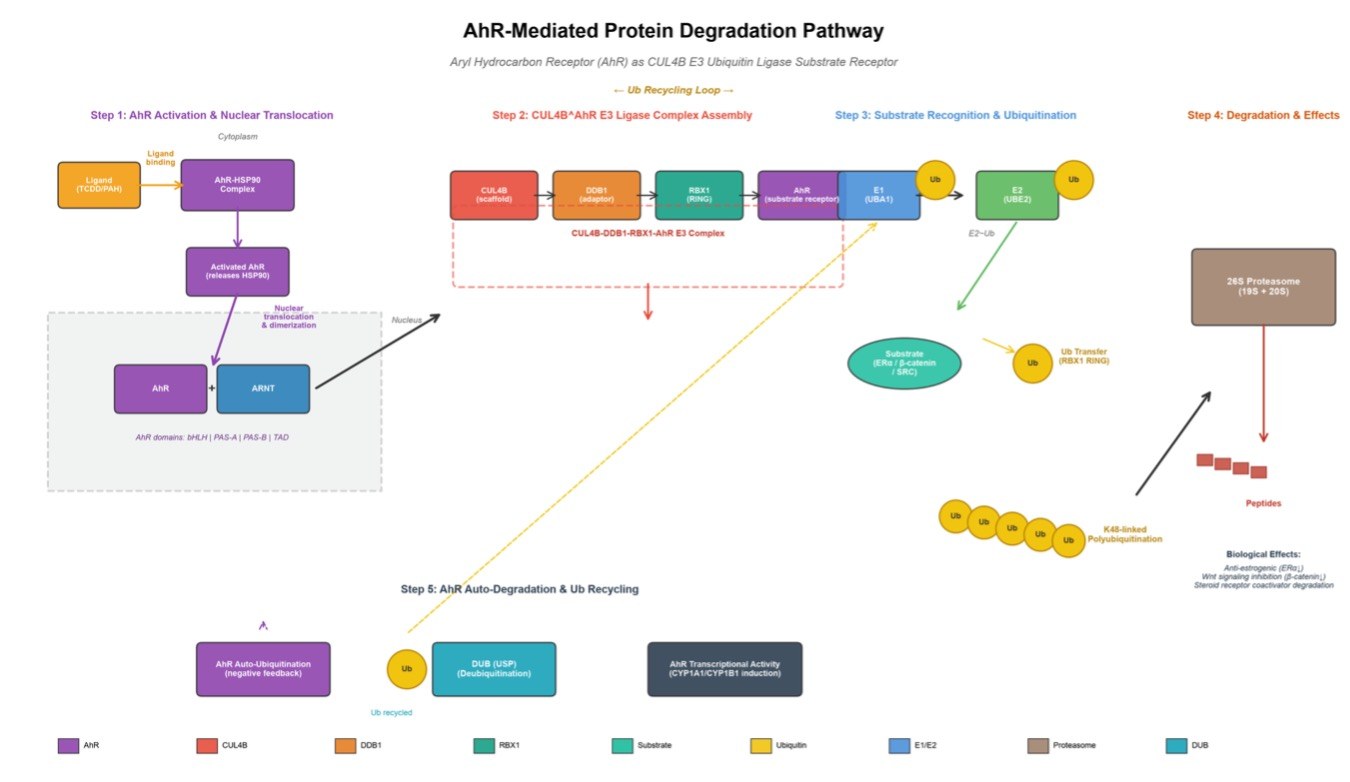 Fig.1 The AhR-mediated protein degradation.