Creative Biolabs is offering the most comprehensive services for antibody development projects. With strict regulation and effective execution, we are dedicated to providing the most valuable solutions to complete your projects.
HighlightsCreative Biolabs is offering the most comprehensive services for antibody development projects. With strict regulation and effective execution, we are dedicated to providing the most valuable solutions to complete your projects.
HighlightsCreative Biolabs has established a broad range of platforms for developing novel antibodies or equivalents. These cutting-edge technologies enable our scientists to meet your demands from different aspects and tailor the most appropriate solution that contributes to the success of your projects.
HighlightsWith deep understanding in antibody-related realms and extensive project experience, Creative Biolabs offers a variety of references to help you learn more about our capacities and achievements, including infographic, flyer, case study, peer-reviewed publications, and all kinds of knowledge that can assist your projects. You are also welcome to contact us directly for more specific solutions.
HighlightsGet a real taste of Creative Biolabs, one of the most professional custom service providers in the world. We are committed to providing highly customized comprehensive solutions with the best quality to advance your projects.
HighlightsImmunogenicity refers to the ability to elicit an immune response that the antigen can stimulate specific immune cells, activate, proliferate, differentiate, and ultimately produce antibodies to immune effector antibodies and sensitized lymphocytes. In recent years, biopharmaceuticals have developed rapidly, but their immunogenicity is not an unsolved problem. Therefore, it is important to assess the immunogenicity of biopharmaceuticals to ensure their drug safety. Creative Biolabs can provide a comprehensive assessment of immunogenicity, a variety of evaluation methods and technical services to help you keep your medication safe.
The direct binding assay is one of the easiest evaluation methods in competitive binding assays, generally, by using a kit to verified, for example, enzyme-linked immunosorbent assay (ELISA) has been widely used for the quantitative determination of IgG. In the past few years, the enzyme-labeled antibody technology for antigen localization has been developed into trace substances in liquid samples. The evaluation method often has advantages such as easy-to-use and automated, high throughput, high therapeutic tolerance, low-cost generic reagents, as well as instrument.
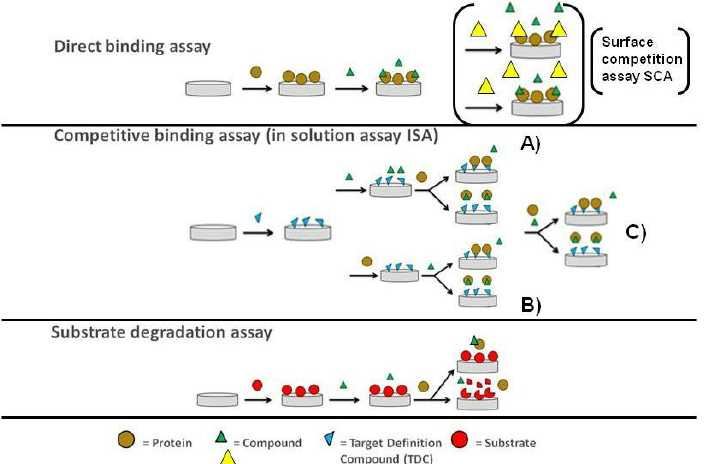 Fig.1 Assay formats among direct binging assay, competitive binding assay, and substrate degradation assay. (Geschwindner, 2012)
It is very necessary to evaluate the immunogenicity of biopharmaceuticals in the early stages of administration. Creative Biolabs provides a rich research background about direct binding assay and immunogenic diagnosis. If you want to know more information, please contact us in time and we are happy to provide you with detailed information and standard technical services.
A direct binding assay involves detecting and measuring the binding of antibodies to drug molecules to assess the immunogenic potential of biotherapeutic drugs. This assay helps in identifying anti-drug antibodies (ADAs) that can impact drug efficacy and safety.
Immunogenicity assessment is essential as it evaluates the potential of a biotherapeutic to induce an immune response, specifically the production of ADAs. Understanding immunogenicity helps in predicting drug safety and efficacy, which is critical for successful clinical outcomes.
Unlike cell-based or competitive ligand binding assays, direct binding assays do not require live cells or competition mechanisms. They directly measure the interaction between antibodies and the drug, providing straightforward and specific results regarding ADA presence.
Direct binding assays are valued for their simplicity, high sensitivity, and specificity. They require less complex sample preparation and can quantitatively measure the levels of ADAs, providing clear data on the immunogenic potential of the drug.
Serum and plasma are the most commonly used samples in direct binding assays for immunogenicity testing. These biological fluids contain antibodies produced in response to biotherapeutic administration, making them ideal for ADA detection.
Researchers may encounter issues such as non-specific binding, interference from other serum components, and the need for highly specific reagents. Proper assay design and validation are critical to overcoming these challenges and ensuring reliable results.
Use the resources in our library to help you understand your options and make critical decisions for your study.
All listed services and products are For Research Use Only. Do Not use in any diagnostic or therapeutic applications.