The key component in EV-NP development are exosomes, naturally secreted nanovesicles typically ranging from 30–150 nm. Functioning as potent intercellular communication couriers, exosomes are responsible for transferring proteins and genetic material between cells. Due to their low immunogenicity and powerful, inherent tissue-specific tropism, exosomes are highly desirable starting materials for creating EV-NPs that can precisely home in on target cells or tissues.
Extracellular Nanovesicles for Targeted Drug Delivery
The future of drug delivery lies in sophisticated biomimetic systems. Extracellular nanovesicle-camouflaged nanoparticles (EV-NPs) merge the targeting finesse of natural systems with synthetic stability. Creative Biolabs specializes in providing high-standard development services for EV-NPs, helping clients overcome the bottleneck of low yield and regulatory standardization to successfully translate next-generation therapeutics into clinical reality.
Click Here to View more about our Service
 Exosome-based Delivery System Exosome Isolation & Purification Service Exosome Characterization & Analysis Service Exosome Cargo Loading Service
Introduction to Extracellular Nanovesicle-Camouflaged Nanoparticles
Extracellular nanovesicles (EVs)—including natural vesicles like exosomes and synthetic structures like microbubbles—are revolutionizing drug delivery. EV-NPs are core-shell systems created by fusing natural EV membranes or synthetic membrane structures onto a functionalized synthetic nanoparticle core. This unique biomimetic strategy integrates the stability and high-loading capacity of engineered NPs with the biological "stealth" and inherent targeting capabilities of natural cellular components, dramatically enhancing drug efficacy and precision in vivo.
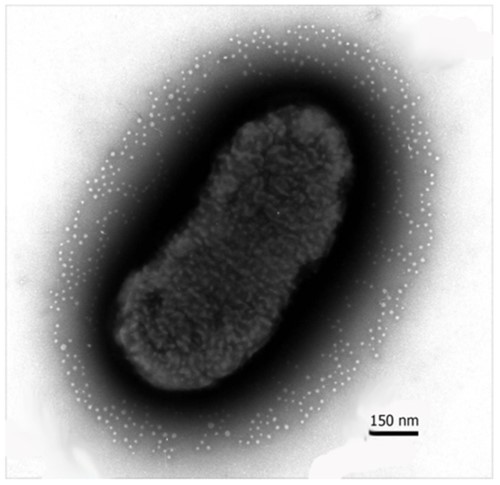 Fig.1 Schematic of numerous extracellular membrane nanovesicles on the surface, outside of bacterial cell.1
Advantages of Extracellular Nanovesicle-Camouflaged Nanoparticles
The EV-NP delivery system involves disguising a synthetic NP core as a natural EV or a synthetic mimic. This approach focuses on using the purified components of the EV surface to bestow crucial advantages over traditional NPs:
Engineered Immune Evasion
By leveraging EV-surface proteins like CD47, the NP effectively bypasses the Mononuclear Phagocytic System (MPS) to gain stealth capability and maximize circulation time.
Intrinsic Biological Homing
The EV shell component grants the NP high-fidelity Homotypic Targeting (e.g., tumor-derived exosomes target parent tumors) or Inflammation Tropism, ensuring maximized specificity and enhanced accumulation at the site of disease via the Enhanced Permeability and Retention (EPR) effect.
Optimized Payload and Release
The synthetic core remains fully optimizable for maximizing drug load, co-delivery of multiple agents, and enabling precise, stimuli-responsive release kinetics (e.g., triggered by pH, temperature, or ultrasound).
Applications of Extracellular Nanovesicle-Camouflaged Nanoparticles
Precision Oncology
This strategy exploits the EV's inherent homotypic targeting capability. EV-NPs coated with tumor-derived exosomes home precisely to the parent tumor and metastatic sites, enhancing drug accumulation via the EPR effect. This camouflaged exterior also helps overcome drug resistance (MDR), enabling efficient delivery of therapeutics (small molecules, gene therapies) directly into cancer cells.
Regenerative Medicine & Tissue Repair
Exosome-based NP disguises, often utilizing Mesenchymal Stem Cell (MSC) nanovesicles combined with NPs, protect delicate growth factors and nucleic acids. This provides sustained, localized release that significantly accelerates the repair of damaged tissues, such as cartilage or bone, offering a distinct advantage over free EVs which are rapidly cleared.
Advanced Theranostics
Integrating larger vesicles like microbubbles with therapeutic NPs creates a powerful tool for simultaneous diagnosis and treatment. These systems can be engineered to concentrate at a disease site for imaging and then be triggered externally (e.g., by focused ultrasound) to burst (acoustic cavitation), achieving on-demand, localized drug release crucial for managing hard-to-reach tumors or vascular lesions.
Immunomodulation and Anti-Inflammation
Nanovesicles derived from immune cells (e.g., macrophages) are used to actively migrate toward cytokine gradients at inflammatory sites (e.g., atherosclerotic plaques). This allows for the precise delivery of anti-inflammatory payloads, minimizing systemic side effects typically associated with conventional immunosuppressive drugs.
Table.1 Examples of EV-NPs.
| Application Area | EVs Type | NP Class | Key Mechanism |
|---|---|---|---|
| Precision Oncology | Tumor-derived Exosomes | PLGA / Gold NPs | Homotypic Targeting & MDR Reversal |
| Regenerative Med. | MSC-derived Exosomes | Hydrogels / Nanofibers | Paracrine Signaling & Factor Retention |
| Theranostics | Engineered Microbubbles | Liposomes / Magnetic NPs | Acoustic Cavitation & Sonoporation |
| Anti-Inflammation | Macrophage Nanovesicles | Polymer Nanoparticles | Chemotaxis (Inflammation Homing) |
Creative Biolabs provides scalable, standardized EV-NP delivery system development services. We particularly drive traffic to our advanced exosome-based delivery system development platform. Contact us today to leverage our expertise and discuss how our technology can enhance your therapeutic candidate's efficacy and path to market.
Reference
- Lusta, Konstantin A., et al. "Involvement of bacterial extracellular membrane nanovesicles in infectious diseases and their application in medicine." Pharmaceutics 14.12 (2022): 2597. Distributed under Open Access license CC BY 4.0, without modification. https://doi.org/10.3390/pharmaceutics14122597
Our services are For Research Use Only. We do not provide services to individuals.
Online Inquiry