
Embedding microcapsules into marine paint films provides a next-generation antifouling coating that offers significantly extended dry-dock intervals, lower fuel consumption (due to reduced drag), and compliance with increasingly stringent environmental regulations regarding biocide effluent.
Targeted Encapsulation for Biofouling Control
In the pursuit of maintaining marine, industrial, and medical surfaces, biofouling presents a constant, costly, and environmentally challenging obstacle. Protecting surfaces from the unwanted adhesion and growth of microorganisms and macroorganisms requires highly effective, yet sustainable, strategies. Our Targeted Encapsulation for Biofouling Control service helps you develop sustainable, highly effective antifouling strategies through precise, release-on-demand delivery of active agents via advanced encapsulation matrices. This technology is crucial for extending the life of marine coatings, protecting sensitive sensors, and ensuring the long-term efficacy of submerged infrastructure, transforming the way you approach surface protection.
Click Here to View more about our Service
Introduction of Targeted Encapsulation for Biofouling Control
Targeted encapsulation for biofouling control is a breakthrough approach that leverages drug delivery principles in material science to mitigate the adhesion of undesirable organisms on submerged surfaces. Biofouling is a complex, multi-stage process, initiated by the immediate adsorption of organic molecules, followed by the reversible and irreversible attachment of bacteria, leading to the formation of a resilient extracellular polymeric substance (EPS) matrix—the biofilm. The biofilm itself is the primary target, as it facilitates the subsequent settlement of macrofoulers.
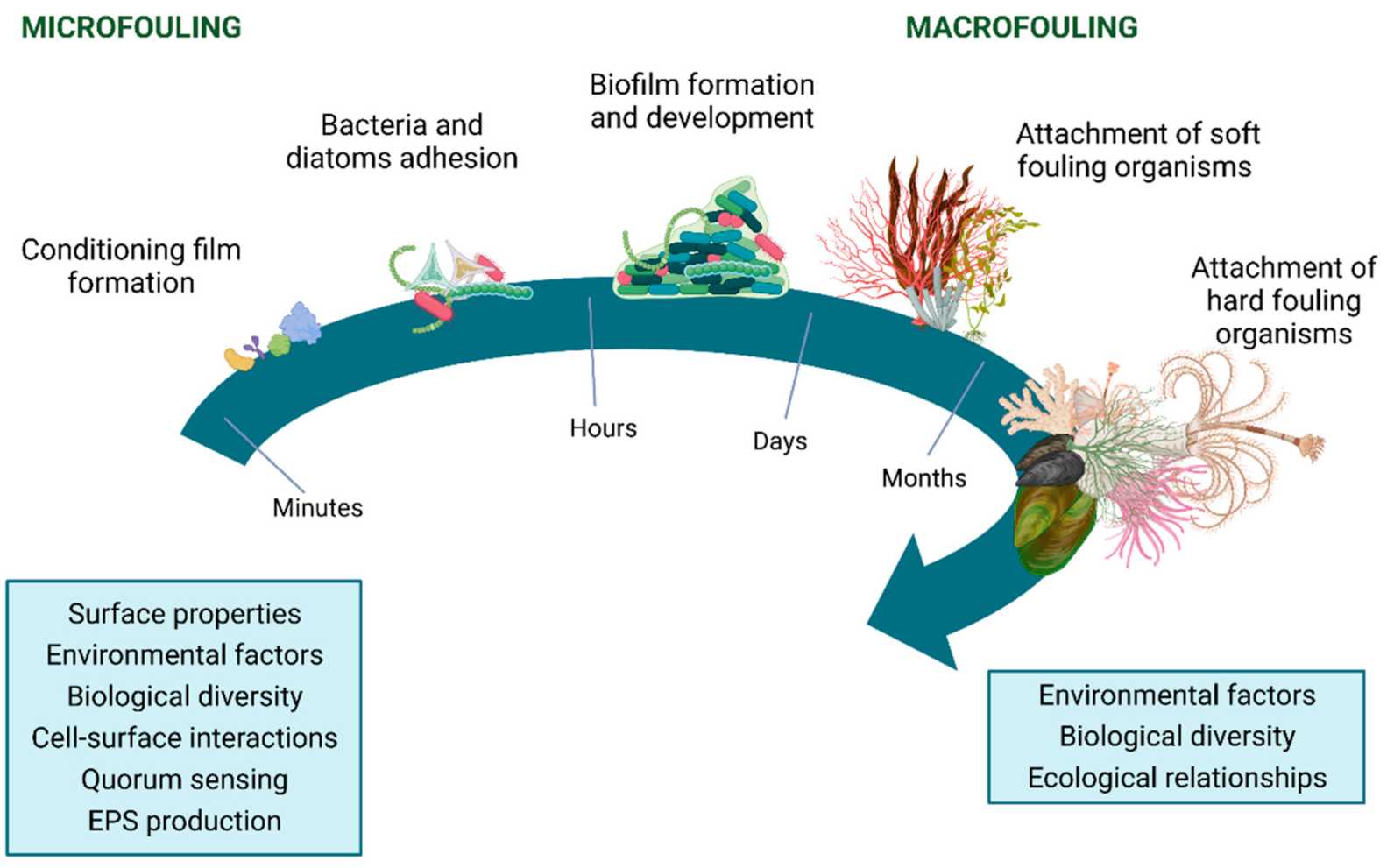 Fig.1 The marine biofouling process and the main factors that affect microfouling and macrofouling events.1
In marine systems, common foulers include diatoms, bacterial species like Escherichia coli and Staphylococcus aureus (used as key indicators in testing), and invertebrates like mussels and barnacles. The signaling pathways involved in biofouling are primarily related to microbial communication (quorum sensing) and adhesion mechanisms. Encapsulation systems are designed to disrupt these processes by:
- Protecting the Payload: The capsule shell safeguards the active agent from premature leaching, chemical degradation, and ultraviolet radiation.
- Targeting the Microenvironment: The encapsulated agent is often released in response to the micro-environmental cues of a forming biofilm (e.g., local pH decrease due to bacterial metabolism), achieving a 'surgical strike' effect.
- Controlled Release: By tuning the wall material (e.g., biopolymers like poly(lactic acid) or polymeric resins) and porosity, the leaching rate is optimized to maintain the minimum effective concentration over long durations, preventing sudden toxic bursts and minimizing pollution. Cited literature supports that aerogel-encapsulated biocide crystals, for example, can enhance protection efficiency and enable low-loading, high-utilization antifouling coatings by efficiently attracting seawater to trigger controlled release.
Application of Targeted Encapsulation in Surface Protection
The versatility and sustainability of targeted encapsulation open up a wide range of applications across various high-value sectors, moving beyond traditional ship hull protection.
Marine Coatings and Shipping
Underwater Sensors and Instruments
Static structures and sensitive instruments (such as oceanographic sensors, sonar domes, and wave energy converters) are highly vulnerable to biofouling, which rapidly compromises their accuracy and functionality. Encapsulation techniques can be applied as specialized, low-leaching surface layers that maintain transparency and performance while proactively controlling initial microbial colonization.
Industrial Water Systems
In cooling towers, heat exchangers, and household water storage tanks, biofilms harbor pathogens and reduce system efficiency. Encapsulation can deliver targeted agents, such as specialized bacteriophages, that are stable in bulk water but autonomously release upon encountering the acidic pH of a nascent biofilm, providing autonomous mitigation without broad chemical dosing (Published Data).
Aquaculture and Mariculture
Protecting nets, cages, and infrastructure in farming environments is critical. Encapsulation allows for the focused delivery of natural inhibitors or anti-settlement agents directly to the surfaces, providing effective and environmentally responsible protection for food safety and operational integrity.
What We Can Offer: Comprehensive Encapsulation Services
Biofouling begins with the rapid formation of a conditioning film and microbial biofilm, a sticky matrix that serves as the foundation for larger organisms (algae, barnacles, mussels) to settle. Traditional solutions rely on the continuous, non-selective leaching of toxic biocides, which leads to environmental pollution, the rapid depletion of the active agent, and poor biocide utilization.
Creative Biolabs' Targeted Encapsulation addresses these critical limitations by fundamentally changing the kinetics and location of biocide release. We engineer sophisticated micro- and nano-scale delivery vehicles—such as polymeric microcapsules, liposomes, and aerogel matrices—that precisely contain and protect antifouling compounds (both traditional biocides and nature-derived, "greener" agents).
Specific Deliverables and Solutions:
Sustained-Release Formulations
We develop encapsulation systems that provide extended, predictable release profiles over periods ranging from months to years, significantly extending the lifespan of your antifouling material compared to conventional coatings.
Triggered-Release Technology
We design "smart" capsules that only release their payload upon encountering specific environmental stimuli associated with biofouling, such as localized changes in pH (caused by microbial activity), shifts in salinity, or temperature increases. This autonomous, release-on-demand mechanism minimizes environmental impact and maximizes biocide efficacy at the exact site of need.
Custom Particle Engineering
We fine-tune particle size, core-to-wall ratio, and surface chemistry to match the requirements of specific applications, such as incorporation into paint matrices or direct application in niche areas (e.g., cooling systems, sensors). This customization ensures optimal mechanical integration and release kinetics.
Encapsulation of Sensitive Agents
We specialize in formulating and stabilizing fragile, natural antifouling compounds, like essential oils, enzymes, or bacteriophages, which would otherwise degrade rapidly in the harsh marine environment.
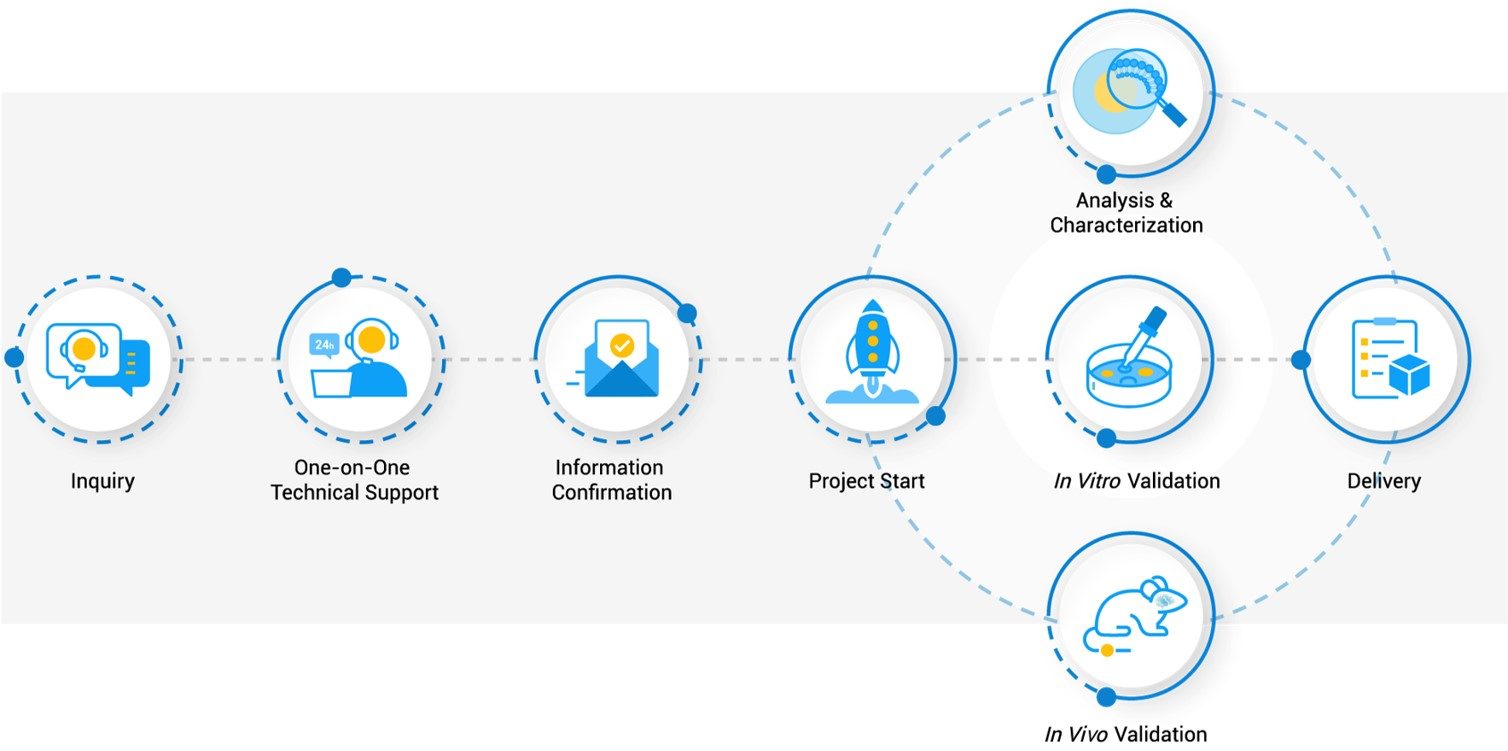
Workflow
Frequently Asked Questions
What is the primary advantage of using encapsulation over simply blending antifouling agents into a coating?
Encapsulation fundamentally transforms the agent's release mechanism from uncontrolled leaching to controlled, sustained, or triggered output. Simply blending leads to a rapid initial burst release, causing high localized toxicity and quick depletion of the compound. Encapsulation creates a protective barrier that meters the release rate, ensuring the agent remains effective for a significantly longer duration at the required Minimum Inhibitory Concentration (MIC) without unnecessarily polluting the surrounding environment.
How do these delivery systems account for the diversity of fouling organisms (micro- vs. macro-foulers)?
Biofouling is a succession process where microbial biofilm formation precedes macrofouler settlement. Effective encapsulation targets the initial stage—the microbial phase. By disrupting bacterial adhesion and communication (quorum sensing inhibitors) or inhibiting primary biofilm growth, the surface loses the necessary 'foundation' for macro-organism attachment. Furthermore, the ability to co-encapsulate different types of agents allows for multi-modal protection targeting different stages of the fouling process.
Is the encapsulation material itself chemically stable in continuous saltwater exposure?
Yes, the materials used for the capsule shell are selected specifically for environmental resilience. Common matrices involve highly stable synthetic polymers (like certain cross-linked polyurethane or melamine resins) or robust biopolymers engineered to resist degradation by salinity, UV radiation, and mechanical abrasion over the required protection period. The goal is to ensure the capsule matrix degrades only after its active life is complete, or in a controlled, non-toxic manner.
Can this technology be used for retrofitting existing structures, or is it only applicable to new materials?
While incorporation into new coatings offers the best integration, encapsulated systems can be formulated for various applications. They can be applied as specialized, clear top-coats over existing passive coatings, or incorporated into patch-repair materials. For complex niche areas on existing structures, custom-engineered semipermeable encapsulation wraps or sleeves containing the active agents can be used for proactive, long-term protection.
What are the main design parameters that determine the ideal particle size for a specific antifouling application?
Particle size is critical and depends on two factors: the target organism and the delivery matrix. For incorporation into smooth antifouling paints, particle size must typically be in the nano- to low micro-meter range (e.g., <10 μm) to maintain the paint's mechanical integrity and surface roughness properties. However, for specialized targeted control of filter-feeding organisms, the particle size must be precisely matched to the feeding preference of the target species, often requiring microcapsules in the 50-200 μm range to ensure efficient ingestion and delivery.
In conclusion, Creative Biolabs' Targeted Encapsulation for Biofouling Control offers a strategic, sustainable, and highly efficient alternative to outdated chemical leaching systems. By enabling the precision delivery of antifouling agents—be they traditional biocides or next-generation bio-derived compounds—we help you achieve prolonged surface protection, minimize environmental impact, and significantly reduce operational costs associated with fouling maintenance. Our deep expertise in custom encapsulation formulation and controlled release technology is the key to unlocking the full potential of your antifouling solutions.
Reference
- Romeu, Maria João, and Filipe Mergulhão. "Development of Antifouling Strategies for Marine Applications." Microorganisms vol. 11,6 1568. 13 Jun. 2023, Distributed under Open Access license CC BY 4.0, without modification. https://doi.org/10.3390/microorganisms11061568
Our services are For Research Use Only. We do not provide services to individuals.
Online Inquiry