
Encapsulation plays a vital role in protecting and delivering microbial cells and enzymes to sites contaminated with petroleum hydrocarbons, persistent organic pollutants (POPs), and pesticides. By immobilizing specialized pollutant-degrading microorganisms (bio-augmentation) or essential nutrients (bio-stimulation) within a protective matrix, we ensure cell viability and sustained activity over long periods in harsh, nutrient-poor, or toxic environments. For example, the use of hydrogel-encapsulated anaerobic communities allows for stable, high-rate resource recovery from complex waste streams.
Targeted Encapsulation for Environmental Remediation
In the pursuit of cleaner ecosystems, the journey from identifying a pollutant to its effective, localized neutralization often relies on one pivotal technology: Targeted Encapsulation for Environmental Remediation. Our Creative Biolabs Targeted Encapsulation services help you streamline pollution mitigation and achieve site-specific cleanup through innovative nano- and micro-scale matrix engineering and environmentally responsive release mechanisms. We provide custom solutions that protect sensitive agents, enhance bioavailability, and ensure the precise, efficient delivery of remediation cargo to the contamination source, transforming environmental challenges into manageable processes.
Click Here to View more about our Service
Introduction of Targeted Encapsulation
Targeted encapsulation refers to the science and engineering of enclosing an active substance (the core or payload) within a protective shell material (the matrix) to control its release kinetics and guide its distribution to a specific site or stimulus. In the context of environmental remediation, this core material can be virtually any agent necessary for pollution abatement, ranging from zero-valent iron nanoparticles (nZVI) for reductive dechlorination of organic solvents to specialized microbial strains for oil spill biodegradation.
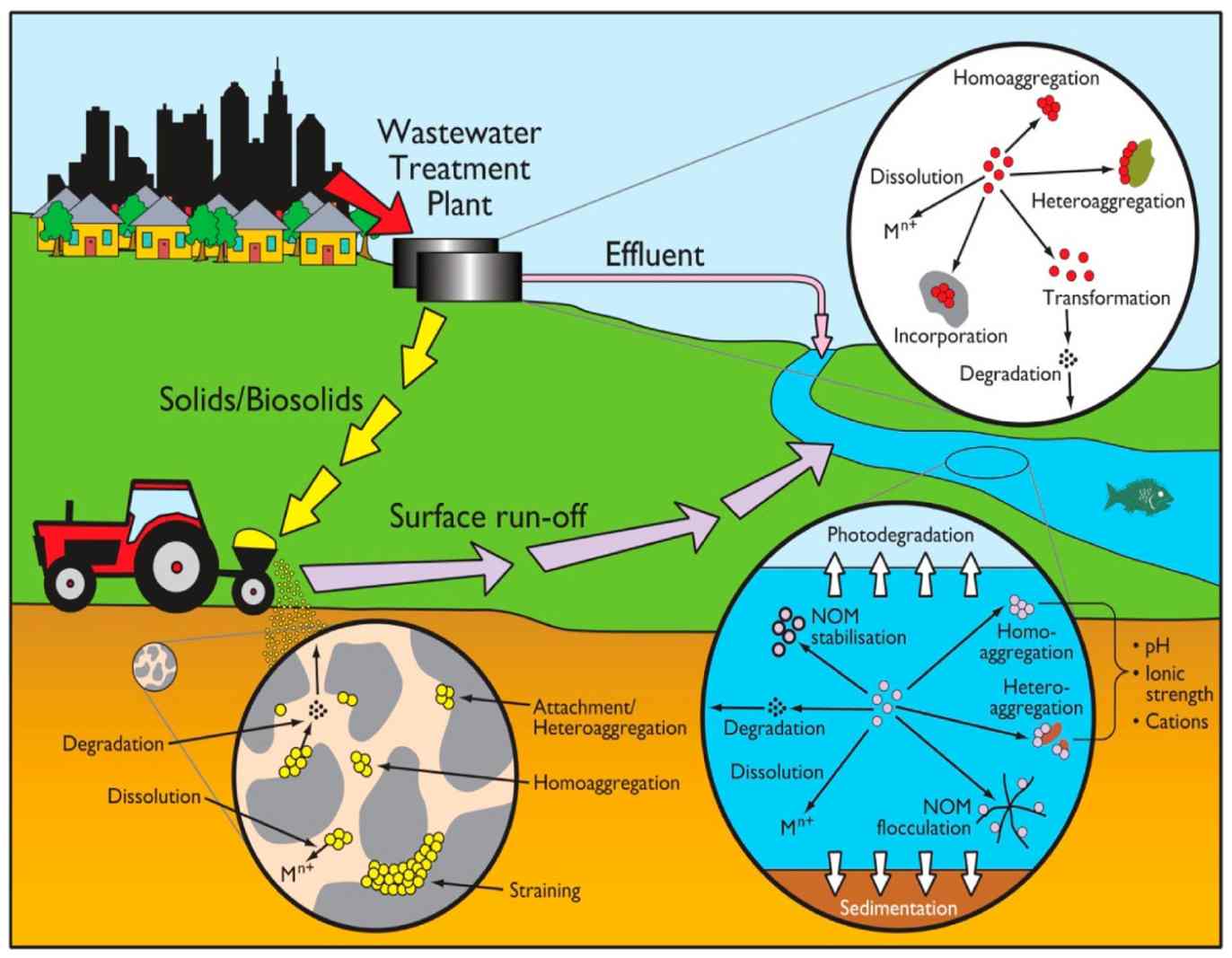 Fig.1 Pathways for releasing nanoparticles into the environment.1
The core principle involves protecting the active agent's function, especially sensitive biological components like enzymes or microorganisms, which might otherwise be rapidly degraded or inhibited by the toxic environment. Nanomaterials often possess a high surface area-to-volume ratio, which, when coupled with tailored surface chemistries, allows for exceptional adsorption and reactivity. By coating these materials, researchers can enhance their stability while functionalizing the exterior for specific contaminant recognition or environmental responsiveness (e.g., pH, temperature, or enzyme triggers specific to the contaminated site). This advanced control over fate and transport is crucial for enabling effective in situ remediation, preventing the uncontrolled spread of contaminants, and ensuring long-term containment. The application is supported by extensive literature detailing the enhanced performance, reusability, and longevity of encapsulated biocatalysts and adsorbents compared to their free counterparts.
Applications in Environmental Remediation
The versatility of targeted encapsulation allows for its application across a broad spectrum of environmental contamination challenges, offering solutions that are often superior to conventional methods in terms of precision and sustainability.
Site-Specific Bioremediation and Bioaugmentation
Heavy Metal Stabilization and Removal
Nanoscale encapsulation systems are highly effective for managing heavy metal contamination (e.g., lead, chromium, cadmium) in soil and water. Functionalized microcapsules containing adsorbents like thiol- or amine-modified mesoporous silica can be designed with a high selectivity for specific metal ions. The encapsulation facilitates easy recovery of the adsorbent after pollutant capture, enabling regeneration and reuse, which is a major advantage over single-use materials.
Controlled-Release Technology for Water Treatment
In municipal and industrial wastewater treatment, targeted encapsulation controls the release of reagents, flocculants, or active disinfectants. This is particularly valuable in dynamic systems where the optimal concentration of an agent needs to be maintained for sustained performance without wastage. Furthermore, responsive capsules can be designed to release agents only upon sensing a specific environmental trigger, such as a shift in pH or the presence of a target organic pollutant.
Long-Term Containment and Stabilization
For large-scale industrial sites and landfills, encapsulation (often macro-scale polymer-based methods) serves as a long-term strategy to prevent the migration and leaching of contaminants like asbestos or polychlorinated biphenyls (PCBs) into groundwater. By creating a robust, low-permeability barrier around the hazardous material, targeted stabilization ensures regulatory compliance and long-term environmental protection.
What We Can Offer
Traditional remediation methods often suffer from inefficiency, high cost, and collateral environmental impact due to non-specific chemical dispersal or extensive physical removal. Creative Biolabs' targeted encapsulation fundamentally redefines this approach by solving the core problem of delivery: getting the right agent to the right place, at the right time.
We engineer sophisticated micro- and nanocapsules, leveraging materials like biodegradable polymers, lipids, and hydrogels, to house active remediation agents—which can include chemical reactants, biosorbents, enzymes, or living microbial cultures. These encapsulation systems are designed to offer protective shielding against harsh environmental conditions (e.g., pH extremes, toxic heavy metals) and include targeting ligands or passive size mechanisms to concentrate the remediation agent exactly where the pollutant concentration is highest, whether in soil, sediment, or groundwater. This dramatically increases contact efficiency, reduces the total amount of remediation material required, and minimizes off-target effects.
Specific Deliverables and Solutions:
Customized Matrix Material Synthesis
Development and scalable production of encapsulation materials, including natural polymers (e.g., alginate, chitosan, cellulose derivatives), synthetic polymers (e.g., PCL), and liposomes, tailored for biodegradability and environmental compatibility.
Encapsulation Technique Optimization
Expertise in various high-efficiency methods such as Spray Drying, Microfluidic Encapsulation, Layer-by-Layer (LbL) Assembly, and Emulsion-based techniques to achieve precise size, morphology, and high loading capacity.
Targeting Module Integration
Functionalization of capsule surfaces with targeting ligands or specialized chemistries (e.g., Calixarenes for selective organic pollutant binding) to enhance agent localization and contaminant selectivity.
Payload Protection and Stabilization
Services focused on ensuring the viability and stability of sensitive payloads, including living microbial cells, enzymes, and volatile chemical reagents, under adverse conditions.
Controlled and Responsive Release Design
Engineering systems that offer a sustained release profile or are stimuli-responsive (e.g., triggered by pH change, temperature, or contaminant concentration) for optimal remediation kinetics.
Workflow
Frequently Asked Questions
How does this advanced delivery method ensure the agent reaches contaminants deep within soil or groundwater matrices?
The technology utilizes particle size optimization, typically operating in the micro- to nano-range, to achieve deep penetration into porous media. Furthermore, the outer shell can be engineered to exhibit specific surface properties, allowing the particles to passively accumulate in zones of high contaminant concentration due to chemical affinity, ensuring maximum contact efficiency where it matters most.
What is the typical lifespan of the encapsulated remediation agent once deployed in the environment?
The active lifespan is fully tunable during the design phase. We engineer the capsule's shell thickness and composition to provide sustained protection, which can range from days to several months, depending on the required duration of the remediation activity. This controlled release protects sensitive components, dramatically extending their functional lifetime compared to applying the free agent.
Can a single capsule be designed to neutralize multiple types of pollutants simultaneously?
Yes, sophisticated multi-layer or multi-core encapsulation is possible. This allows us to load different active agents within a single system, or design the outer shell to selectively adsorb one type of pollutant while the inner core releases an agent to neutralize another, creating a powerful, multifunctional remediation tool.
How does the cost of this targeted approach compare to conventional remediation methods like pump-and-treat or excavation?
While the initial cost of developing a customized targeted system may involve specialized engineering, the long-term cost-effectiveness is often superior. By precisely localizing the agent and preventing its off-target degradation, the required material volume is significantly reduced, operational time is often shortened, and the need for expensive, disruptive excavation or continuous, high-energy pump-and-treat operations is minimized.
Are the materials used for the encapsulation shell safe for the ecosystem after the remediation process is complete?
We predominantly utilize highly biocompatible and naturally occurring materials, such as specific lipid and polysaccharide derivatives, in our encapsulation matrices. These materials are selected specifically for their ability to naturally degrade into environmentally benign compounds once their protective function is complete, ensuring a sustainable and low-impact cleanup solution.
Creative Biolabs offers world-class expertise in Targeted Encapsulation for Environmental Remediation, providing comprehensive R&D and manufacturing support from initial concept through large-scale deployment. We specialize in engineering precise, stable, and highly effective micro- and nanocapsule delivery systems to address contamination of soil, water, and air, enabling highly efficient, sustainable, and targeted environmental cleanup. Our dedication to customized, science-driven solutions ensures your project achieves optimal remediation outcomes.
Reference
- Yusuf, Esther O., et al. "Controlled Application of Nanoparticles for Remediation in Oil and Gas Application: Strategies, Challenges, and Innovations." Energies 18.4 (2025): 991. Distributed under Open Access license CC BY 4.0, without modification. https://doi.org/10.3390/en18040991
Our services are For Research Use Only. We do not provide services to individuals.
Online Inquiry