
Introduction
The clinical promise of antibody-antibiotic conjugates (AACs) rests on the successful integration of three components: a targeting antibody, a chemical linker, and a potent antibiotic payload. While much attention has been directed toward antibody engineering and linker chemistry, the antibiotic payload itself represents a critical — and often underappreciated — determinant of conjugate efficacy. The payload must not only possess intrinsic bactericidal potency but also remain amenable to chemical modification for linker attachment without compromising its antimicrobial activity.
The selection and synthesis of antibiotic payloads for AACs draws from the rich chemical diversity of natural product and semisynthetic antimicrobials, spanning rifamycin derivatives, beta-lactam subclasses (penicillins, cephalosporins, monobactams, and carbapenems), and other mechanistically distinct scaffolds. Each class presents unique synthetic challenges, conjugation handles, and structure-activity relationships that must be navigated during payload development. This article surveys the major antibiotic classes employed as AAC payloads, examines the synthetic strategies that enable their conjugation, and discusses how integrated chemistry support can accelerate preclinical AAC programs.
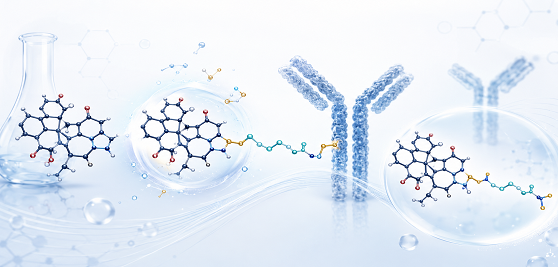
The Antibiotic Payload Landscape for AACs
Unlike conventional antibiotic therapy, where systemic exposure governs both efficacy and toxicity, AACs change the pharmacokinetic paradigm entirely. By linking an antibiotic to a targeting antibody, the conjugate restricts payload distribution primarily to sites of bacterial infection, concentrating antimicrobial activity within host cells where intracellular pathogens reside. This mechanism imposes distinct requirements on the antibiotic payload: it must be amenable to conjugation chemistry, retain or regain activity upon linker cleavage, and function effectively in the phagolysosomal environment — a compartment characterized by acidic pH, proteolytic enzymes, and reducing conditions.
The foundational demonstration of this concept was established through an AAC combining an anti-Staphylococcus aureus antibody with the rifamycin analog dmDNA31. This conjugate, later designated DSTA4637S (clinical formulation), showed superior efficacy to vancomycin in murine bacteremia models and validated the intracellular antibiotic delivery paradigm. Since this landmark study, the AAC field has expanded to explore a broader repertoire of antibiotic payloads, each with distinct synthetic and pharmacological profiles.
dmDNA31 and Rifamycin-Class Payloads
Rifamycin antibiotics, which inhibit bacterial RNA polymerase by binding to the beta subunit and sterically blocking RNA transcript elongation, represent one of the most clinically validated payload classes for AACs. dmDNA31 (4-dimethylamino piperidino-hydroxybenzoxazinorifamycin) is a rifalazil analog — a next-generation rifamycin — specifically engineered for AAC applications. Compared with the parent compound rifampicin, dmDNA31 exhibits superior intracellular retention within macrophages and enhanced bactericidal activity against both actively replicating and stationary-phase S. aureus.
The synthesis of dmDNA31 and related rifamycin analogs for AAC conjugation requires careful attention to functional group compatibility. The tertiary amine present in the dmDNA31 scaffold serves as a critical conjugation handle: in the DSTA4637A construct, this amine is linked to a cathepsin B-cleavable valine-citrulline linker via a self-immolative p-aminobenzyl quaternary ammonium salt (PABQ) spacer. This design ensures that the antibiotic remains covalently attached and inactive during circulation, with active dmDNA31 released only after proteolytic cleavage in the phagolysosome. For research groups pursuing rifamycin-based AACs, specialized dmDNA31 Synthesis services that optimize linker attachment chemistry while preserving antibiotic potency can significantly streamline lead candidate generation.
Beta-Lactam Antibiotics as AAC Payloads
The beta-lactam antibiotic family — encompassing penicillins, cephalosporins, monobactams, and carbapenems — remains the most extensively deployed class of antibacterial agents in clinical medicine. Their mechanism of action, targeting penicillin-binding proteins (PBPs) to disrupt cell wall peptidoglycan cross-linking, is well characterized and mechanistically orthogonal to the rifamycin class. This diversity in killing mechanisms makes beta-lactams attractive candidates for AAC payload development, particularly when designing conjugates against Gram-negative pathogens where cell wall targeting may offer complementary advantages.
Penicillin Derivative Payloads
Penicillins feature a core penam scaffold — a four-membered beta-lactam ring fused to a five-membered thiazolidine ring — with the variable side chain at the 6-position determining antibacterial spectrum and pharmacokinetic properties. The fused bicyclic system distorts the beta-lactam amide bond, enhancing its reactivity toward PBPs relative to monocyclic beta-lactams. This intrinsic reactivity, while essential for antibacterial activity, also creates synthetic challenges: the beta-lactam ring is susceptible to nucleophilic ring-opening under basic conditions and to acid-catalyzed hydrolysis, constraining the choice of conjugation chemistries.
For AAC applications, penicillin derivatives can be modified at the carboxyl group of the thiazolidine ring or at the primary amine of the side chain (as in amoxicillin and ampicillin) to introduce linker attachment points. The choice of modification site must preserve PBP binding affinity, which is predominantly determined by the intact beta-lactam ring and the stereochemistry of the side chain amide. Penicillin Derivative Synthesis programs that incorporate structure-guided linker placement can help maintain the delicate balance between conjugate stability and antibiotic activity.
Cephalosporin Payloads
Cephalosporins share the beta-lactam pharmacophore with penicillins but are built on a cephem core — a beta-lactam ring fused to a six-membered dihydrothiazine ring. This structural difference provides cephalosporins with enhanced stability toward certain beta-lactamases and allows for modifications at two positions (C-3 and C-7) that independently tune antibacterial spectrum and pharmacokinetics. The C-3 substituent is particularly notable for AAC design, as chemical modifications at this position can be introduced without directly perturbing the beta-lactam ring that mediates PBP acylation.
From a synthetic standpoint, cephalosporins offer several practical advantages as AAC payloads. The C-3 acetoxymethyl group in first-generation cephalosporins serves as a latent leaving group that can be exploited for linker attachment. Furthermore, the progressive expansion of antibacterial spectrum across cephalosporin generations — from predominantly Gram-positive activity (first generation) to broad Gram-negative coverage (third and fourth generation) — provides a tunable platform for matching payload spectrum to the intended bacterial target. Dedicated Cephalosporin Synthesis services can accelerate payload optimization by providing access to diverse cephalosporin scaffolds with pre-installed functional handles for downstream conjugation.
Beyond Classical Beta-Lactams: Monobactam and Carbapenem Payloads
Two additional beta-lactam subclasses offer unique properties that may complement — or in some cases, surpass — traditional penicillin and cephalosporin payloads for specific AAC applications.
Monobactams
Monobactams are distinguished by their monocyclic beta-lactam structure — the four-membered ring stands alone without fusion to a second heterocycle, in contrast to penicillins (penam), cephalosporins (cephem), and carbapenems (carbapenem). Aztreonam remains the only commercially available monobactam and is notable for its narrow spectrum of activity, targeting aerobic Gram-negative bacteria including Pseudomonas aeruginosa while largely sparing Gram-positive organisms and anaerobes. This selectivity arises from its preferential binding to PBP3 in Gram-negative species.
The synthetic accessibility of the monobactam core — which can be constructed through cyclization of beta-amino acid derivatives or via [2+2] cycloaddition strategies — offers flexibility in introducing conjugation handles at positions distant from the pharmacophoric beta-lactam. The sulfamic acid moiety at the N-1 position and substituents on the beta-lactam ring provide potential sites for linker attachment. For AAC programs targeting Gram-negative pathogens, Monobactam Synthesis expertise can support the generation of monobactam-linker complexes with optimized conjugation efficiency and preserved antibacterial activity.
Carbapenems
Carbapenems represent the broadest-spectrum beta-lactam antibiotics, active against Gram-positive, Gram-negative, and anaerobic bacteria. Their exceptional potency derives from efficient penetration of the Gram-negative outer membrane, high-affinity binding to multiple PBPs (including PBP2 and PBP3), and relative stability to many beta-lactamases. Clinically important carbapenems include imipenem (co-formulated with the dehydropeptidase inhibitor cilastatin), meropenem, doripenem, and ertapenem, each with distinct antibacterial spectra and pharmacokinetic profiles.
The carbapenem scaffold differs from the penam and cephem cores in its unsaturated five-membered ring and the trans configuration of the beta-lactam ring protons — a stereochemical feature that contributes to its beta-lactamase stability. For AAC conjugation, carbapenems present several potential modification sites, including the C-2 side chain, the C-6 hydroxyethyl group, and amine functionalities present in certain derivatives. The primary amine in imipenem and the pyrrolidine nitrogen in meropenem offer nucleophilic handles for linker attachment, though careful optimization is required to avoid compromising PBP binding or introducing immunogenic epitopes. Research groups exploring carbapenem-based conjugates can benefit from Carbapenem Synthesis capabilities that deliver structurally diverse carbapenem-linker constructs for systematic structure-activity relationship evaluation.
Key Considerations in Antibiotic Payload Synthesis for AACs
The synthesis of antibiotic payloads for conjugation imposes requirements that extend beyond those of conventional antibiotic manufacturing. Several cross-cutting considerations guide the development of AAC-compatible payloads across all antibiotic classes.
First, the conjugation handle — the functional group through which the linker is attached — must be strategically positioned to avoid interfering with the antibiotic pharmacophore. Structure-guided design, informed by co-crystal structures of antibiotics bound to their molecular targets, can identify solvent-exposed positions that tolerate chemical modification without compromising target engagement. Second, the linker attachment chemistry must be compatible with the inherent reactivity of the antibiotic scaffold. For instance, beta-lactam-containing payloads generally require mild conjugation conditions (pH 6-8, ambient temperature) to prevent ring hydrolysis, whereas rifamycins tolerate a broader range of reaction conditions. Third, the drug-to-antibody ratio (DAR) achievable with a given payload-linker construct directly influences conjugate potency and homogeneity, with DAR values of 2-4 being typical for site-specific cysteine conjugation approaches.
Finally, the released antibiotic species — whether the native drug or a linker-modified derivative — must retain activity in the phagolysosomal milieu. This consideration has practical implications for linker design: cleavable linkers that release the unmodified antibiotic (traceless release) are generally preferred, as they avoid uncertainties associated with linker adducts on antimicrobial activity. Comprehensive Antibiotic Synthesis programs that integrate payload design, linker chemistry, and analytical characterization can address these interconnected challenges within a unified workflow.
Preclinical Development and Integrated CRO Support
Translating a promising antibiotic payload into a characterized AAC lead candidate requires capabilities spanning synthetic chemistry, analytical characterization, and biological evaluation. Key in vitro assays include minimum inhibitory concentration (MIC) determination against target bacterial strains, serum stability profiling of the intact conjugate, and intracellular killing assays using relevant phagocytic cell lines. In vivo efficacy evaluation in animal infection models — bacteremia, tissue infection, or biofilm models, depending on the target indication — provides translational validation and informs dose selection.
For research teams pursuing AAC programs, the complexity of coordinating synthetic chemistry, conjugation optimization, and biological characterization across multiple specialized disciplines can present significant operational challenges. Partnering with an experienced preclinical CRO that provides integrated services — from custom antibiotic payload synthesis through conjugate characterization and efficacy testing — can help reduce technical risk, accelerate development timelines, and ensure that experimental design is appropriately matched to the specific chemistry and biology of each payload class.
Conclusion
The antibiotic payload is far more than a passive cargo in AAC design — it is a determinant of conjugate potency, selectivity, stability, and translational potential. The diverse chemical space encompassed by rifamycins, penicillins, cephalosporins, monobactams, and carbapenems offers a rich palette of payload options, each with distinct synthetic considerations, conjugation strategies, and antibacterial profiles. Successfully navigating this complexity requires integrated expertise in medicinal chemistry, linker design, conjugation technology, and preclinical pharmacology.
Creative Biolabs offers comprehensive preclinical CRO services tailored to the unique requirements of AAC development programs, including custom antibiotic payload synthesis, linker-payload optimization, conjugation chemistry, and thorough in vitro and in vivo characterization. Whether your research focuses on rifamycin analogs such as dmDNA31, beta-lactam derivatives, or novel antibiotic scaffolds, our integrated platform can support your program from early payload design through lead candidate nomination. To discuss how a tailored development strategy can advance your AAC research, contact our scientific team to explore project-specific solutions.
FAQ
Q: Why is antibiotic payload selection critical for AAC development?
A: The antibiotic payload determines the conjugate mechanism of killing — whether through cell wall disruption (beta-lactams), transcription inhibition (rifamycins), or other pathways. Beyond intrinsic potency, the payload must possess functional groups amenable to linker conjugation without loss of activity, remain stable during circulation, and release in an active form within the phagolysosome. The choice of payload class also influences the spectrum of antibacterial activity and the selection of compatible linker chemistry.
Q: What distinguishes dmDNA31 from conventional rifamycin antibiotics?
A: dmDNA31 is a rifalazil analog engineered specifically for AAC applications. Compared with rifampicin, dmDNA31 demonstrates significantly longer intracellular retention within macrophages and enhanced bactericidal activity against both replicating and dormant S. aureus. Its tertiary amine group provides a conjugation handle for linker attachment through a self-immolative PABQ spacer, enabling traceless release of the active antibiotic after proteolytic cleavage in the phagolysosome.
Q: How do beta-lactam subclasses differ in their suitability as AAC payloads?
A: Each beta-lactam subclass offers distinct advantages. Penicillins and cephalosporins provide well-characterized synthetic routes and clinically validated antibacterial profiles. Monobactams such as aztreonam are notable for their narrow Gram-negative spectrum, which can be advantageous when targeting specific pathogens without disrupting the commensal microbiota. Carbapenems offer the broadest antibacterial coverage and high intrinsic potency, though their greater chemical complexity can present synthetic challenges during linker conjugation.
Q: What are the main synthetic challenges in preparing antibiotic payloads for conjugation?
A: Key challenges include: (1) preserving the integrity of labile functional groups — particularly the beta-lactam ring — under conjugation conditions; (2) introducing a conjugation handle at a site that does not impair target binding or antibacterial activity; (3) achieving sufficient purity and homogeneity of the antibiotic-linker intermediate; and (4) ensuring that the released antibiotic species retains full potency in the phagolysosomal environment. Structure-guided design and mild conjugation chemistries are essential to addressing these challenges.
Q: How can partnering with a preclinical CRO support antibiotic payload development for AAC programs?
A: An experienced preclinical CRO can provide integrated capabilities spanning custom antibiotic synthesis, linker design, conjugation optimization, and comprehensive biological characterization. This integration reduces the burden of coordinating multiple specialized workflows, accelerates structure-activity relationship iteration, and ensures that payload development is strategically aligned with downstream conjugate pharmacology. For research teams without extensive in-house synthetic chemistry resources, such partnerships can substantially de-risk AAC lead candidate generation.