
State-of-the-Art Instrument
Creative Biolabs has realized that in the field of protein research, there is a growing demand among scientists for high-quality data and precise analysis. To meet this demand, we consistently strive for cutting-edge technologies to ensure that our services remain at the forefront of scientific research. We have introduced an advanced nano-liquid chromatography-tandem mass spectrometry system to offer a more refined, accurate, and comprehensive service for de novo protein sequencing.
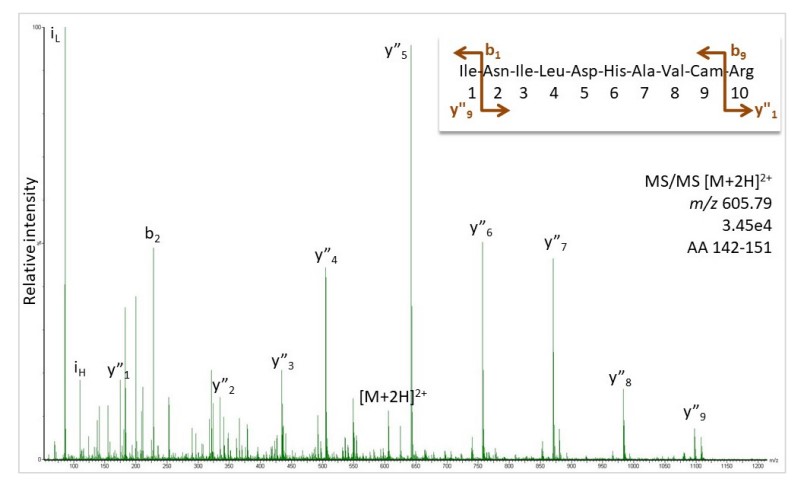 Fig.1 MS/MS spectrum of the doubly-charged peptide ion detected.1
Principle Overview
The nano liquid chromatography-tandem mass spectrometry system we have introduced is an advanced protein analysis platform. Its operation involves the coordinated interaction of key steps such as ionization, chromatographic separation, mass analysis, and data interpretation.
1. Proteins from the sample are extracted and processed to obtain samples suitable for mass spectrometry analysis.

2. The target proteins are enzymatically cleaved into peptide fragments, which are subsequently analyzed using the nano liquid chromatography system.
3. In chromatographic analysis, the peptide fragments are separated into distinct components within the liquid chromatography column.
4. Based on their chemical properties and affinities, the separated peptide fragments enter the mass spectrometer for mass analysis. Within the mass spectrometer, the charged ions of the peptide fragments are separated and detected based on their mass-to-charge ratio. These charged ions generate mass spectra, recording the relative abundance of ions with different masses.
5. By analyzing the mass spectra, peptide sequences within the proteins can be identified. The shapes and intensities of peaks in the mass spectra also provide information about modifications and structural characteristics of the peptide fragments. This data assists in determining protein sequences and post-translational modifications.
High-Quality Spectra: Enabling More Comprehensive and Accurate De Novo Protein Sequencing
De novo protein sequencing is based on peptide fragmentation - a process conducted in a mass spectrometer using collision gases like helium or nitrogen. Various types of ions are produced depending on the collision conditions. Currently, the most common fragmentation techniques include:
| Fragmentation Technique | Advantages | Drawbacks |
|---|---|---|
|
CID (Collision Induced Dissociation) |
Generates very complete ion series. | Masses less than 200 Da are often undetectable. |
|
HCD (High Energy Collision Dissociation) |
No low mass cutoff. | Often lacks y-ion series in the spectra. |
|
ETD (Electron Transfer Dissociation) |
Suitable for high charge state peptides (+3 and higher), aiding in sequencing lysine- and arginine-rich sequences. | Less effective for low-charge state peptides. |
Creative Biolabs employs the latest generation of mass spectrometers equipped with all three of the above fragmentation techniques. Based on the advantages and disadvantages of different technologies, we can even combine two methods, such as HCD with ETD, to ensure that any sequence is resolved with the highest accuracy. Additionally, we have optimized collision conditions (type of gas, pressure, and energy input) to maximize the completeness of both y- and b-ion series. Having both ion series available allows us to validate the sequence derived from the y-ion series by reading the b-ion series in the opposite direction, simplifying sequence interpretation for our de novo algorithm.
Achievable Protein Analysis Services at Creative Biolabs
Creative Biolabs recognizes the significance of antibodies and proteins in the field of life sciences. Leveraging the aforementioned advantages, we utilize an advanced nano liquid chromatography-tandem mass spectrometry system to provide the following specialized services to our clients, offering robust support for gaining in-depth insights into the structure, function, and modifications of antibodies and proteins:

If you are seeking an advanced liquid chromatography-tandem mass spectrometry analysis platform to thoroughly analyze your protein samples, we welcome you to contact us for more information. Our expert team possesses extensive experience and professional knowledge to provide you with customized analysis solutions, ensuring high-quality and accurate results.
Reference
- König, Simone, Wolfgang MJ Obermann, and Johannes A. Eble. "The current state-of-the-art identification of unknown proteins using mass spectrometry exemplified on de novo sequencing of a venom protease from Bothrops moojeni." Molecules 27.15 (2022): 4976. Distributed under Open Access license CC BY 4.0, without modification.
Related Services:
- DASS Technology
- Precise Leucine/Isoleucine Discrimination
- Isobaric Amino Acid Discrimination
- Manual Sequence Curation
- Intact Mass Validation