A New Method for Native Antibody Discovery

The development of monoclonal antibody (mAb) has leaped forward over these decades since the first therapeutic mAb has been approved for the treatment of kidney transplant rejection in 1986. Several antibody technologies have been born and thousands of therapeutic mAbs have entered clinical evaluation for diverse human diseases.

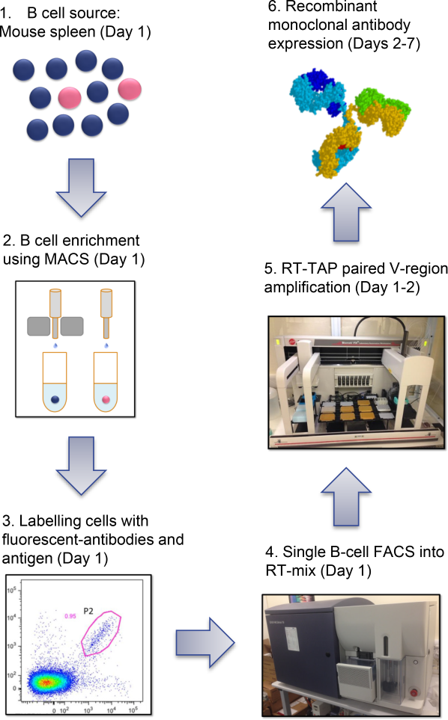
Native™ antigen-specific mAbs are mainly produced by primary antigen-specific lymphocyte B cells. To minimize the immunogenicity heteroantibodies and improve the activity of mAbs, an easier and more efficient antibody technology, single B cell sorting, came into being, which allows for rapid mAb discovery with preservation of the natural heavy chain and light chain pairing in a time-saving manner. By direct isolating antibody-secreting B cells from the immunized individuals and then amplifying and expressing VH and VL region-encoding genes in vitro, B cell sorting technology is recognized as a powerful technique for native antibody discovery and therapeutic antibody development.

Fig.1 Schematic representation of the single B cell sorting protocol used for antibody discovery from immunised mice.Fig.1 Workflow of a multi-parameter flow cytometric single B cell sorting technique.1

Founded by world-leading scientists with decades of experience in scientific research, Creative Biolabs is focused on giving you convenient and optimized antibody discovery services. Our diverse, award-winning team brings together decades of experience in antibody, molecule genetics, and diseases to provide you with the expertise you need to advance your native antibody discovery. Our well-established B cell sorting platform enables clients all over the world to make breakthroughs in different applications, including but not limited to:

Reference

  1. Starkie, Dale O., et al. "Generation of recombinant monoclonal antibodies from immunised mice and rabbits via flow cytometry and sorting of antigen-specific IgG+ memory B cells." PLoS One 11.3 (2016): e0152282. Distributed under Open Access license CC BY 4.0, without modification.
For Research Use Only. Not For Clinical Use.


Related Sections:

Copyright © 2025 Creative Biolabs. All rights reserved.