
What is Episomal Vector iPSC Reprogramming?
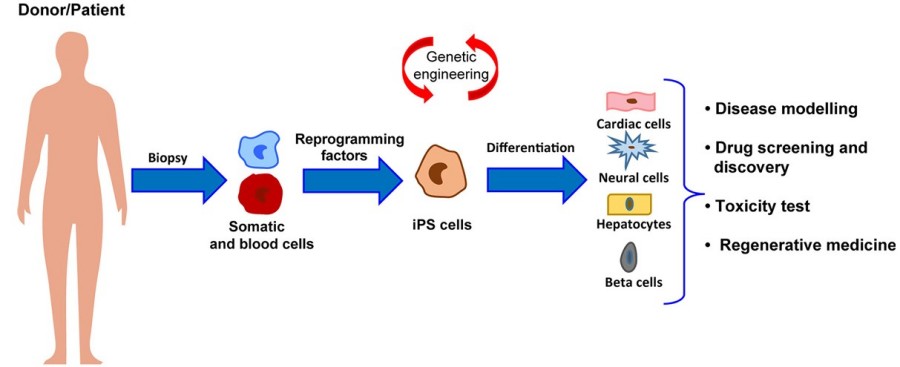 Fig.1 Workflow of iPSC reprogramming and differentiation1,4.
Episomal vectors are non-viral, plasmid-based systems carrying OriP/EBNA1 elements from Epstein-Barr virus. These elements enable plasmid replication and transient retention in dividing cells without genomic integration. Within 10–15 passages, vectors are completely lost, yielding footprint-free iPSCs ideal for disease modeling and cell therapy development.
Table1. Comparison to other reprogramming methods
| Reprogramming Method | Genomic Integration? | Efficiency | Turnaround Time |
|---|---|---|---|
| Retroviral/Lentiviral | Yes | High (1–5%) | 4–6 weeks |
| Sendai Virus | No | High (0.5–3%) | 5–8 weeks |
| Episomal Vectors | No | Moderate (0.1–1%) | 6–10 weeks |
| mRNA Reprogramming | No | Low (<0.1%) | 8–12 weeks |
Technical Workflow for iPSC Reprogramming by Episomal Vectors
Over the last two decades, our teams have supported hundreds of labs, biotech companies, and pharma innovators by generating custom iPSC lines using episomal vectors. We leverage our deep understanding of stem cell biology with robust QC systems to guarantee reproducibility, consistency, and premium-grade deliverables. Our iPSC reprogramming by episomal vectors service follows a rigorously optimized, step-by-step protocol. Below is a detailed breakdown of our standardized workflow.
Source Cell Processing
We reprogram iPSCs from a variety of somatic cell sources.
| Cell Sources | Isolation & Expansion |
|---|---|
| Dermal fibroblasts | Cultured in medium supplemented with FBS and bFGF to maintain viability. |
| Peripheral blood mononuclear cells (PBMCs) | Isolated, expanded in medium with SCF, IL-3, and IL-6 for hematopoietic progenitor enrichment. |
| Urine-derived epithelial cells | Processed via urothelial cell culture medium with EGF and Rho kinase inhibitor to prevent anoikis. |
| Adipose-derived stem cells (ADSCs) | Differentiated from stromal vascular fraction (SVF) and expanded in adipocyte growth medium. |
Episomal Transfection
We offer plasmid design with the following options.
- Vector backbone: pCEP4-based episomal plasmids with EBNA1/OriP system for transient replication.
- Reprogramming factors: Oct4, Sox2, Klf4, c-Myc (OSKM) ± Lin28 or Nanog under CAG promoter for strong, sustained expression.
- Optional: GFP/RFP reporter for tracking transfection efficiency.
iPSC Colony Picking & Expansion
Emerging colonies are screened for morphology, picked, and expanded under xeno-free, GMP-compliant conditions.
Pluripotency & Quality Control
Every generated iPSC line undergoes multi-tier validation:
- Expression of pluripotency markers (Nanog, Oct4, TRA-1-60, SSEA-4)
- Karyotype analysis
- Functional differentiation assays (EB formation, trilineage differentiation)
Applications of Episomal iPSC Reprogramming
-
Disease Modeling
Generate patient-specific iPSCs for neurological, cardiac, or metabolic disorders. -
Drug Screening Platforms
Create isogenic panels for toxicity testing or compound validation. -
CRISPR-Cas9 Gene Editing
Edit footprint-free iPSCs for knockouts (KO), knockins (KI), or point mutations. -
Organoid Generation
Derive brain, gut, or kidney organoids from genetically pristine iPSCs.
Customization Options
Our episomal iPSC reprogramming platform is fully adaptable, allowing you to define specifications that align perfectly with your scientific or commercial objectives.
| Customization | Options |
|---|---|
| Flexible Somatic Cell Sources |
|
| Tailored Reprogramming Factor Design |
|
| Scalability & Production Options |
|
| Custom Deliverables |
|
Customization is more than an option, it is the core of our service philosophy. We adapt our technologies, workflows, and documentation to fit your project seamlessly.
Data Output & Documentation
Our episomal reprogramming services are backed by a robust data output package designed to empower researchers with the clarity and confidence they need to move forward.
- Standard Data Package - Each project is delivered with a core dataset that confirms the authenticity, pluripotency, and stability of your newly generated iPSCs.
- Extended Characterization Options - For clients with advanced requirements, we provide additional analyses to deepen the characterization of iPSC lines.
- Documentation Style - We understand that different stakeholders require different levels of detail. Our report formats are customizable.
- Delivery Formats - All results are compiled into a comprehensive package.
Published Data
In this study, researchers performed a side-by-side comparison of iPSC colony-forming efficiencies in fibroblasts and epithelial cells transiently transfected with episomal plasmids and demonstrated that iPSC generation efficiency was highest when donor samples were derived from epithelial cells. They determined that reprogramming efficiency of episomal system could be further improved.
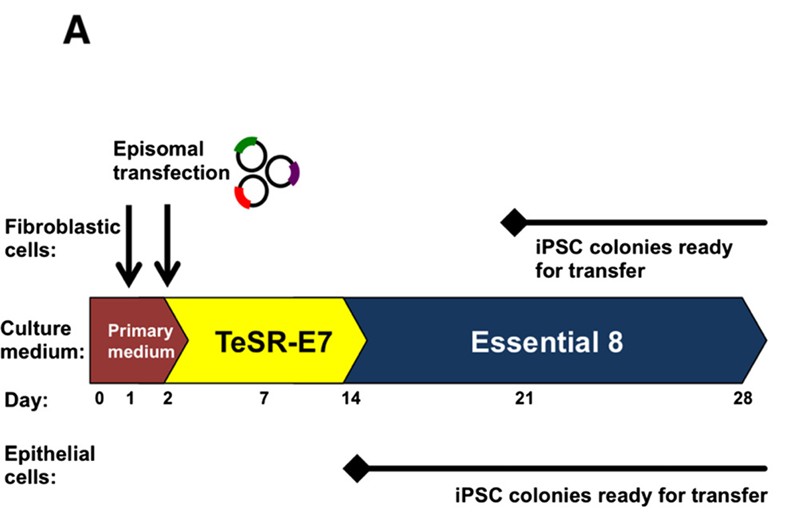 Fig.2. Schematic diagram of the protocol used to obtain iPSCs by transient introduction of episomes carrying OCT3/4, SOX2, KLF4, L-MYC, and LIN28 transcription factors and dominant negative mutant of p53 protein into human somatic cells2,4.
In this study, researchers determined optimal conditions for generating integration-free iPSCs from human fibroblasts through the use of different concentrations of episomal vectors (OCT4/p53, SOX2/KLF4, L-MYC/LIN28A) and different plating cell density. They found that optimized vector concentration and cell density accelerate reprogramming and improve iPSC generation.
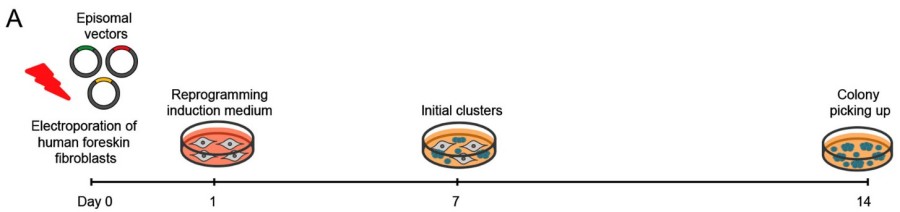 Fig.3 Generation of integration-free Epi-iPSCs from fibroblasts by using episomal vectors3,4.
What Our Clients Say
"Their episomal reprogramming service converted our ALS patient fibroblasts into integration-free iPSCs in 8 weeks. All lines passed stringent QC, and we've since differentiated them into motor neurons for drug screening."
— Dr. Arjun Patel
"After failed retroviral reprogramming attempts, their team rescued our rare disease project. The episomal iPSCs showed better genomic stability and differentiation potential."
— Prof. James O'Donnell
"Our collaboration with Creative Biolabs was seamless. They not only delivered high-quality episomal iPSCs but also provided guidance on downstream differentiation. It felt like working with a partner, not just a service provider."
— Dr. Simone Russo
"The customer support was exceptional. We appreciated the direct access to project managers and the responsiveness of their scientists when troubleshooting. It's rare to find a CRO that values communication this highly."
— Prof. Kenji Tanaka
FAQ
Q: What are the typical success rates of episomal iPSC reprogramming at Creative Biolabs?
A: Success rates depend on the starting cell type and sample quality. With fibroblasts and PBMCs, our optimized protocols routinely achieve high efficiency, generating multiple stable clones per project. Each line undergoes rigorous QC to ensure only high-quality, pluripotent, and genomically stable iPSCs are delivered.
Q: Can Creative Biolabs provide differentiation services in addition to reprogramming?
A: Absolutely. We offer lineage-specific differentiation services into neuronal, cardiac, hepatic, and hematopoietic lineages, as well as custom differentiation protocols upon request. This ensures that your episomal iPSCs are immediately usable for downstream applications such as disease modeling, screening, or regenerative research.
Q: Do you accept rare or challenging samples?
A: Yes. Our scientists are experienced in handling a wide variety of somatic cell sources, including rare disease samples and low-viability cells. We optimize reprogramming conditions on a case-by-case basis and provide feasibility assessments upfront, ensuring the best possible outcomes for challenging projects.
Q: How long will my project take from start to finish?
A: Timelines vary with project scope, but a standard episomal reprogramming workflow usually takes several months, including colony formation, expansion, and quality control. Additional assays, such as teratoma formation or WGS, may extend timelines. We provide milestone updates to keep you informed at every stage
Take the Next Step with Creative Biolabs







1. Contact Us
via the Inquiry Form or Email
2. Define Your Needs
Cell Type, Function, Quantity, Modifications
3. Kickstart the Project
Our Expert Team Guiding Every Step
When it comes to iPSC reprogramming by episomal vectors, precision, safety, and reliability are everything. Creative Biolabs combines world-class technical know-how with a deep understanding of stem cell biology to empower researchers across academia, biotech, and pharma.
Let us tailor a reprogramming strategy for your unique research needs. Contact Us Now!
References
- Frazer-Abel, Ashley, Michael Kirschfink, and Zoltán Prohászka. "Expanding horizons in complement analysis and quality control." Frontiers in immunology 12 (2021): 697313. https://doi.org/10.3389/fimmu.2021.697313
- Drozd, Anna M., et al. "Generation of human iPSCs from cells of fibroblastic and epithelial origin by means of the oriP/EBNA-1 episomal reprogramming system." Stem cell research & therapy 6.1 (2015): 122. https://doi.org/10.1186/s13287-015-0112-3.
- Bang, Jin Seok, et al. "Optimization of episomal reprogramming for generation of human induced pluripotent stem cells from fibroblasts." Animal cells and systems 22.2 (2018): 132-139. https://doi.org/10.1080/19768354.2018.1451367.
- Distributed under Open Access license CC BY 4.0, without modification.
Created August 2025