ADC Bystander Effect Cell Panel Screening Service
At Creative Biolabs, we are dedicated to advancing ADC research and development. We have developed specialized ADC bystander effect cell panel screening services, harnessing cutting-edge technology to assess the bystander effect of ADC.
What is the ADC Bystander Effect?
The ADC bystander effect is a phenomenon observed in cancer treatment where the therapeutic action of the ADC extends beyond targeted cancer cells to affect neighboring non-targeted cells. ADCs are designed to deliver potent cytotoxic agents directly to cancer cells by binding to specific antigens on their surfaces. However, upon internalization and degradation of the ADC within the cancer cell, the released drug can diffuse out and impact nearby antigen-negative cells, leading to what is termed the bystander effect. This effect can be beneficial, as it allows the destruction of cancer cells in heterogeneous tumor environments, but it also poses a challenge because it can inadvertently damage healthy tissue.
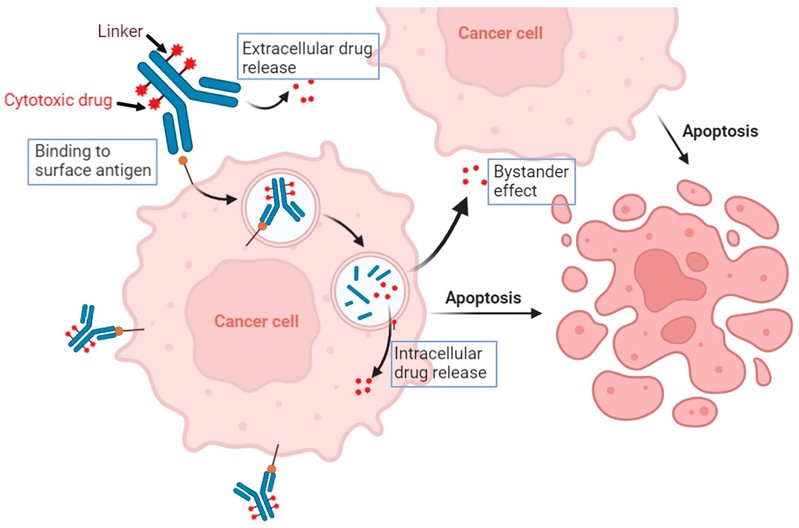 Fig.1 ADC bystander effect.1
Our ADC Bystander Effect Cell Panels
At Creative Biolabs, we offer a suite of bystander effect cell panel screening services designed to provide extensive insights into the efficacy and potential of ADCs. Our services leverage cutting-edge technologies and engineered cell lines, providing you with the insights necessary to refine your therapeutic strategies. Our goal is to provide deep insights into how ADCs interact with both target and non-target cells, thereby enhancing drug development efforts.
- Extensive Cell Lines
At the heart of our screening service is our diverse portfolio of tumor cell lines, specifically engineered to facilitate detailed analysis of ADC-induced bystander effects. Our panel includes both antigen-positive and antigen-negative cell lines, allowing for precise monitoring of cytotoxic payload diffusion and its impact on non-target cells:
- Diverse Cancer Cell Panels: We provide a broad range of cell lines representing various cancer types, which mimics the tumor heterogeneity encountered in vivo.
- Reporter Tumor Cell Lines: These cell lines are engineered with fluorescent or luminescent reporters, enabling real-time tracking of ADC interaction and effect on both antigen-positive and antigen-negative cells.
- Our Functional Assays
- Flow Cytometry-Based Bystander Effect Assay: Employing high-throughput flow cytometry, we offer a detailed analysis of cell viability, apoptosis, and other critical markers in co-cultured cell environments. By using flow cytometry, we can quantitatively assess how the cytotoxic payload impacts both Ag+ and Ag- cells, offering a granular view of cell interactions and ADC effectiveness.
- Image-Based Bystander Effect Assay: Our image-based approach offers real-time, live-cell imaging, allowing continuous monitoring of both antigen-positive and antigen-negative cells. This provides valuable insights into the spatial and temporal dynamics of payload diffusion and action.
Why Choose Us
- Specialized cell panels include both antigen-positive and antigen-negative lines for accurate bystander effect evaluation.
- Advanced flow cytometry and image-based assays provide real-time, quantitative insights into payload diffusion and cell viability.
- Reporter tumor cell lines enable precise, dynamic monitoring of ADC-induced cytotoxic effects.
- Mimics tumor heterogeneity with diverse cancer types to enhance clinical relevance.
- Data-rich, high-throughput screening accelerates ADC optimization and risk assessment in complex tumor environments
Applications
- Evaluate ADC-induced bystander cytotoxicity in heterogeneous tumor models.
- Assess payload diffusion effects on antigen-negative neighboring cells.
- Screen ADC candidates for efficacy and off-target risk profiles.
- Investigate spatial and temporal dynamics of payload action via live-cell imaging.
- Support ADC design optimization by comparing linker stability and payload potency.
- Validate mechanism of action in co-culture systems using quantitative assays.
Contact us today to explore how our ADC bystander effect cell panel screening services can enhance your drug development pipeline.
Reference
- Mark, Cynthia, et al. "Antibody–drug conjugates in breast cancer: current status and future directions." International Journal of Molecular Sciences 24.18 (2023): 13726. Distributed under Open Access license CC BY 4.0, without modification.
 Download our brochure