Biased Cytokine Signaling Engineering Service
Creative Biolabs' biased cytokine signaling engineering service empowers your research to achieve controlled, pathway-specific immune modulation. Through advanced structure-guided cytokine design, receptor geometry optimization, and computational engineering, we help you create next-generation cytokine therapies with enhanced precision and reduced side effects. Accelerate Your Cytokine Innovation Journey Today!
Overview
Biased cytokine signaling represents a transformative leap in immunotherapy design. Instead of uniformly activating all receptor pathways, engineered cytokines can selectively bias signaling toward desired downstream cascades, achieving precise immune regulation. Recent structural studies on IL-2, IFNγ, and IL-10 variants have revealed that receptor geometry and ligand orientation determine pathway activation. By reshaping these molecular interactions, researchers have successfully enhanced antitumor and antiviral efficacy while minimizing immune-related adverse effects. Creative Biolabs leverages these scientific advances to deliver practical, application-ready cytokine engineering solutions.
Creative Biolabs integrates multidisciplinary strategies to engineer cytokine bias with scientific rigor and scalability. Each approach is customized to align with your target signaling pathway, biological objective, and translational requirements:
-
Receptor Geometry Modulation
Structural remodeling of ligand–receptor interfaces adjusts receptor dimer angles and subunit distances, selectively promoting favorable JAK/STAT activation patterns and improved immune balance. -
Ligand–Receptor Affinity Tuning
Fine-tuning of receptor subunit affinities (e.g., increasing IL-2Rβγ while reducing IL-2Rα binding) achieves specific immune subset targeting, enhancing effector cell stimulation with minimal Treg activation. -
Molecular Conjugation and Scaffold Redesign
Polymer or Fc conjugation extends cytokine half-life while sterically limiting unwanted receptor engagement. This enhances in vivo stability and reduces systemic toxicity. -
De Novo Cytokine Mimetics
Synthetic, geometry-programmed scaffolds replicate receptor activation motifs with ultra-high precision, unlocking bias control beyond natural cytokine capabilities. -
Localized and Prodrug Activation
Protease-activated cytokine proforms and depot formulations ensure spatially restricted cytokine activity in the tumor microenvironment or tissue of interest. -
Computational and AI-Driven Optimization
Predictive modeling integrates biophysical data and machine learning to forecast structure-function relationships, accelerating rational cytokine design and minimizing experimental cycles.
Discover How We Can Help – Request a Consultation.
What We Can Offer
Customized Cytokine Design
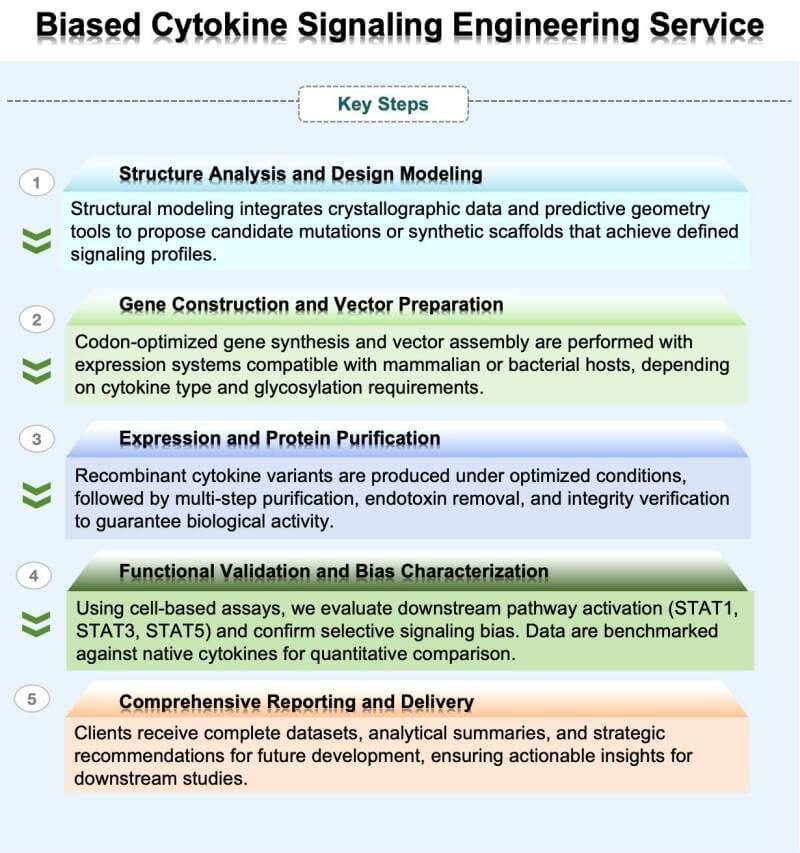
We create tailored cytokine variants that exhibit specific receptor selectivity, signaling bias, and optimized stability. Our design phase incorporates advanced molecular modeling, binding energy calculations, and interface residue scanning to ensure precision at the atomic level.
Quantitative Functional Validation
Our expert team employs a range of quantitative bioassays—including STAT phosphorylation mapping, receptor occupancy analysis, and cytokine release profiling—to confirm that engineered variants achieve the intended signaling bias across relevant cell types.
Structural and Biophysical Characterization
We provide comprehensive analysis of folding, oligomerization, and receptor engagement using biophysical tools such as surface plasmon resonance (SPR), analytical ultracentrifugation, and thermal stability testing.
Recombinant Expression and Purification
From gene synthesis to large-scale expression, our optimized production systems (HEK293, CHO, or E. coli) deliver high-yield, bioactive cytokine proteins. Multi-step purification ensures homogeneity and reproducibility for downstream research.
Workflow
Required Starting Materials
- Target cytokine or receptor system (e.g., IL-2/IL-2R complex, IFNγ/IFNGR1-2, IL-10/IL-10R).
- Desired signaling direction (e.g., STAT1 vs. STAT3 dominance, effector vs. regulatory bias).
- Application context (e.g., oncology, autoimmune modulation, antiviral research).
Highlights
Precision-Controlled Signaling
Achieve finely tuned activation of specific pathways to target beneficial immune outcomes while minimizing off-target toxicity.
Enhanced Therapeutic Safety
Engineered selectivity significantly reduces cytokine storm risks, improving safety margins in both research and preclinical models.

Integrated Structural Expertise
Leveraging structure-guided insights and receptor geometry modeling ensures robust predictability in ligand design.
Flexible and Scalable Production
From exploratory design to large-scale manufacturing, our systems accommodate diverse research and development needs.
Discover the Creative Biolabs Advantage – Contact Us for a Customized Quote.
Customer Reviews
-
Improved Tumor-Targeted Activity
"Using Creative Biolabs' biased cytokine signaling engineering service, our IL-2 derivative achieved potent CD8+ T-cell activation with minimal Treg expansion. This selective response translated into stronger antitumor effects in our in vivo model." – Dr. L. *** -
Refined IFNγ Modulation
"The structure-guided IFNγ variants developed by Creative Biolabs allowed us to preserve antiviral signaling while eliminating overexpression of inhibitory checkpoint markers. This fine-tuned response was critical for our cytokine-based vaccine research." – Dr. K. *** -
Extended Cytokine Stability and Efficacy
"Creative Biolabs' optimized cytokine constructs demonstrated exceptional thermal stability and prolonged half-life, greatly simplifying our pharmacodynamic studies and reducing batch variability." – Dr. M. ***
FAQs
Q: How does biased cytokine signaling differ from conventional cytokine modification?
A: It focuses on steering receptor activation toward selective intracellular pathways, creating refined immunomodulatory effects rather than general cytokine stimulation.
Q: Which cytokines are suitable for bias engineering?
A: We specialize in IL-2, IL-10, IFNγ, and several interleukins or interferons with well-defined receptor structures, though custom targets can be evaluated upon consultation.
Q: How do you confirm functional bias experimentally?
A: We use multiplexed assays measuring STAT phosphorylation, receptor engagement kinetics, and transcriptional signatures to confirm pathway specificity.
Related Services
Cytokine Fc-Fusion Design & Half-Life Extension Service
Creative Biolabs designs Fc-fused cytokines to extend serum half-life, enhance stability, and maintain bioactivity. Our optimized Fc-linking strategy reduces clearance and dosing frequency, delivering long-acting cytokine therapeutics with improved pharmacokinetics.
Learn More →Cytokine PEGylation Optimization Services
Creative Biolabs provides precise cytokine PEGylation to boost stability and half-life while preserving receptor activity. Our tailored PEG chemistry minimizes immunogenicity and degradation, creating safer, longer-lasting cytokine candidates.
Learn More →Creative Biolabs offers integrated expertise across cytokine biology, molecular engineering, and translational immunology, ensuring that each client receives data-driven, actionable outcomes supported by scientific precision and real-world applicability. Our global R&D infrastructure and dedicated scientists collaborate with you to transform conceptual ideas into tangible therapeutic progress.
Contact Our Cytokine Engineering Experts Today to Explore How Creative Biolabs' Biased Cytokine Signaling Engineering Service Can Accelerate Your Immunotherapy Project.
 Download our brochure